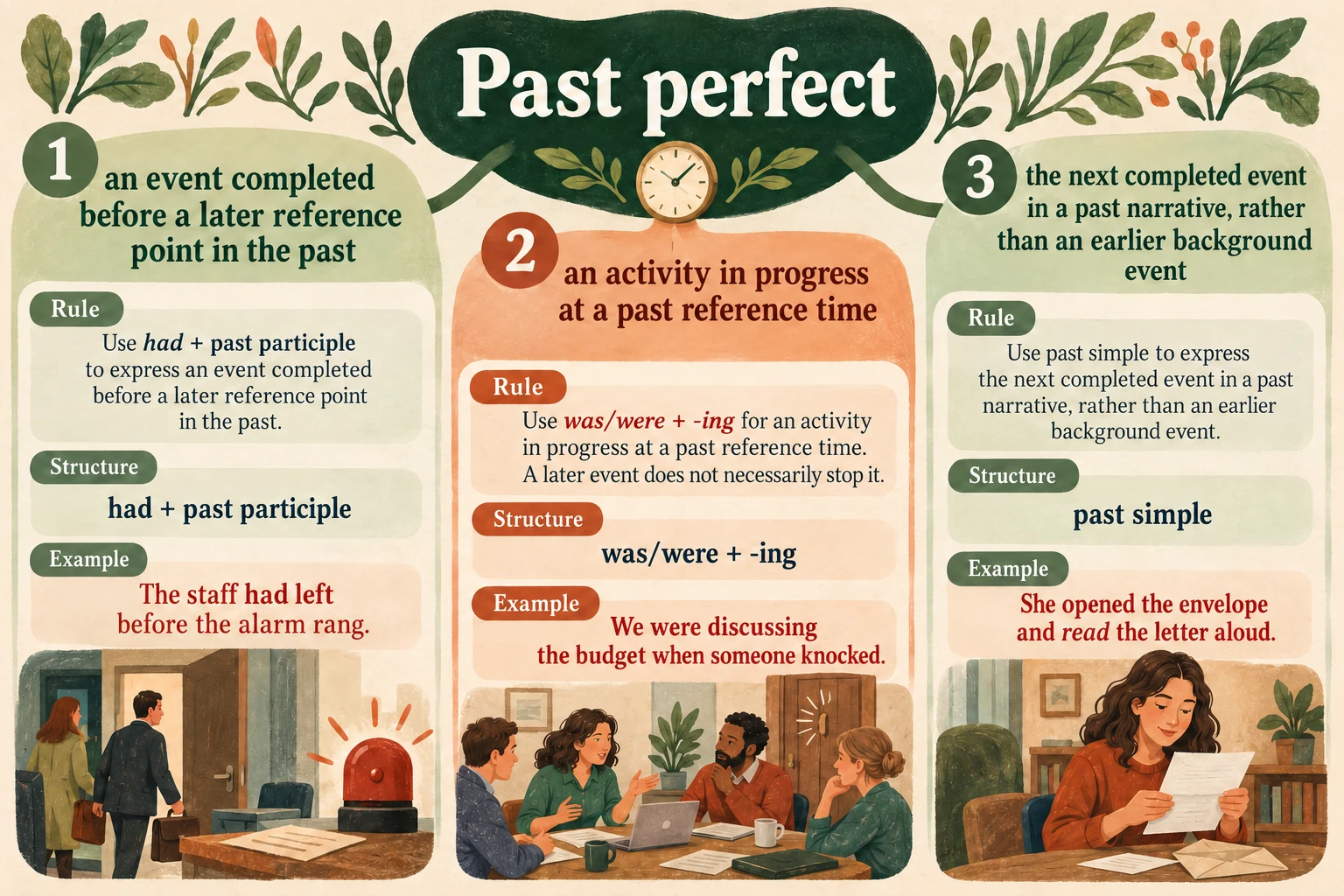
01an event completed before a later reference point in the past
Use had + past participle to express an event completed before a later reference point in the past.
The staff had left before the alarm rang.
Past perfect · B1. Use had + past participle to express an event completed before a later reference point in the past.
Complete 12 original tasks. Use the situation to choose the intended meaning, practise the form, then apply it in a fresh context.
Use had + past participle to express an event completed before a later reference point in the past.
The staff had left before the alarm rang.Use was/were + -ing for a background activity in progress at a past reference time. Another event can establish that time; it does not necessarily stop the activity.
We were discussing the budget when someone knocked.Use past simple to express the next completed event in a past narrative, rather than an earlier background event.
She opened the envelope and read the letter aloud.
The fire alarm rang at 10; the staff left at 9:55.
Use had + past participle to express an event completed before a later reference point in the past.
The staff had left before the alarm rang.Use was/were + -ing for a background activity in progress at a past reference time. Another event can establish that time; it does not necessarily stop the activity.
We were discussing the budget when someone knocked.Use past simple to express the next completed event in a past narrative, rather than an earlier background event.
She opened the envelope and read the letter aloud.Keep the first try. Understand the change. Check it in a fresh situation.
No practice notes yet. Try a short warm-up.
Use had + past participle to express an event completed before a later reference point in the past.
The staff had left before the alarm rang.Use was/were + -ing for a background activity in progress at a past reference time. Another event can establish that time; it does not necessarily stop the activity.
We were discussing the budget when someone knocked.Use past simple to express the next completed event in a past narrative, rather than an earlier background event.
She opened the envelope and read the letter aloud.Opening an answer records help for that question.
The fire alarm rang at 10; the staff left at 9:55.
Look at “The staff ___ before the alarm rang.”. Use had + past participle to express an event completed before a later reference point in the past. Complete sentence: “The staff had left before the alarm rang.”.
An unfinished conversation was interrupted by a knock.
Look at “We ___ the budget when someone knocked.”. Use was/were + -ing for a background activity in progress at a past reference time. Another event can establish that time; it does not necessarily stop the activity. Complete sentence: “We were discussing the budget when someone knocked.”.
This is the next action after opening the envelope.
Look at “She opened the envelope and ___ the letter aloud.”. Use past simple to express the next completed event in a past narrative, rather than an earlier background event. Complete sentence: “She opened the envelope and read the letter aloud.”.
The tickets were sold before we reached the booth.
Look at “By the time we arrived, the last ticket ___.”. Use had + past participle to express an event completed before a later reference point in the past. Complete sentence: “By the time we arrived, the last ticket had gone.”.
Use the past continuous of carry for the background activity in progress when the lights went out.
“I was carrying a tray when the lights went out.” Use was or were + -ing for an activity already in progress at a past reference time. A later event can supply that reference without proving the activity stopped.
The events are given in their actual order.
Look at “The guard checked my pass, then ___ the gate.”. Use past simple to express the next completed event in a past narrative, rather than an earlier background event. Complete sentence: “The guard checked my pass, then opened the gate.”.
Use the past perfect of see and include never for an experience before the museum visit.
Complete sentence: “Before that visit, I had never seen a meteorite.” Use had + past participle to express an event completed before a later reference point in the past. The subject, time and meaning in the task determine this form. Only reviewed responses are matched automatically; other wording is not automatically wrong.
The forgotten password explains the later login failure.
Look at “I could not sign in because I ___ my password.”. Use had + past participle to express an event completed before a later reference point in the past. Complete sentence: “I could not sign in because I had forgotten my password.”.
Use the past continuous of work for the activity in progress.
“At the moment the siren sounded, the engineers were working underground.” Use was or were + -ing for an activity already in progress at a past reference time. A later event can supply that reference without proving the activity stopped.
The runner crossed the line; the next event followed.
Look at “She crossed the line and ___ onto the grass.”. Use past simple to express the next completed event in a past narrative, rather than an earlier background event. Complete sentence: “She crossed the line and collapsed onto the grass.”.
Background activity at the moment a past event happened.
Look at “The lecturer ___ when the projector failed.”. Use was/were + -ing for a background activity in progress at a past reference time. Another event can establish that time; it does not necessarily stop the activity. Complete sentence: “The lecturer was speaking when the projector failed.”.
Use the past simple of lock for the next action in this sequence.
Complete sentence: “He put the files away, locked the cupboard and left.” Use past simple to express the next completed event in a past narrative, rather than an earlier background event. The subject, time and meaning in the task determine this form. Only reviewed responses are matched automatically; other wording is not automatically wrong.