
B1

Narrative tenses Exercises

About this lesson

Narrative tenses · B1. Use was/were + -ing for a background activity in progress at a past reference time. Another event can establish that time; it does not necessarily stop the activity.

Complete 12 original tasks. Use the situation to choose the intended meaning, practise the form, then apply it in a fresh context.

12 items
Save it to find it in My collection.
Knowledge map

Narrative tenses

Start practising
Narrative tenses — Knowledge map

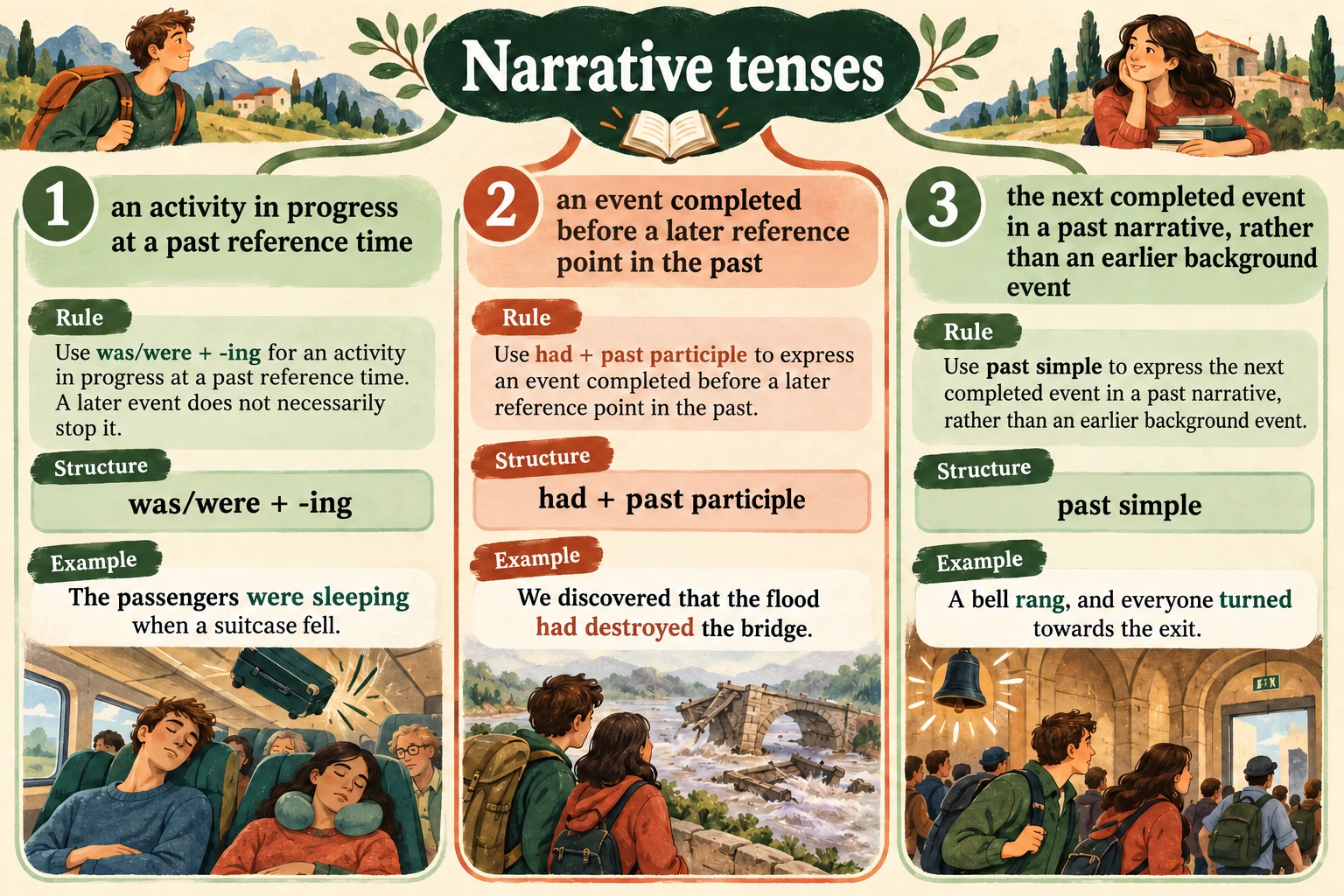
01a background activity in progress at a past reference time

Use was/were + -ing for a background activity in progress at a past reference time. Another event can establish that time; it does not necessarily stop the activity.

The passengers were sleeping when a suitcase fell.
02an event completed before a later reference point in the past

Use had + past participle to express an event completed before a later reference point in the past.

We discovered that the flood had destroyed the bridge.

03the next completed event in a past narrative, rather than an earlier background event

Use past simple to express the next completed event in a past narrative, rather than an earlier background event.

A bell rang, and everyone turned towards the exit.

Illustrated guide

0/12
Questions
01 / 12D01Save it to find it in My collection.

The quiet activity was interrupted by the crash.

The passengers ___ when a suitcase fell.

Your answer
1 / 12

Your learning route

01
Step 1 · Warm-up

Warm-up

0/3
02
Step 2 · Build the skill

a background activity in progress at a past reference time

0/2

Use was/were + -ing for a background activity in progress at a past reference time. Another event can establish that time; it does not necessarily stop the activity.

The passengers were sleeping when a suitcase fell.
03
Step 3 · Build the skill

an event completed before a later reference point in the past

0/1

Use had + past participle to express an event completed before a later reference point in the past.

We discovered that the flood had destroyed the bridge.
04
Step 4 · Build the skill

the next completed event in a past narrative, rather than an earlier background event

0/1

Use past simple to express the next completed event in a past narrative, rather than an earlier background event.

A bell rang, and everyone turned towards the exit.
05
Step 5 · New contexts

New contexts

0/3
06
Step 6 · A fresh challenge

A fresh challenge

0/2
Practice notes in this unit

Make mistakes useful.

Keep the first try. Understand the change. Check it in a fresh situation.

0

No practice notes yet. Try a short warm-up.

Lesson map

Narrative tenses

B1
Narrative tenses

Lesson points

01

a background activity in progress at a past reference time

Use was/were + -ing for a background activity in progress at a past reference time. Another event can establish that time; it does not necessarily stop the activity.

The passengers were sleeping when a suitcase fell.
02

an event completed before a later reference point in the past

Use had + past participle to express an event completed before a later reference point in the past.

We discovered that the flood had destroyed the bridge.
03

the next completed event in a past narrative, rather than an earlier background event

Use past simple to express the next completed event in a past narrative, rather than an earlier background event.

A bell rang, and everyone turned towards the exit.

Questions & answers

Opening an answer records help for that question.

D01 · Warm-up

The quiet activity was interrupted by the crash.

The passengers ___ when a suitcase fell.

  1. had sleep
  2. were sleeping
  3. are sleep
  4. will sleep
Answer & explanation
were sleeping

Look at “The passengers ___ when a suitcase fell.”. Use was/were + -ing for a background activity in progress at a past reference time. Another event can establish that time; it does not necessarily stop the activity. Complete sentence: “The passengers were sleeping when a suitcase fell.”.

D02 · Warm-up

The bridge was destroyed a day before our arrival.

We discovered that the flood ___ the bridge.

  1. is destroying
  2. had destroyed
  3. destroys
  4. will destroy
Answer & explanation
had destroyed

Look at “We discovered that the flood ___ the bridge.”. Use had + past participle to express an event completed before a later reference point in the past. Complete sentence: “We discovered that the flood had destroyed the bridge.”.

D03 · Warm-up

The next event moves the story forward.

A bell rang, and everyone ___ towards the exit.

  1. will turn
  2. has turn
  3. is turning
  4. turned
Answer & explanation
turned

Look at “A bell rang, and everyone ___ towards the exit.”. Use past simple to express the next completed event in a past narrative, rather than an earlier background event. Complete sentence: “A bell rang, and everyone turned towards the exit.”.

P01 · Build the skill

A continuous background action at the stated past moment.

As I entered, the chef ___ vegetables.

  1. has chop
  2. is chop
  3. will chop
  4. was chopping
Answer & explanation
was chopping

Look at “As I entered, the chef ___ vegetables.”. Use was/were + -ing for a background activity in progress at a past reference time. Another event can establish that time; it does not necessarily stop the activity. Complete sentence: “As I entered, the chef was chopping vegetables.”.

P02 · Build the skill

Use the past perfect of leave; departure preceded our reaching the stop.

When we reached the stop, the bus ___.

Answer & explanation
had left

Complete sentence: “When we reached the stop, the bus had left.” Use had + past participle to express an event completed before a later reference point in the past. The subject, time and meaning in the task determine this form. Only reviewed responses are matched automatically; other wording is not automatically wrong.

P03 · Build the skill

The narrative advances through completed steps.

Mina found the key, unlocked the box and ___ the map.

  1. has remove
  2. removed
  3. will remove
  4. is removing
Answer & explanation
removed

Look at “Mina found the key, unlocked the box and ___ the map.”. Use past simple to express the next completed event in a past narrative, rather than an earlier background event. Complete sentence: “Mina found the key, unlocked the box and removed the map.”.

P04 · Build the skill

Use the past continuous of snow for the background at dawn yesterday.

At dawn yesterday, it ___ heavily.

Answer & explanation
was snowing

“At dawn yesterday, it was snowing heavily.” Use was or were + -ing for an activity already in progress at a past reference time. A later event can supply that reference without proving the activity stopped.

R01 · New contexts

The rain was underway when the phone rang.

I ___ home through the rain when my phone rang.

  1. am walk
  2. have walk
  3. was walking
  4. will walk
Answer & explanation
was walking

Look at “I ___ home through the rain when my phone rang.”. Use was/were + -ing for a background activity in progress at a past reference time. Another event can establish that time; it does not necessarily stop the activity. Complete sentence: “I was walking home through the rain when my phone rang.”.

R02 · New contexts

Use the past perfect of eat; the meal happened before the invitation. The word already is supplied after the gap.

They declined dinner because they ___ already.

Answer & explanation
had eaten

Complete sentence: “They declined dinner because they had eaten already.” Use had + past participle to express an event completed before a later reference point in the past. The subject, time and meaning in the task determine this form. Only reviewed responses are matched automatically; other wording is not automatically wrong.

R03 · New contexts

A new completed event follows the door opening.

The door opened and a stranger ___ inside.

  1. is stepping
  2. has step
  3. stepped
  4. will step
Answer & explanation
stepped

Look at “The door opened and a stranger ___ inside.”. Use past simple to express the next completed event in a past narrative, rather than an earlier background event. Complete sentence: “The door opened and a stranger stepped inside.”.

X01 · A fresh challenge

The later discovery refers back to an earlier mistake.

We realised we ___ the wrong train an hour earlier.

  1. have board
  2. had boarded
  3. are boarding
  4. will board
Answer & explanation
had boarded

Look at “We realised we ___ the wrong train an hour earlier.”. Use had + past participle to express an event completed before a later reference point in the past. Complete sentence: “We realised we had boarded the wrong train an hour earlier.”.

X02 · A fresh challenge

Use the past simple of ring for the event that interrupted the silence.

Everyone was listening quietly when a phone suddenly ___.

Answer & explanation
rang

Complete sentence: “Everyone was listening quietly when a phone suddenly rang.” Use past simple to express the next completed event in a past narrative, rather than an earlier background event. The subject, time and meaning in the task determine this form. Only reviewed responses are matched automatically; other wording is not automatically wrong.