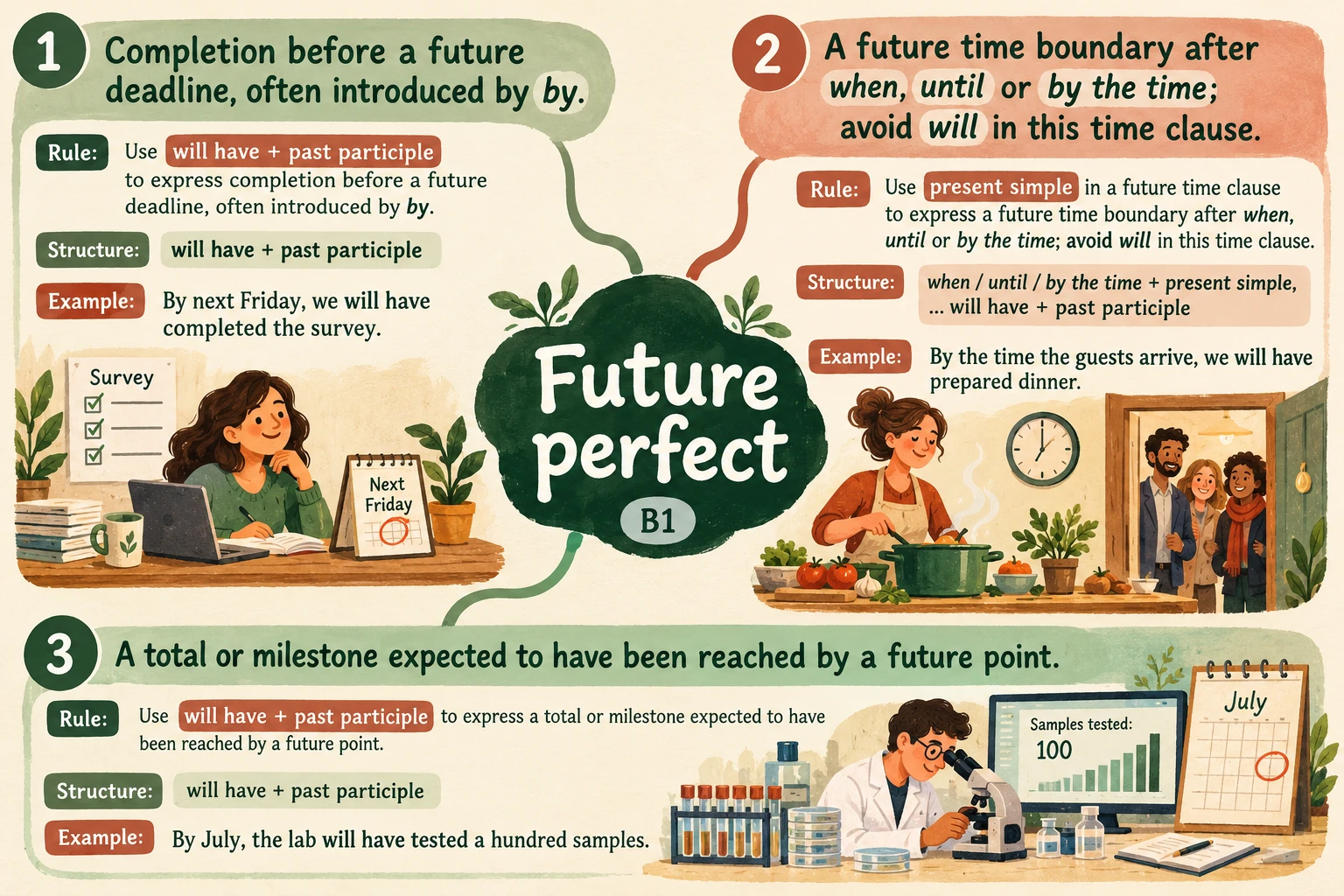
01completion before a future deadline, often introduced by by
Use will have + past participle to express completion before a future deadline, often introduced by by.
By next Friday, we will have completed the survey.
Future perfect · B1. Use will have + past participle to express completion before a future deadline, often introduced by by.
Complete 12 original tasks. Use the situation to choose the intended meaning, practise the form, then apply it in a fresh context.
Use will have + past participle to express completion before a future deadline, often introduced by by.
By next Friday, we will have completed the survey.Use present simple in a future time clause to express a future time boundary after when, until or by the time; avoid will in this time clause.
By the time the guests arrive, we will have prepared dinner.Use will have + past participle to express a total or milestone expected to have been reached by a future point.
By July, the lab will have tested a hundred samples.
The deadline is next Friday; the work will be complete earlier.
Use will have + past participle to express completion before a future deadline, often introduced by by.
By next Friday, we will have completed the survey.Use present simple in a future time clause to express a future time boundary after when, until or by the time; avoid will in this time clause.
By the time the guests arrive, we will have prepared dinner.Use will have + past participle to express a total or milestone expected to have been reached by a future point.
By July, the lab will have tested a hundred samples.Keep the first try. Understand the change. Check it in a fresh situation.
No practice notes yet. Try a short warm-up.
Use will have + past participle to express completion before a future deadline, often introduced by by.
By next Friday, we will have completed the survey.Use present simple in a future time clause to express a future time boundary after when, until or by the time; avoid will in this time clause.
By the time the guests arrive, we will have prepared dinner.Use will have + past participle to express a total or milestone expected to have been reached by a future point.
By July, the lab will have tested a hundred samples.Opening an answer records help for that question.
The deadline is next Friday; the work will be complete earlier.
Look at “By next Friday, we ___ the survey.”. Use will have + past participle to express completion before a future deadline, often introduced by by. Complete sentence: “By next Friday, we will have completed the survey.”.
A future time clause starts with by the time.
Look at “By the time the guests ___, we will have prepared dinner.”. Use present simple in a future time clause to express a future time boundary after when, until or by the time; avoid will in this time clause. Complete sentence: “By the time the guests arrive, we will have prepared dinner.”.
The total is expected to be achieved before July begins.
Look at “By July, the lab ___ a hundred samples.”. Use will have + past participle to express a total or milestone expected to have been reached by a future point. Complete sentence: “By July, the lab will have tested a hundred samples.”.
The report will be finished before tomorrow noon.
Look at “By noon tomorrow, I ___ the report.”. Use will have + past participle to express completion before a future deadline, often introduced by by. Complete sentence: “By noon tomorrow, I will have written the report.”.
Use the present simple of end in the future time clause.
Complete sentence: “We will have packed everything by the time the lease ends.” Use present simple in a future time clause to express a future time boundary after when, until or by the time; avoid will in this time clause. The subject, time and meaning in the task determine this form. Only reviewed responses are matched automatically; other wording is not automatically wrong.
Their ten-year anniversary occurs before the future reference point.
Look at “By December, they ___ ten years in this town.”. Use will have + past participle to express a total or milestone expected to have been reached by a future point. Complete sentence: “By December, they will have spent ten years in this town.”.
Use the future perfect of leave; departure will be complete before your arrival tomorrow.
Complete sentence: “By the time you get here tomorrow, I will have left.” Use will have + past participle to express completion before a future deadline, often introduced by by. The subject, time and meaning in the task determine this form. Only reviewed responses are matched automatically; other wording is not automatically wrong.
The last payment occurs before the future deadline.
Look at “By the end of May, she ___ the loan.”. Use will have + past participle to express completion before a future deadline, often introduced by by. Complete sentence: “By the end of May, she will have repaid the loan.”.
Use the present simple of close in the future time clause.
Complete sentence: “We will have served everyone before the kitchen closes.” Use present simple in a future time clause to express a future time boundary after when, until or by the time; avoid will in this time clause. The subject, time and meaning in the task determine this form. Only reviewed responses are matched automatically; other wording is not automatically wrong.
The future reference point is after the completion of all interviews.
Look at “By five tomorrow, the panel ___ all eight applicants.”. Use will have + past participle to express a total or milestone expected to have been reached by a future point. Complete sentence: “By five tomorrow, the panel will have interviewed all eight applicants.”.
Future time boundary after before.
Look at “I will have checked the figures before the director ___.”. Use present simple in a future time clause to express a future time boundary after when, until or by the time; avoid will in this time clause. Complete sentence: “I will have checked the figures before the director returns.”.
Use the future perfect of save for a target reached before next summer.
Complete sentence: “By next summer, we will have saved enough for the deposit.” Use will have + past participle to express a total or milestone expected to have been reached by a future point. The subject, time and meaning in the task determine this form. Only reviewed responses are matched automatically; other wording is not automatically wrong.