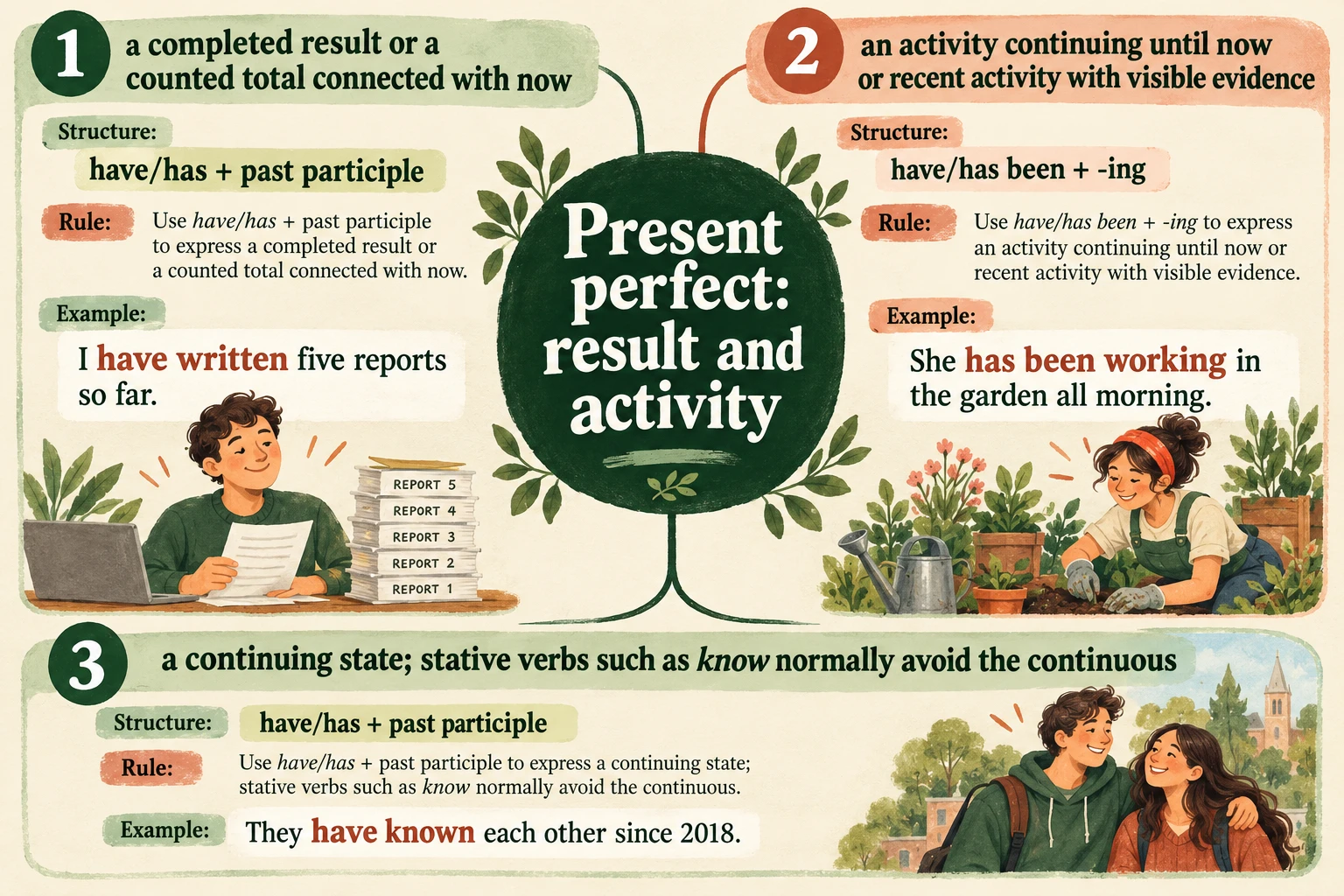
01a completed result or a counted total connected with now
Use have/has + past participle to express a completed result or a counted total connected with now.
I have written five reports so far.
Present perfect: result and activity · B1. Use have/has + past participle to express a completed result or a counted total connected with now.
Complete 12 original tasks. Use the situation to choose the intended meaning, practise the form, then apply it in a fresh context.
Use have/has + past participle to express a completed result or a counted total connected with now.
I have written five reports so far.Use have/has been + -ing to express an activity continuing until now or recent activity with visible evidence.
She has been working in the garden all morning.Use have/has + past participle to express a continuing state; stative verbs such as know normally avoid the continuous.
They have known each other since 2018.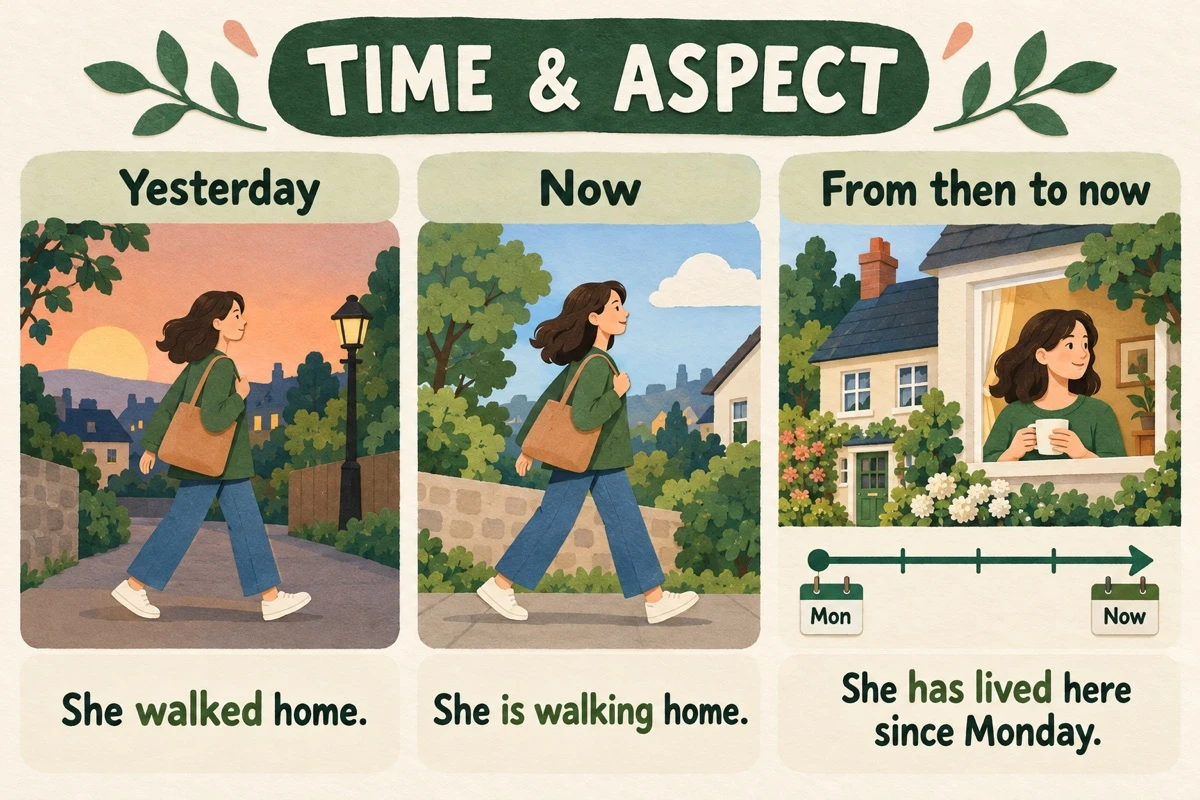
Only the number of completed reports matters.
Use have/has + past participle to express a completed result or a counted total connected with now.
I have written five reports so far.Use have/has been + -ing to express an activity continuing until now or recent activity with visible evidence.
She has been working in the garden all morning.Use have/has + past participle to express a continuing state; stative verbs such as know normally avoid the continuous.
They have known each other since 2018.Keep the first try. Understand the change. Check it in a fresh situation.
No practice notes yet. Try a short warm-up.
Use have/has + past participle to express a completed result or a counted total connected with now.
I have written five reports so far.Use have/has been + -ing to express an activity continuing until now or recent activity with visible evidence.
She has been working in the garden all morning.Use have/has + past participle to express a continuing state; stative verbs such as know normally avoid the continuous.
They have known each other since 2018.Opening an answer records help for that question.
Only the number of completed reports matters.
Look at “I ___ five reports so far.”. Use have/has + past participle to express a completed result or a counted total connected with now. Complete sentence: “I have written five reports so far.”.
Her clothes are muddy after a continuous activity; the garden is not finished.
Look at “She ___ in the garden all morning.”. Use have/has been + -ing to express an activity continuing until now or recent activity with visible evidence. Complete sentence: “She has been working in the garden all morning.”.
They first met in 2018 and remain friends. Know describes a state.
Look at “They ___ each other since 2018.”. Use have/has + past participle to express a continuing state; stative verbs such as know normally avoid the continuous. Complete sentence: “They have known each other since 2018.”.
The mechanic is showing a completed total.
Look at “We ___ six bicycles today; all six are ready.”. Use have/has + past participle to express a completed result or a counted total connected with now. Complete sentence: “We have repaired six bicycles today; all six are ready.”.
Use the present perfect continuous of wait to stress duration continuing now.
Complete sentence: “I have been waiting for the delayed coach for ninety minutes.” Use have/has been + -ing to express an activity continuing until now or recent activity with visible evidence. The subject, time and meaning in the task determine this form. Only reviewed responses are matched automatically; other wording is not automatically wrong.
The house still belongs to us; own is a state verb.
Look at “We ___ this cottage for fifteen years.”. Use have/has + past participle to express a continuing state; stative verbs such as know normally avoid the continuous. Complete sentence: “We have owned this cottage for fifteen years.”.
Use the present perfect simple of finish to report the completed total.
Complete sentence: “The translators have finished all twelve chapters.” Use have/has + past participle to express a completed result or a counted total connected with now. The subject, time and meaning in the task determine this form. Only reviewed responses are matched automatically; other wording is not automatically wrong.
The count of successfully sent invitations is the focus.
Look at “Nora ___ forty invitations, and the counter now reads 40.”. Use have/has + past participle to express a completed result or a counted total connected with now. Complete sentence: “Nora has sent forty invitations, and the counter now reads 40.”.
Use the present perfect continuous of practise; the activity is still underway.
Complete sentence: “The choir has been practising since breakfast and is still singing.” Use have/has been + -ing to express an activity continuing until now or recent activity with visible evidence. The subject, time and meaning in the task determine this form. Only reviewed responses are matched automatically; other wording is not automatically wrong.
You remain convinced; believe is used as a state verb here.
Look at “I ___ that explanation ever since I heard the evidence.”. Use have/has + past participle to express a continuing state; stative verbs such as know normally avoid the continuous. Complete sentence: “I have believed that explanation ever since I heard the evidence.”.
The repeated activity caused the paint on his hands; focus on activity, not completed rooms.
Look at “Why are his hands blue? He ___ the kitchen.”. Use have/has been + -ing to express an activity continuing until now or recent activity with visible evidence. Complete sentence: “Why are his hands blue? He has been painting the kitchen.”.
Use the present perfect simple of belong for the continuing state.
Complete sentence: “This land has belonged to our family for generations.” Use have/has + past participle to express a continuing state; stative verbs such as know normally avoid the continuous. The subject, time and meaning in the task determine this form. Only reviewed responses are matched automatically; other wording is not automatically wrong.