01um evento concluído antes de outro momento passado
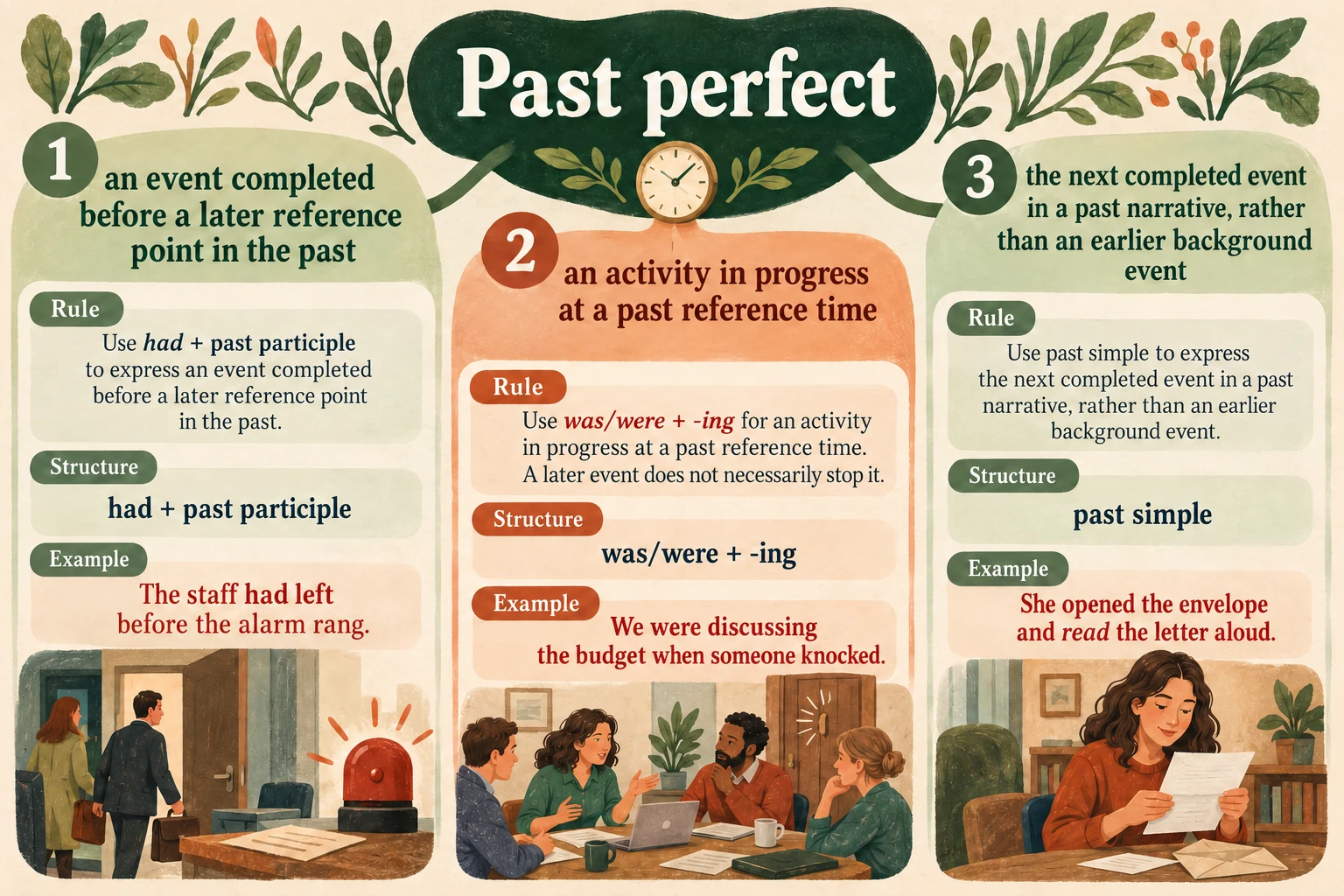
Use had + past participle para expressar um evento concluído antes de outro momento passado.
The staff had left before the alarm rang.
Past perfect · B1. Use had + past participle para expressar um evento concluído antes de outro momento passado.
Resolva 12 tarefas originais. Use a situação para interpretar o sentido, praticar a estrutura e aplicá-la em um novo contexto.
Use had + past participle para expressar um evento concluído antes de outro momento passado.
The staff had left before the alarm rang.Use was/were + -ing para uma atividade de fundo em andamento num momento passado. Outro evento pode marcar esse momento sem necessariamente interromper a atividade.
We were discussing the budget when someone knocked.Use past simple para expressar o próximo evento concluído da narrativa, em vez de um antecedente.
She opened the envelope and read the letter aloud.
The fire alarm rang at 10; the staff left at 9:55.
Use had + past participle para expressar um evento concluído antes de outro momento passado.
The staff had left before the alarm rang.Use was/were + -ing para uma atividade de fundo em andamento num momento passado. Outro evento pode marcar esse momento sem necessariamente interromper a atividade.
We were discussing the budget when someone knocked.Use past simple para expressar o próximo evento concluído da narrativa, em vez de um antecedente.
She opened the envelope and read the letter aloud.Guarde a primeira tentativa, entenda a mudança e confira em outra situação.
Ainda não há revisões. Faça um aquecimento curto.
Use had + past participle para expressar um evento concluído antes de outro momento passado.
The staff had left before the alarm rang.Use was/were + -ing para uma atividade de fundo em andamento num momento passado. Outro evento pode marcar esse momento sem necessariamente interromper a atividade.
We were discussing the budget when someone knocked.Use past simple para expressar o próximo evento concluído da narrativa, em vez de um antecedente.
She opened the envelope and read the letter aloud.Abrir uma resposta registra ajuda para essa questão.
The fire alarm rang at 10; the staff left at 9:55.
Observe “The staff ___ before the alarm rang.”. Use had + past participle para expressar um evento concluído antes de outro momento passado. Frase completa: “The staff had left before the alarm rang.”.
An unfinished conversation was interrupted by a knock.
Observe “We ___ the budget when someone knocked.”. Use was/were + -ing para uma atividade de fundo em andamento num momento passado. Outro evento pode marcar esse momento sem necessariamente interromper a atividade. Frase completa: “We were discussing the budget when someone knocked.”.
This is the next action after opening the envelope.
Observe “She opened the envelope and ___ the letter aloud.”. Use past simple para expressar o próximo evento concluído da narrativa, em vez de um antecedente. Frase completa: “She opened the envelope and read the letter aloud.”.
The tickets were sold before we reached the booth.
Observe “By the time we arrived, the last ticket ___.”. Use had + past participle para expressar um evento concluído antes de outro momento passado. Frase completa: “By the time we arrived, the last ticket had gone.”.
Use the past continuous of carry for the background activity in progress when the lights went out.
“I was carrying a tray when the lights went out.” Use was ou were + -ing para uma atividade em andamento num momento passado. Outro evento pode fornecer esse ponto sem provar que a atividade parou.
The events are given in their actual order.
Observe “The guard checked my pass, then ___ the gate.”. Use past simple para expressar o próximo evento concluído da narrativa, em vez de um antecedente. Frase completa: “The guard checked my pass, then opened the gate.”.
Use the past perfect of see and include never for an experience before the museum visit.
Frase completa: “Before that visit, I had never seen a meteorite.” Use had + past participle para expressar um evento concluído antes de outro momento passado. O sujeito, o tempo e o sentido da tarefa determinam esta forma. Só as respostas revisadas são comparadas automaticamente; outras formulações não estão automaticamente erradas.
The forgotten password explains the later login failure.
Observe “I could not sign in because I ___ my password.”. Use had + past participle para expressar um evento concluído antes de outro momento passado. Frase completa: “I could not sign in because I had forgotten my password.”.
Use the past continuous of work for the activity in progress.
“At the moment the siren sounded, the engineers were working underground.” Use was ou were + -ing para uma atividade em andamento num momento passado. Outro evento pode fornecer esse ponto sem provar que a atividade parou.
The runner crossed the line; the next event followed.
Observe “She crossed the line and ___ onto the grass.”. Use past simple para expressar o próximo evento concluído da narrativa, em vez de um antecedente. Frase completa: “She crossed the line and collapsed onto the grass.”.
Background activity at the moment a past event happened.
Observe “The lecturer ___ when the projector failed.”. Use was/were + -ing para uma atividade de fundo em andamento num momento passado. Outro evento pode marcar esse momento sem necessariamente interromper a atividade. Frase completa: “The lecturer was speaking when the projector failed.”.
Use the past simple of lock for the next action in this sequence.
Frase completa: “He put the files away, locked the cupboard and left.” Use past simple para expressar o próximo evento concluído da narrativa, em vez de um antecedente. O sujeito, o tempo e o sentido da tarefa determinam esta forma. Só as respostas revisadas são comparadas automaticamente; outras formulações não estão automaticamente erradas.