01un hecho terminado antes de otro punto pasado
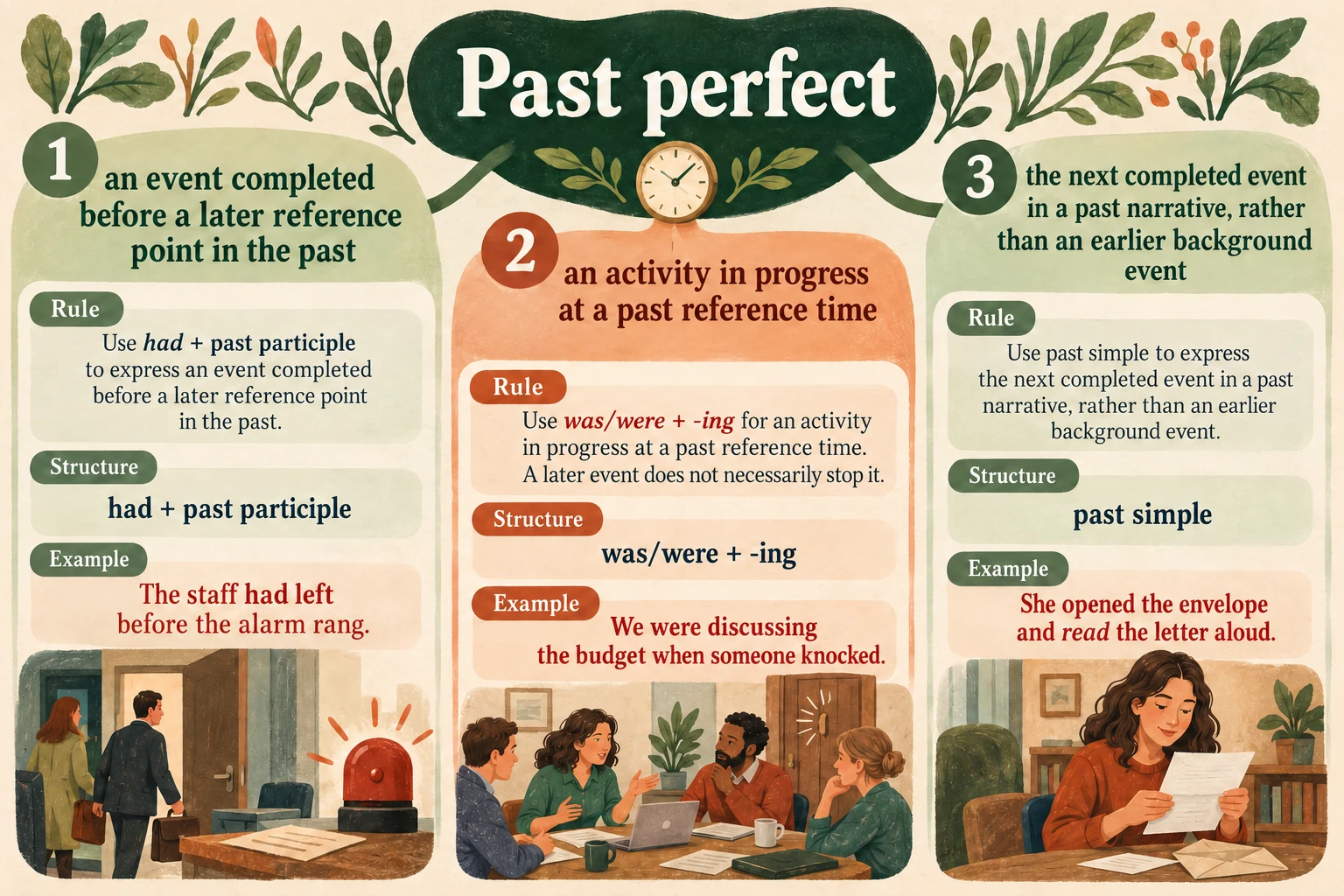
Usa had + past participle para expresar un hecho terminado antes de otro punto pasado.
The staff had left before the alarm rang.
Pasado perfecto · B1. Usa had + past participle para expresar un hecho terminado antes de otro punto pasado.
Completa 12 tareas originales. Deduce el sentido por la situación, practica la forma y aplícala en un contexto nuevo.
Usa had + past participle para expresar un hecho terminado antes de otro punto pasado.
The staff had left before the alarm rang.Usa was/were + -ing para una actividad de fondo en curso en un momento pasado. Otro hecho puede fijar ese momento sin detener necesariamente la actividad.
We were discussing the budget when someone knocked.Usa past simple para expresar el siguiente hecho completo del relato, no un antecedente anterior.
She opened the envelope and read the letter aloud.
The fire alarm rang at 10; the staff left at 9:55.
Usa had + past participle para expresar un hecho terminado antes de otro punto pasado.
The staff had left before the alarm rang.Usa was/were + -ing para una actividad de fondo en curso en un momento pasado. Otro hecho puede fijar ese momento sin detener necesariamente la actividad.
We were discussing the budget when someone knocked.Usa past simple para expresar el siguiente hecho completo del relato, no un antecedente anterior.
She opened the envelope and read the letter aloud.Conserva el primer intento, entiende el cambio y compruébalo en otra situación.
Aún no hay repasos. Prueba un calentamiento corto.
Usa had + past participle para expresar un hecho terminado antes de otro punto pasado.
The staff had left before the alarm rang.Usa was/were + -ing para una actividad de fondo en curso en un momento pasado. Otro hecho puede fijar ese momento sin detener necesariamente la actividad.
We were discussing the budget when someone knocked.Usa past simple para expresar el siguiente hecho completo del relato, no un antecedente anterior.
She opened the envelope and read the letter aloud.Abrir una respuesta registra ayuda para esa pregunta.
The fire alarm rang at 10; the staff left at 9:55.
Mira «The staff ___ before the alarm rang.». Usa had + past participle para expresar un hecho terminado antes de otro punto pasado. Oración completa: «The staff had left before the alarm rang.».
An unfinished conversation was interrupted by a knock.
Mira «We ___ the budget when someone knocked.». Usa was/were + -ing para una actividad de fondo en curso en un momento pasado. Otro hecho puede fijar ese momento sin detener necesariamente la actividad. Oración completa: «We were discussing the budget when someone knocked.».
This is the next action after opening the envelope.
Mira «She opened the envelope and ___ the letter aloud.». Usa past simple para expresar el siguiente hecho completo del relato, no un antecedente anterior. Oración completa: «She opened the envelope and read the letter aloud.».
The tickets were sold before we reached the booth.
Mira «By the time we arrived, the last ticket ___.». Usa had + past participle para expresar un hecho terminado antes de otro punto pasado. Oración completa: «By the time we arrived, the last ticket had gone.».
Use the past continuous of carry for the background activity in progress when the lights went out.
“I was carrying a tray when the lights went out.” Usa was o were + -ing para una actividad en curso en un momento pasado. Otro hecho puede dar ese punto de referencia sin demostrar que la actividad se detuvo.
The events are given in their actual order.
Mira «The guard checked my pass, then ___ the gate.». Usa past simple para expresar el siguiente hecho completo del relato, no un antecedente anterior. Oración completa: «The guard checked my pass, then opened the gate.».
Use the past perfect of see and include never for an experience before the museum visit.
Oración completa: «Before that visit, I had never seen a meteorite.» Usa had + past participle para expresar un hecho terminado antes de otro punto pasado. El sujeto, el tiempo y el sentido de la tarea determinan la forma. Solo se cotejan automáticamente las respuestas revisadas; otra redacción no es automáticamente incorrecta.
The forgotten password explains the later login failure.
Mira «I could not sign in because I ___ my password.». Usa had + past participle para expresar un hecho terminado antes de otro punto pasado. Oración completa: «I could not sign in because I had forgotten my password.».
Use the past continuous of work for the activity in progress.
“At the moment the siren sounded, the engineers were working underground.” Usa was o were + -ing para una actividad en curso en un momento pasado. Otro hecho puede dar ese punto de referencia sin demostrar que la actividad se detuvo.
The runner crossed the line; the next event followed.
Mira «She crossed the line and ___ onto the grass.». Usa past simple para expresar el siguiente hecho completo del relato, no un antecedente anterior. Oración completa: «She crossed the line and collapsed onto the grass.».
Background activity at the moment a past event happened.
Mira «The lecturer ___ when the projector failed.». Usa was/were + -ing para una actividad de fondo en curso en un momento pasado. Otro hecho puede fijar ese momento sin detener necesariamente la actividad. Oración completa: «The lecturer was speaking when the projector failed.».
Use the past simple of lock for the next action in this sequence.
Oración completa: «He put the files away, locked the cupboard and left.» Usa past simple para expresar el siguiente hecho completo del relato, no un antecedente anterior. El sujeto, el tiempo y el sentido de la tarea determinan la forma. Solo se cotejan automáticamente las respuestas revisadas; otra redacción no es automáticamente incorrecta.