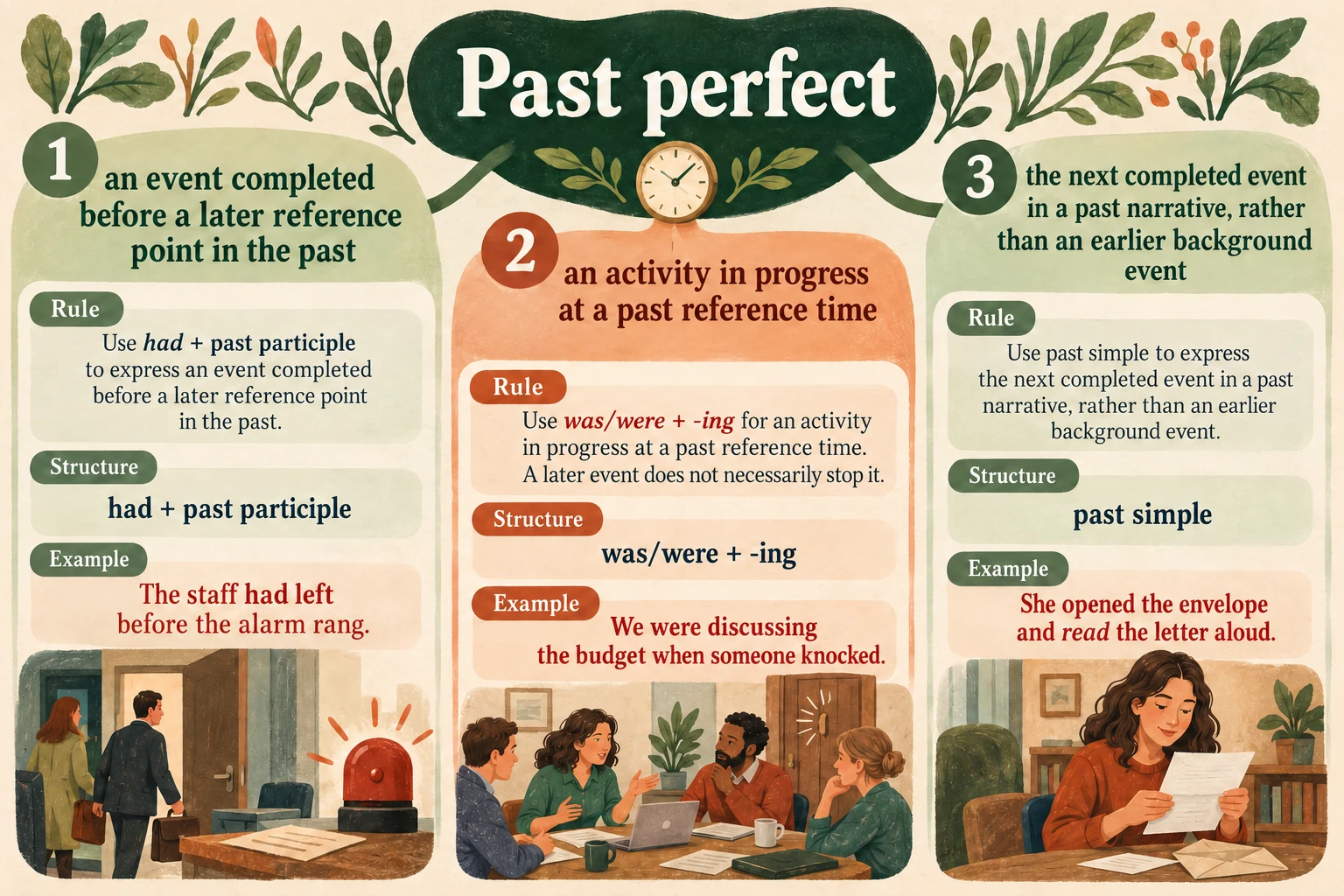
01un événement accompli avant un repère passé ultérieur
Utilisez had + past participle pour exprimer un événement accompli avant un repère passé ultérieur.
The staff had left before the alarm rang.
Past perfect · B1. Utilisez had + past participle pour exprimer un événement accompli avant un repère passé ultérieur.
Réalisez 12 exercices originaux. Appuyez-vous sur la situation pour interpréter le sens, pratiquer la forme et la réutiliser dans un nouveau contexte.
Utilisez had + past participle pour exprimer un événement accompli avant un repère passé ultérieur.
The staff had left before the alarm rang.Utilisez was/were + -ing pour une activité de fond en cours à un repère passé. Un autre événement peut fixer ce repère sans arrêter nécessairement l’activité.
We were discussing the budget when someone knocked.Utilisez past simple pour exprimer l’événement suivant du récit, plutôt qu’un fait antérieur.
She opened the envelope and read the letter aloud.
The fire alarm rang at 10; the staff left at 9:55.
Utilisez had + past participle pour exprimer un événement accompli avant un repère passé ultérieur.
The staff had left before the alarm rang.Utilisez was/were + -ing pour une activité de fond en cours à un repère passé. Un autre événement peut fixer ce repère sans arrêter nécessairement l’activité.
We were discussing the budget when someone knocked.Utilisez past simple pour exprimer l’événement suivant du récit, plutôt qu’un fait antérieur.
She opened the envelope and read the letter aloud.Gardez la première tentative, comprenez le changement et essayez dans une nouvelle situation.
Pas encore de notes. Essayez un court échauffement.
Utilisez had + past participle pour exprimer un événement accompli avant un repère passé ultérieur.
The staff had left before the alarm rang.Utilisez was/were + -ing pour une activité de fond en cours à un repère passé. Un autre événement peut fixer ce repère sans arrêter nécessairement l’activité.
We were discussing the budget when someone knocked.Utilisez past simple pour exprimer l’événement suivant du récit, plutôt qu’un fait antérieur.
She opened the envelope and read the letter aloud.Ouvrir une réponse enregistre une aide pour cette question.
The fire alarm rang at 10; the staff left at 9:55.
Observe « The staff ___ before the alarm rang. ». Utilisez had + past participle pour exprimer un événement accompli avant un repère passé ultérieur. Phrase complète : « The staff had left before the alarm rang. ».
An unfinished conversation was interrupted by a knock.
Observe « We ___ the budget when someone knocked. ». Utilisez was/were + -ing pour une activité de fond en cours à un repère passé. Un autre événement peut fixer ce repère sans arrêter nécessairement l’activité. Phrase complète : « We were discussing the budget when someone knocked. ».
This is the next action after opening the envelope.
Observe « She opened the envelope and ___ the letter aloud. ». Utilisez past simple pour exprimer l’événement suivant du récit, plutôt qu’un fait antérieur. Phrase complète : « She opened the envelope and read the letter aloud. ».
The tickets were sold before we reached the booth.
Observe « By the time we arrived, the last ticket ___. ». Utilisez had + past participle pour exprimer un événement accompli avant un repère passé ultérieur. Phrase complète : « By the time we arrived, the last ticket had gone. ».
Use the past continuous of carry for the background activity in progress when the lights went out.
“I was carrying a tray when the lights went out.” Utilisez was ou were + -ing pour une activité en cours à un repère passé. Un autre événement peut donner ce repère sans prouver que l’activité s’est arrêtée.
The events are given in their actual order.
Observe « The guard checked my pass, then ___ the gate. ». Utilisez past simple pour exprimer l’événement suivant du récit, plutôt qu’un fait antérieur. Phrase complète : « The guard checked my pass, then opened the gate. ».
Use the past perfect of see and include never for an experience before the museum visit.
Phrase complète : « Before that visit, I had never seen a meteorite. » Utilisez had + past participle pour exprimer un événement accompli avant un repère passé ultérieur. Le sujet, le temps et le sens de la consigne déterminent cette forme. Seules les réponses vérifiées sont comparées automatiquement ; toute autre formulation n’est pas automatiquement fausse.
The forgotten password explains the later login failure.
Observe « I could not sign in because I ___ my password. ». Utilisez had + past participle pour exprimer un événement accompli avant un repère passé ultérieur. Phrase complète : « I could not sign in because I had forgotten my password. ».
Use the past continuous of work for the activity in progress.
“At the moment the siren sounded, the engineers were working underground.” Utilisez was ou were + -ing pour une activité en cours à un repère passé. Un autre événement peut donner ce repère sans prouver que l’activité s’est arrêtée.
The runner crossed the line; the next event followed.
Observe « She crossed the line and ___ onto the grass. ». Utilisez past simple pour exprimer l’événement suivant du récit, plutôt qu’un fait antérieur. Phrase complète : « She crossed the line and collapsed onto the grass. ».
Background activity at the moment a past event happened.
Observe « The lecturer ___ when the projector failed. ». Utilisez was/were + -ing pour une activité de fond en cours à un repère passé. Un autre événement peut fixer ce repère sans arrêter nécessairement l’activité. Phrase complète : « The lecturer was speaking when the projector failed. ».
Use the past simple of lock for the next action in this sequence.
Phrase complète : « He put the files away, locked the cupboard and left. » Utilisez past simple pour exprimer l’événement suivant du récit, plutôt qu’un fait antérieur. Le sujet, le temps et le sens de la consigne déterminent cette forme. Seules les réponses vérifiées sont comparées automatiquement ; toute autre formulation n’est pas automatiquement fausse.