
B1

Reported Speech Exercises

About this lesson

Reported speech · B1. For the marked backshift tasks: present simple -> past simple; present continuous -> past continuous; present perfect -> past perfect; past simple -> past perfect when requested. Past perfect normally stays past perfect. Pronouns depend on who speaks and listens now.

Keep the meaning as you report statements, questions and instructions from a new viewpoint.

48 items
Save it to find it in My collection.
Knowledge map

Reported speech

Start practising
Reported speech — Knowledge map

01Choose a past viewpoint; track the people

For the marked backshift tasks: present simple -> past simple; present continuous -> past continuous; present perfect -> past perfect; past simple -> past perfect when requested. Past perfect normally stays past perfect. Pronouns depend on who speaks and listens now.

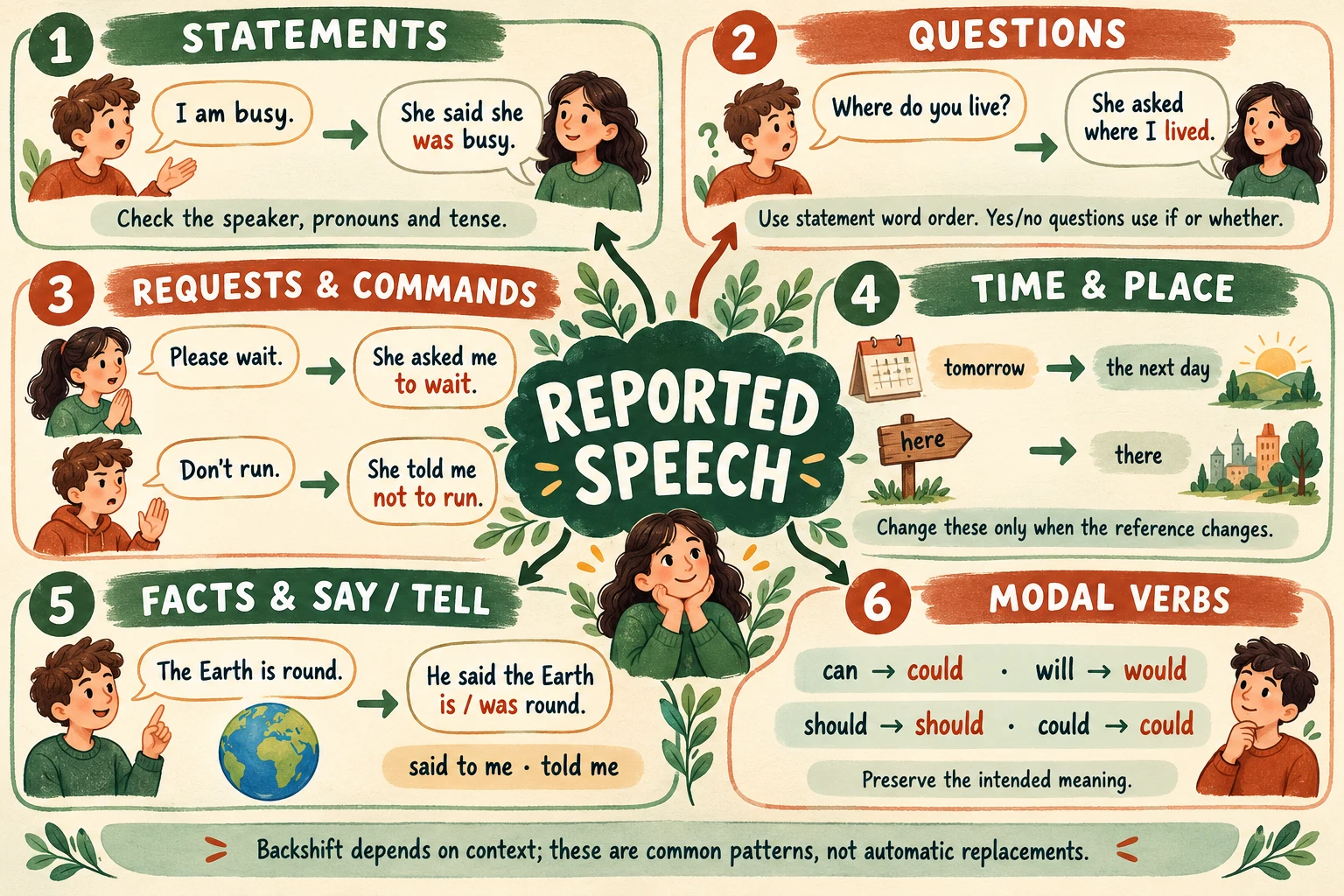
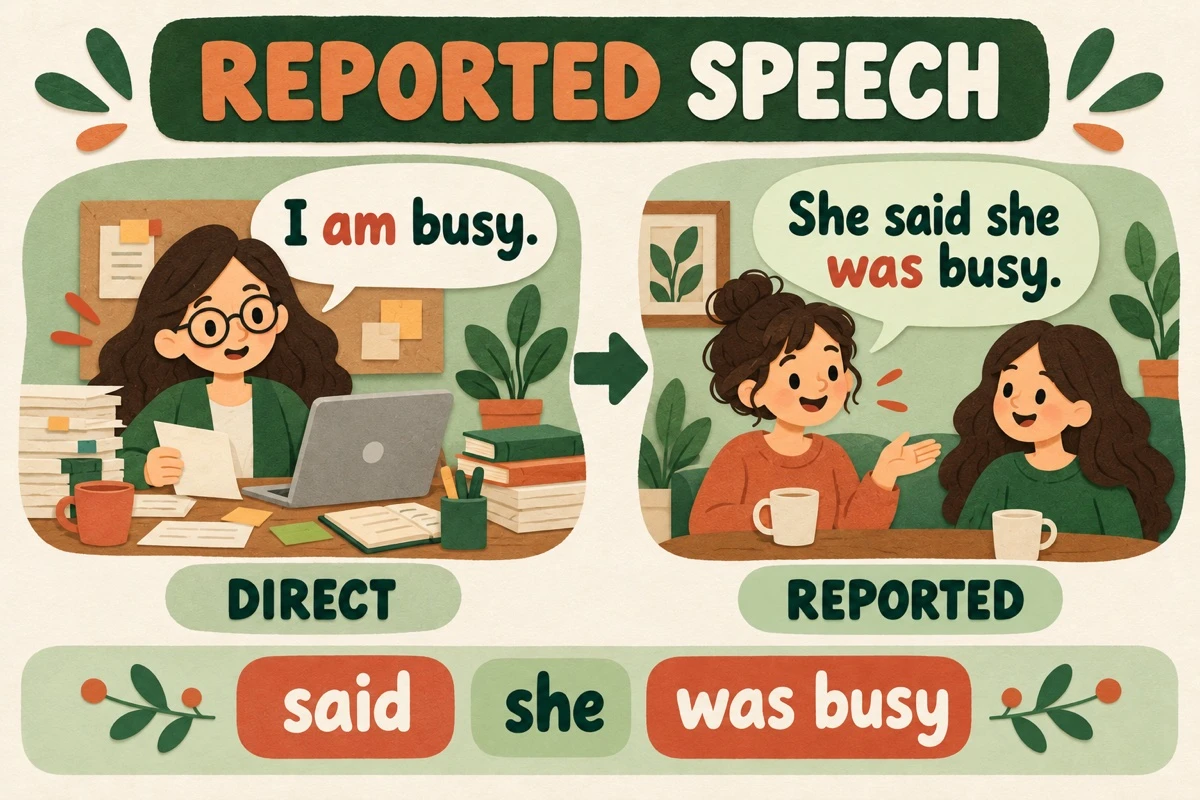
“I am busy.” → She said she was busy.
02Reported questions use statement order

Wh-question: asked + person + where/why/what time + subject + verb. Yes/no question: asked + person + if/whether + subject + verb. Remove do/does/did used only to form the direct question.

“Where do you live?” → She asked where I lived.

03Report instructions with an infinitive

Request: asked + person + to + base verb. Instruction: told + person + to + base verb. Negative: not to + base verb. To not + base verb is also grammatical. A polite question can function as a request; identify the intended function before choosing a pattern.

“Please wait.” → She asked me to wait.

04Preserve the real time and place

Tomorrow may become the next/following day; yesterday may become the day before. Here/these may need there/those when the reference changes. These are not automatic word swaps. An explicit date or place can also preserve the meaning.

tomorrow → the next day (when the time reference changes)

05Backshift is not always compulsory

With a still-true fact, a present form and a normal backshifted form can both be correct. A present reporting verb often keeps the present viewpoint. If a task requests one form, a different valid viewpoint is a task mismatch, not automatically bad English. Say takes said (to somebody); tell takes told somebody, without to before the person.

“The Earth is round.” → He said the Earth is / was round.

06Keep the modal meaning

In normal past reports, can often becomes could and will becomes would. Should, could, would and might normally stay unchanged. Must for obligation can become had to and can sometimes remain must. Must for deduction is not mechanically converted to had to. May for possibility normally becomes might in a past report.

can → could · will → would · should → should

Illustrated guide

0/48
Questions
01 / 48D01Save it to find it in My collection.

On Monday, Ben (he) spoke to Maya. Maya is reporting his words on Tuesday, using normal past-time backshift.

“I am waiting for your email.”

Maya: Ben told me that ...

Your answer
1 / 48

Your learning route

01
Step 1 · Warm-up

Warm-up

0/6
02
Step 2 · Build the skill

Choose a past viewpoint; track the people

0/3

For the marked backshift tasks: present simple -> past simple; present continuous -> past continuous; present perfect -> past perfect; past simple -> past perfect when requested. Past perfect normally stays past perfect. Pronouns depend on who speaks and listens now.

03
Step 3 · Build the skill

Reported questions use statement order

0/3

Wh-question: asked + person + where/why/what time + subject + verb. Yes/no question: asked + person + if/whether + subject + verb. Remove do/does/did used only to form the direct question.

04
Step 4 · Build the skill

Report instructions with an infinitive

0/3

Request: asked + person + to + base verb. Instruction: told + person + to + base verb. Negative: not to + base verb. To not + base verb is also grammatical. A polite question can function as a request; identify the intended function before choosing a pattern.

05
Step 5 · Build the skill

Preserve the real time and place

0/3

Tomorrow may become the next/following day; yesterday may become the day before. Here/these may need there/those when the reference changes. These are not automatic word swaps. An explicit date or place can also preserve the meaning.

06
Step 6 · Build the skill

Backshift is not always compulsory

0/3

With a still-true fact, a present form and a normal backshifted form can both be correct. A present reporting verb often keeps the present viewpoint. If a task requests one form, a different valid viewpoint is a task mismatch, not automatically bad English. Say takes said (to somebody); tell takes told somebody, without to before the person.

07
Step 7 · Build the skill

Keep the modal meaning

0/3

In normal past reports, can often becomes could and will becomes would. Should, could, would and might normally stay unchanged. Must for obligation can become had to and can sometimes remain must. Must for deduction is not mechanically converted to had to. May for possibility normally becomes might in a past report.

08
Step 8 · New contexts

New contexts

0/16
09
Step 9 · A fresh challenge

A fresh challenge

0/8
Practice notes in this unit

Make mistakes useful.

Keep the first try. Understand the change. Check it in a fresh situation.

0

No practice notes yet. Try a short warm-up.

Lesson map

Reported speech

B1
Reported speech

Lesson points

01

Choose a past viewpoint; track the people

For the marked backshift tasks: present simple -> past simple; present continuous -> past continuous; present perfect -> past perfect; past simple -> past perfect when requested. Past perfect normally stays past perfect. Pronouns depend on who speaks and listens now.

02

Reported questions use statement order

Wh-question: asked + person + where/why/what time + subject + verb. Yes/no question: asked + person + if/whether + subject + verb. Remove do/does/did used only to form the direct question.

03

Report instructions with an infinitive

Request: asked + person + to + base verb. Instruction: told + person + to + base verb. Negative: not to + base verb. To not + base verb is also grammatical. A polite question can function as a request; identify the intended function before choosing a pattern.

04

Preserve the real time and place

Tomorrow may become the next/following day; yesterday may become the day before. Here/these may need there/those when the reference changes. These are not automatic word swaps. An explicit date or place can also preserve the meaning.

05

Backshift is not always compulsory

With a still-true fact, a present form and a normal backshifted form can both be correct. A present reporting verb often keeps the present viewpoint. If a task requests one form, a different valid viewpoint is a task mismatch, not automatically bad English. Say takes said (to somebody); tell takes told somebody, without to before the person.

06

Keep the modal meaning

In normal past reports, can often becomes could and will becomes would. Should, could, would and might normally stay unchanged. Must for obligation can become had to and can sometimes remain must. Must for deduction is not mechanically converted to had to. May for possibility normally becomes might in a past report.

Questions & answers

Opening an answer records help for that question.

D01 · Warm-up

On Monday, Ben (he) spoke to Maya. Maya is reporting his words on Tuesday, using normal past-time backshift.

I am waiting for your email.

Maya: Ben told me that ...

  1. he was waiting for her email.
  2. I was waiting for his email.
  3. he had waited for my email.
  4. he was waiting for my email.
Answer & explanation
he was waiting for my email.

Am waiting becomes was waiting in the requested past viewpoint. Ben becomes he; your email becomes my email because Maya is now speaking.

D02 · Warm-up

A visitor asked this at the station yesterday. Report it using normal past-time backshift.

Where does the shuttle stop?

The visitor asked where ...

  1. the shuttle stopped.
  2. the shuttle had stopped.
  3. did the shuttle stop.
  4. the shuttle stops.
Answer & explanation
the shuttle stopped.

A reported wh-question keeps where, but uses subject + verb. Remove does and backshift stops to stopped.

D03 · Warm-up

A caretaker gave a group a negative instruction. Keep the negative meaning.

Don't move the boxes.

The caretaker told us ...

  1. to move the boxes.
  2. not move the boxes.
  3. don't move the boxes.
  4. not to move the boxes.
Answer & explanation
not to move the boxes.

A negative instruction uses told + person + not to + base verb. Do not drop not.

D04 · Warm-up

Lia (she) spoke on Monday 12 October. It is now Wednesday 14 October. Report her Monday plan with normal backshift.

I will send the file tomorrow.

On Monday, Lia said that ...

  1. she would send the file today.
  2. she had sent the file the following day.
  3. she would send the file the following day.
  4. she would send the file the following week.
Answer & explanation
she would send the file the following day.

Tomorrow in the Monday message means Tuesday, not the Wednesday of this report. Will becomes would. On Tuesday 13 October is also an accurate time reference.

D05 · Warm-up

A guide said that the museum opens at ten. This timetable is still true. Compare Report 1: The guide said that the museum opens at ten. Report 2: The guide said that the museum opened at ten.

Which explanation is accurate?

  1. Report 2 proves that the museum no longer opens at ten.
  2. Both can be correct; Report 1 presents the timetable as still current.
  3. Only Report 2 is correct because every verb must change after said.
  4. Only Report 1 is correct because backshift is never allowed for facts.
Answer & explanation
Both can be correct; Report 1 presents the timetable as still current.

Present opens can preserve a fact that is still true. Backshifted opened can also be grammatical. Opened alone does not prove the timetable changed.

D06 · Warm-up

Noah (he) spoke yesterday. Use normal past-time backshift to report his ability at that time.

I can repair the lock.

Noah said that ...

  1. he could repair the lock.
  2. he had to repair the lock.
  3. he can repair the lock.
  4. he would repair the lock.
Answer & explanation
he could repair the lock.

Can becomes could when the requested report looks back at his ability. Had to would express obligation, not ability.

P01 · Build the skill

Nia (she) made this statement last week while she still had the job. She has since left it. Report it using normal past-time backshift.

I work at weekends.

Nia said that ...

  1. she worked at weekends.
  2. I worked at weekends.
  3. she had worked at weekends.
  4. she works at weekends.
Answer & explanation
she worked at weekends.

Work becomes worked in the past report. Had worked adds an earlier-past relationship that this simple-present statement does not require.

P02 · Build the skill

Ava (she) made this statement yesterday. Complete the report using the past perfect.

I have finished the survey.

Ava said that she ...

Answer & explanation
had finished the survey.

Have finished becomes had finished. The reporting starter already supplies she. Only reviewed responses are checked automatically. A different grammatical viewpoint may not meet this task, but unfamiliar wording is not automatically wrong.

P03 · Build the skill

Omar (he) spoke to his colleague yesterday. For this exercise, backshift the past simple to the past perfect.

I left my keys at home.

Omar said that he ...

Answer & explanation
had left his keys at home.

The requested transformation is left -> had left and my -> his. Past simple can also remain in some natural reports; here the task explicitly asks for past perfect. Only reviewed responses are checked automatically. A different grammatical viewpoint may not meet this task, but unfamiliar wording is not automatically wrong.

P04 · Build the skill

Mira (she) asked Dan this yesterday. Dan is reporting her question now. Use normal backshift.

Are you using my charger?

Dan: Mira asked me ...

Answer & explanation
if I was using her charger.

A yes/no question needs if or whether. Use I was, not was I. My refers to Mira, so it becomes her in Dan's report. Only reviewed responses are checked automatically. A different grammatical viewpoint may not meet this task, but unfamiliar wording is not automatically wrong.

Other accepted versions
  • whether I was using her charger.
  • if I was using Mira's charger.
  • whether I was using Mira's charger.
  • if I was using the charger she owned.
  • whether I was using the charger she owned.
  • whether or not I was using her charger.
  • whether or not I was using Mira's charger.
  • whether or not I was using the charger she owned.
P05 · Build the skill

Yesterday a coach asked Leo (he) about an earlier departure. Backshift did leave to had left.

Why did you leave early?

The coach asked Leo why ...

  1. he has left early.
  2. had he left early.
  3. if he had left early.
  4. he had left early.
Answer & explanation
he had left early.

The reported question uses he had left, not had he left. The coach is asking for a reason, so why must remain.

P06 · Build the skill

On Tuesday, Reece asked Ivy (she) about an earlier event. Ivy is reporting the question. Keep the original past perfect.

Had you seen the notice before Monday?

Ivy: Reece asked me ...

Answer & explanation
whether I had seen the notice before Monday.

Use whether or if and statement word order. Past perfect normally stays past perfect; there is no further routine backshift. Only reviewed responses are checked automatically. A different grammatical viewpoint may not meet this task, but unfamiliar wording is not automatically wrong.

Other accepted versions
  • if I had seen the notice before Monday.
  • whether I had seen the notice before that Monday.
  • if I had seen the notice before that Monday.
  • whether or not I had seen the notice before Monday.
  • whether or not I had seen the notice before that Monday.
P07 · Build the skill

A caretaker politely requested this of Max. Report the request with the infinitive construction after asked Max.

Please close the side gate.

The caretaker asked Max ...

Answer & explanation
to close the side gate.

Report a request with asked + person + to + base verb. Reports commonly omit please, but to please close the side gate is also a natural polite form and earns credit. Only reviewed responses are checked automatically. A different grammatical viewpoint may not meet this task, but unfamiliar wording is not automatically wrong.

Other accepted versions
  • to please close the side gate.
  • to close the side gate, please.
P08 · Build the skill

Lina (she) asked Arun for his address. Arun is reporting her request with the infinitive construction after asked me.

Please email me your address.

Arun: Lina asked me ...

Answer & explanation
to email her my address.

Me in Lina's words refers to Lina; your refers to Arun. In Arun's report they become her and my. Only reviewed responses are checked automatically. A different grammatical viewpoint may not meet this task, but unfamiliar wording is not automatically wrong.

Other accepted versions
  • to email Lina my address.
  • to email my address to her.
  • to email my address to Lina.
  • to please email her my address.
  • to email her my address, please.
P09 · Build the skill

A supervisor gave a negative instruction. Repair the reported sentence. Write the whole corrected sentence.

The supervisor told us to don't touch the switch.

Corrected report:

Answer & explanation
The supervisor told us not to touch the switch.

Use not to touch after told us. To not touch is also a grammatical placement of not and should not be marked as bad English. Only reviewed responses are checked automatically. A different grammatical viewpoint may not meet this task, but unfamiliar wording is not automatically wrong.

Other accepted versions
  • The supervisor told us to not touch the switch.
P10 · Build the skill

On Tuesday, Ella (she) spoke to you at the library entrance. On Wednesday you report it from home. Use normal backshift; Friday is still the intended meeting day.

I will meet you here on Friday.

Ella said that ...

  1. she would meet me there on Friday.
  2. she would meet me there the next day.
  3. she had met me there on Friday.
  4. she would meet me here on Friday.
Answer & explanation
she would meet me there on Friday.

Here becomes there because the report is made in a different place. Friday stays Friday: its reference has not changed.

P11 · Build the skill

Finn (he) spoke to you on Monday 12 October. You report it on Wednesday 14 October. Use past perfect and keep the original event on Sunday 11 October.

I saw your tutor yesterday.

On Monday, Finn said that he ...

Answer & explanation
had seen my tutor the day before.

Yesterday was Sunday relative to Finn's Monday words. The day before or an explicit Sunday date preserves that reference. Only reviewed responses are checked automatically. A different grammatical viewpoint may not meet this task, but unfamiliar wording is not automatically wrong.

Other accepted versions
  • had seen my tutor on Sunday 11 October.
  • had seen my tutor on Sunday.
  • had seen my tutor on 11 October.
  • had seen my tutor the previous day.
  • had seen my tutor on the day before.
P12 · Build the skill

An usher pointed at some seats in the theatre yesterday. You report it from home today. Use normal past-time backshift and identify the theatre seats without pretending you are pointing at them now.

These seats are reserved.

The usher said that ...

Answer & explanation
those seats were reserved.

Those seats or the seats keeps the theatre reference. A change of viewpoint can change these, but a neutral noun phrase is also accurate. Only reviewed responses are checked automatically. A different grammatical viewpoint may not meet this task, but unfamiliar wording is not automatically wrong.

Other accepted versions
  • the seats were reserved.
  • the seats in the theatre were reserved.
  • those seats in the theatre were reserved.
P13 · Build the skill

A teacher said, "The school has a small library." The school still has it. You want to present that fact as current.

The school has a small library.

The teacher said that the school ...

Answer & explanation
has a small library.

Has presents the fact as still current. Had can also be grammatical with a past reporting viewpoint; it does not by itself mean the library has gone. This task asks for the current viewpoint. Only reviewed responses are checked automatically. A different grammatical viewpoint may not meet this task, but unfamiliar wording is not automatically wrong.

P14 · Build the skill

Violet (she) is still on the bus and has just sent this message. Report it immediately with the present reporting verb says.

I am on the bus now.

Violet says that she ...

Answer & explanation
is on the bus now.

The reporting verb is present and the situation is still current, so there is no reason here to change is to was or now to then. Only reviewed responses are checked automatically. A different grammatical viewpoint may not meet this task, but unfamiliar wording is not automatically wrong.

Other accepted versions
  • is on the bus right now.
  • is on the bus at the moment.
P15 · Build the skill

Yesterday, Ben spoke to Jo. Jo is reporting it today. The pool’s timetable is still current. Choose a grammatical report.

The pool is closed on Mondays.

Jo's report:

  1. Ben told to me that the pool is closed on Mondays.
  2. Ben told that the pool is closed on Mondays.
  3. Ben said me that the pool was closed on Mondays.
  4. Ben told me that the pool was closed on Mondays.
Answer & explanation
Ben told me that the pool was closed on Mondays.

Told needs a listener object: told me. Said can take to me, but not me directly. Told to me is not the standard pattern. Was closed is a valid normal backshift even though the timetable is still current.

P16 · Build the skill

Eli (he) made this promise yesterday. Use normal backshift.

I will help Nora.

Eli said that ...

  1. he would help Nora.
  2. he had helped Nora.
  3. he had to help Nora.
  4. he could help Nora.
Answer & explanation
he would help Nora.

Would preserves the future promise from Eli's earlier viewpoint. Could changes it into ability or possibility.

P17 · Build the skill

On Monday, Lena (she) described an obligation. You report it the following week, after the Friday deadline. Use had to in this exercise.

I must submit the form by Friday.

Lena said that she ...

Answer & explanation
had to submit the form by that Friday.

Had to reports the past obligation. That Friday makes the original deadline explicit; by Friday can also be understood from this context. Must may remain in other reports, but this task requests had to. Must for deduction is not mechanically converted to had to. Only reviewed responses are checked automatically. A different grammatical viewpoint may not meet this task, but unfamiliar wording is not automatically wrong.

Other accepted versions
  • had to submit the form by Friday.
  • had to submit the form by the Friday of that week.
P18 · Build the skill

A tutor gave Iris this advice. Iris is reporting it.

You should save a copy.

Iris: The tutor said that I ...

Answer & explanation
should save a copy.

Should normally stays should in reported advice. Do not invent shoulded or replace advice with an obligation. Only reviewed responses are checked automatically. A different grammatical viewpoint may not meet this task, but unfamiliar wording is not automatically wrong.

R01 · New contexts

Milo (he) spoke to Nia yesterday. Nia reports his words with normal past-time backshift.

I am taking your bike to the shop.

Nia: Milo told me that he ...

Answer & explanation
was taking my bike to the shop.

Am taking becomes was taking. Your refers to Nia and becomes my when Nia reports it. This retests the listener-to-reporter possessive change in D01. Only reviewed responses are checked automatically. A different grammatical viewpoint may not meet this task, but unfamiliar wording is not automatically wrong.

R02 · New contexts

Rosa (she) spoke yesterday. Complete the report using the past perfect.

I have locked the door.

Rosa said that she ...

Answer & explanation
had locked the door.

Have locked becomes had locked. There is no change to the completed action's meaning. Only reviewed responses are checked automatically. A different grammatical viewpoint may not meet this task, but unfamiliar wording is not automatically wrong.

R03 · New contexts

An agent asked Iris (she) this yesterday. Iris reports it with normal backshift.

Where do you keep the tickets?

Iris: The agent asked me where ...

Answer & explanation
I kept the tickets.

Where is retained; the order becomes I kept. Do disappears and keep backshifts to kept. Only reviewed responses are checked automatically. A different grammatical viewpoint may not meet this task, but unfamiliar wording is not automatically wrong.

R04 · New contexts

A tutor asked May this yesterday. May reports it. For this exercise, backshift the past simple to the past perfect.

Did you charge the tablet?

May: The tutor asked me ...

Answer & explanation
if I had charged the tablet.

If or whether introduces the yes/no question. Use I had charged, not had I charged. Only reviewed responses are checked automatically. A different grammatical viewpoint may not meet this task, but unfamiliar wording is not automatically wrong.

Other accepted versions
  • whether I had charged the tablet.
  • whether I had charged the tablet or not.
  • if I had charged the tablet or not.
  • whether or not I had charged the tablet.
R05 · New contexts

A coach made this request of Toby. Toby reports it with the infinitive construction after asked me.

Please bring your notebook.

Toby: The coach asked me ...

Answer & explanation
to bring my notebook.

Use asked me to bring. Your points to Toby and becomes my in Toby's report. Polite please and meaning-preserving bring along variants are also accepted. Only reviewed responses are checked automatically. A different grammatical viewpoint may not meet this task, but unfamiliar wording is not automatically wrong.

Other accepted versions
  • to please bring my notebook.
  • to bring my notebook, please.
  • to bring along my notebook.
  • to bring my notebook along.
  • to bring my notebook along, please.
  • to bring along my notebook, please.
R06 · New contexts

A ranger gave this instruction to your group. Keep the negative meaning.

Don't feed the birds.

The ranger told us ...

Answer & explanation
not to feed the birds.

Use not to feed. To not feed is also grammatical, although not to is the main teaching pattern here. Only reviewed responses are checked automatically. A different grammatical viewpoint may not meet this task, but unfamiliar wording is not automatically wrong.

Other accepted versions
  • to not feed the birds.
  • not to feed the birds, please.
R07 · New contexts

Dana (she) spoke on Tuesday 3 November. You report it on Thursday 5 November with normal backshift. Preserve the planned return on Wednesday 4 November.

I will return tomorrow.

On Tuesday, Dana said that she ...

Answer & explanation
would return the following day.

Tomorrow referred to Wednesday. The following day, the next day or the explicit Wednesday date keeps the intended day. Only reviewed responses are checked automatically. A different grammatical viewpoint may not meet this task, but unfamiliar wording is not automatically wrong.

Other accepted versions
  • would return the next day.
  • would return on Wednesday 4 November.
  • would return on Wednesday.
  • would return on 4 November.
  • would return on the following day.
  • would return on the next day.
  • would return the day after she spoke.
R08 · New contexts

On Monday, Kit (they) pointed at a desk in the office. On Tuesday you report it from home. Use the past perfect and preserve the office location without pretending you are still there.

I left the parcel here.

Kit said that they ...

Answer & explanation
had left the parcel there.

Here in the office becomes there from home. At that desk is an accurate explicit reference too. The requested past-perfect shift is had left. Only reviewed responses are checked automatically. A different grammatical viewpoint may not meet this task, but unfamiliar wording is not automatically wrong.

Other accepted versions
  • had left the parcel at that desk.
  • had left the parcel at the desk in the office.
  • had left the parcel at the office desk.
R09 · New contexts

Darius (he) said, "I work for a charity." He still has this job. Write two reports: one presenting the fact as current, and one using normal backshift.

I work for a charity.

Darius said that he ... [current] Darius said that he ... [backshifted]

Answer & explanation
works for a charity. / worked for a charity.

Works presents the job as current; worked is the past reporting viewpoint. The past form alone does not show that he left the charity. Only reviewed responses are checked automatically. A different grammatical viewpoint may not meet this task, but unfamiliar wording is not automatically wrong.

R10 · New contexts

The neighbour spoke to me yesterday. The cafe’s timetable is still current. A learner wrote: “The neighbour said me that the cafe is closed on Mondays.” Correct the whole report. Either a current or a normal past viewpoint is allowed.

The cafe is closed on Mondays.

Write the corrected full report.

Answer & explanation
The neighbour told me that the cafe is closed on Mondays.

Use told me or said to me; said me is not the standard pattern. The current timetable can be reported with is closed or with normal backshift, was closed. Both keep the meaning in this context. Only reviewed responses are checked automatically. A different grammatical viewpoint may not meet this task, but unfamiliar wording is not automatically wrong.

Other accepted versions
  • The neighbour told me that the cafe was closed on Mondays.
  • The neighbour told me the cafe is closed on Mondays.
  • The neighbour told me the cafe was closed on Mondays.
  • The neighbour said to me that the cafe is closed on Mondays.
  • The neighbour said to me that the cafe was closed on Mondays.
  • The neighbour said to me the cafe is closed on Mondays.
  • The neighbour said to me the cafe was closed on Mondays.
  • The neighbor told me that the cafe is closed on Mondays.
  • The neighbor told me that the cafe was closed on Mondays.
  • The neighbor told me the cafe is closed on Mondays.
  • The neighbor told me the cafe was closed on Mondays.
  • The neighbor said to me that the cafe is closed on Mondays.
  • The neighbor said to me that the cafe was closed on Mondays.
  • The neighbor said to me the cafe is closed on Mondays.
  • The neighbor said to me the cafe was closed on Mondays.
  • The neighbour told me that the café is closed on Mondays.
  • The neighbour told me that the café was closed on Mondays.
  • The neighbour told me the café is closed on Mondays.
  • The neighbour told me the café was closed on Mondays.
  • The neighbour said to me that the café is closed on Mondays.
  • The neighbour said to me that the café was closed on Mondays.
  • The neighbour said to me the café is closed on Mondays.
  • The neighbour said to me the café was closed on Mondays.
  • The neighbor told me that the café is closed on Mondays.
  • The neighbor told me that the café was closed on Mondays.
  • The neighbor told me the café is closed on Mondays.
  • The neighbor told me the café was closed on Mondays.
  • The neighbor said to me that the café is closed on Mondays.
  • The neighbor said to me that the café was closed on Mondays.
  • The neighbor said to me the café is closed on Mondays.
  • The neighbor said to me the café was closed on Mondays.
R11 · New contexts

Ari (they) described an ability yesterday. Use normal past-time backshift.

I can carry the ladder.

Ari said that they ...

Answer & explanation
could carry the ladder.

Can becomes could to report the stated ability from the past viewpoint. Only reviewed responses are checked automatically. A different grammatical viewpoint may not meet this task, but unfamiliar wording is not automatically wrong.

R12 · New contexts

A tutor gave Zoe advice about a labelled folder. Zoe reports the advice.

You should check the label.

Zoe: The tutor said that I ...

Answer & explanation
should check the label.

Should stays should when Zoe reports the advice. Only reviewed responses are checked automatically. A different grammatical viewpoint may not meet this task, but unfamiliar wording is not automatically wrong.

R13 · New contexts

Omar (he) made this promise to Rae yesterday. Rae reports it using normal backshift.

I will check your figures.

Rae: Omar said that he ...

Answer & explanation
would check my figures.

Will becomes would to report the earlier promise. Your refers to Rae, so Rae uses my. This is the fresh repair for P16. Only reviewed responses are checked automatically. A different grammatical viewpoint may not meet this task, but unfamiliar wording is not automatically wrong.

R14 · New contexts

Alma (she) spoke on Friday about the following Tuesday’s deadline. You report it on the Wednesday after that deadline. Report the past obligation and preserve that original Tuesday.

I must return the key by Tuesday.

Alma said that she ...

Answer & explanation
had to return the key by that Tuesday.

Had to preserves the past obligation; that Tuesday identifies the deadline after Alma's Friday statement. This is a new obligation-and-deadline context for P17. Only reviewed responses are checked automatically. A different grammatical viewpoint may not meet this task, but unfamiliar wording is not automatically wrong.

Other accepted versions
  • had to return the key by the Tuesday after she spoke.
  • had to return the key by Tuesday.
  • had to return the key by the following Tuesday.
R15 · New contexts

On Tuesday, Jay asked Robin about an earlier event. Robin reports the question. Keep the past perfect that is already in the original question.

Had you read the message before Monday?

Robin: Jay asked me ...

Answer & explanation
if I had read the message before Monday.

The original already uses had read. Keep it, add if or whether and use statement order: I had read, not had I read. Only reviewed responses are checked automatically. A different grammatical viewpoint may not meet this task, but unfamiliar wording is not automatically wrong.

Other accepted versions
  • whether I had read the message before Monday.
  • if I had read the message before that Monday.
  • whether I had read the message before that Monday.
  • whether or not I had read the message before Monday.
  • whether or not I had read the message before that Monday.
R16 · New contexts

Elena (she) has just sent this message and is still in the library. Report it immediately with the present reporting verb says.

I am in the library now.

Elena says that she ...

Answer & explanation
is in the library now.

Says is a present reporting verb and Elena is still there. Keep is and now. This fresh item retests P14, rather than a different past-reporting fact pattern. Only reviewed responses are checked automatically. A different grammatical viewpoint may not meet this task, but unfamiliar wording is not automatically wrong.

Other accepted versions
  • is in the library right now.
  • is in the library at the moment.
X01 · A fresh challenge

Noor (she) spoke to Cal yesterday. Cal reports her statement now using normal past-time backshift.

I have printed your map.

Cal: Noor said that she ...

Answer & explanation
had printed my map.

Have printed becomes had printed; your map refers to Cal and becomes my map in Cal's report. Only reviewed responses are checked automatically. A different grammatical viewpoint may not meet this task, but unfamiliar wording is not automatically wrong.

X02 · A fresh challenge

A receptionist asked a visitor (he) this yesterday. Use normal backshift.

What time does your train arrive?

The receptionist asked the visitor what time ...

  1. his train had arrived.
  2. did his train arrive.
  3. his train arrived.
  4. your train arrived.
Answer & explanation
his train arrived.

Use his train arrived after what time. Do not retain does or direct-question order.

X03 · A fresh challenge

Yesterday, Sam asked Alex (they) about an earlier document check. Alex reports it now. In this exercise, backshift the past simple to the past perfect.

Did you check the dates?

Alex: Sam asked me ...

Answer & explanation
whether I had checked the dates.

If and whether are both valid. The requested past perfect is I had checked; no question inversion remains. Only reviewed responses are checked automatically. A different grammatical viewpoint may not meet this task, but unfamiliar wording is not automatically wrong.

Other accepted versions
  • if I had checked the dates.
  • whether I had checked the dates or not.
  • if I had checked the dates or not.
  • whether or not I had checked the dates.
X04 · A fresh challenge

A manager gave a group this instruction. Report the negative instruction.

Don't leave the window open.

The manager told us ...

Answer & explanation
not to leave the window open.

Keep not and use an infinitive after told us. To not leave is also grammatical. Only reviewed responses are checked automatically. A different grammatical viewpoint may not meet this task, but unfamiliar wording is not automatically wrong.

Other accepted versions
  • to not leave the window open.
X05 · A fresh challenge

On Thursday, Ada (she) spoke to you at the sports centre. On Saturday you report it from home. The planned event is Friday. Use normal backshift.

I will wait for you here tomorrow.

On Thursday, Ada said that ...

Answer & explanation
she would wait for me there the following day.

Here means the sports centre; tomorrow means Friday relative to Thursday's words. The next day or on Friday also preserves the date. Only reviewed responses are checked automatically. A different grammatical viewpoint may not meet this task, but unfamiliar wording is not automatically wrong.

Other accepted versions
  • she would wait for me there the next day.
  • she would wait for me there on Friday.
  • she would wait for me at the sports centre on Friday.
  • she would wait for me at the sports centre the following day.
  • she would wait for me at the sports centre the next day.
  • she would wait for me there on the Friday after she spoke.
X06 · A fresh challenge

A guide told you that the community hall has two exits. Both exits are still there. Pass this information to a friend who is visiting today. A current or a backshifted viewpoint is acceptable.

The community hall has two exits.

The guide said that the community hall ...

Answer & explanation
has two exits.

Has presents the information as current. Had is a valid backshifted report too; it does not mean an exit disappeared. Either preserves the given fact. Only reviewed responses are checked automatically. A different grammatical viewpoint may not meet this task, but unfamiliar wording is not automatically wrong.

Other accepted versions
  • had two exits.
X07 · A fresh challenge

Pavel (he) spoke to a colleague yesterday about a meeting. Report both parts with normal past-time backshift, keeping the ability and possibility meanings.

I can explain the route, but I may arrive late.

Pavel said that he ...

Answer & explanation
could explain the route, but he might arrive late.

Can becomes could for ability; may becomes might for the possibility in this past report. Keep the contrast with but. Repeating he in the second clause is optional because Pavel is the subject of both actions. Only reviewed responses are checked automatically. A different grammatical viewpoint may not meet this task, but unfamiliar wording is not automatically wrong.

Other accepted versions
  • could explain the route but he might arrive late.
  • could explain the route, but might arrive late.
  • could explain the route but might arrive late.
X08 · A fresh challenge

Optional extension. A designer proposed an action for the whole team. Report the suggestion rather than quoting Let's.

Let's use a larger label.

The designer suggested ...

Answer & explanation
using a larger label.

Suggested + -ing and suggested that + clause can both report the proposal. Suggested us to use is not the appropriate pattern here. This one item is an extension, not proof of B2 level. Only reviewed responses are checked automatically. A different grammatical viewpoint may not meet this task, but unfamiliar wording is not automatically wrong.

Other accepted versions
  • that we use a larger label.
  • that we should use a larger label.
  • we use a larger label.
  • we should use a larger label.
  • our using a larger label.
  • that the team use a larger label.
  • that the team should use a larger label.