01an activity in progress at a specified future moment
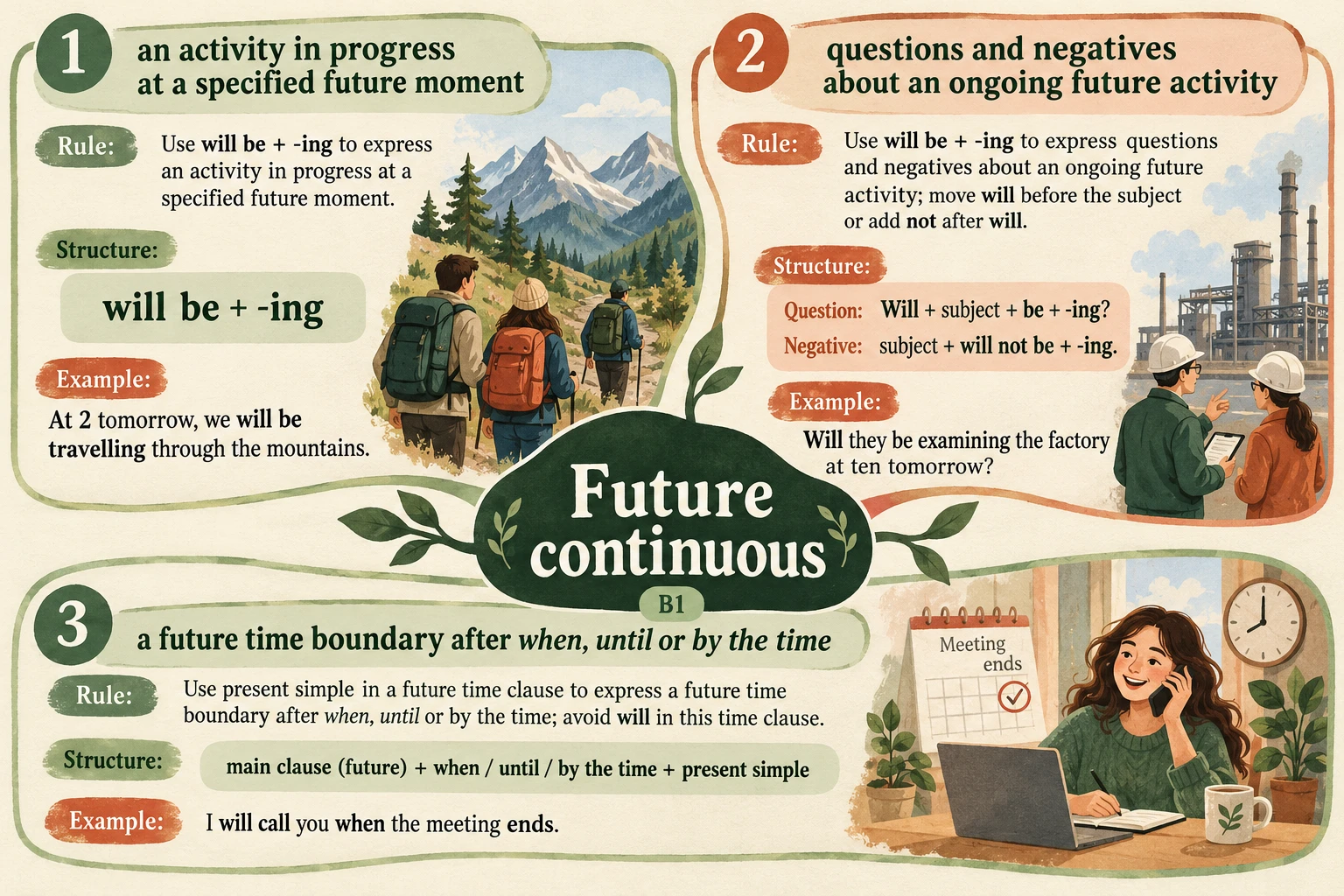
Use will be + -ing to express an activity in progress at a specified future moment.
At 2 tomorrow, we will be travelling through the mountains.
Future continuous · B1. Use will be + -ing to express an activity in progress at a specified future moment.
Complete 12 original tasks. Use the situation to choose the intended meaning, practise the form, then apply it in a fresh context.
Use will be + -ing to express an activity in progress at a specified future moment.
At 2 tomorrow, we will be travelling through the mountains.Use will be + -ing to express questions and negatives about an ongoing future activity; move will before the subject or add not after will.
Will they be examining the factory at ten tomorrow?Use present simple in a future time clause to express a future time boundary after when, until or by the time; avoid will in this time clause.
I will call you when the meeting ends.
The train journey runs from 1 to 4 tomorrow.
Use will be + -ing to express an activity in progress at a specified future moment.
At 2 tomorrow, we will be travelling through the mountains.Use will be + -ing to express questions and negatives about an ongoing future activity; move will before the subject or add not after will.
Will they be examining the factory at ten tomorrow?Use present simple in a future time clause to express a future time boundary after when, until or by the time; avoid will in this time clause.
I will call you when the meeting ends.Keep the first try. Understand the change. Check it in a fresh situation.
No practice notes yet. Try a short warm-up.
Use will be + -ing to express an activity in progress at a specified future moment.
At 2 tomorrow, we will be travelling through the mountains.Use will be + -ing to express questions and negatives about an ongoing future activity; move will before the subject or add not after will.
Will they be examining the factory at ten tomorrow?Use present simple in a future time clause to express a future time boundary after when, until or by the time; avoid will in this time clause.
I will call you when the meeting ends.Opening an answer records help for that question.
The train journey runs from 1 to 4 tomorrow.
Look at “At 2 tomorrow, we ___ through the mountains.”. Use will be + -ing to express an activity in progress at a specified future moment. Complete sentence: “At 2 tomorrow, we will be travelling through the mountains.”.
Ask about an activity in progress at ten tomorrow; keep future continuous question order.
Look at “___ the factory at ten tomorrow?”. Use will be + -ing to express questions and negatives about an ongoing future activity; move will before the subject or add not after will. Complete sentence: “Will they be examining the factory at ten tomorrow?”.
This is a future time clause, not an indirect question.
Look at “I will call you when the meeting ___.”. Use present simple in a future time clause to express a future time boundary after when, until or by the time; avoid will in this time clause. Complete sentence: “I will call you when the meeting ends.”.
Her night shift tomorrow covers midnight.
Look at “At midnight tomorrow, Lea ___ at the hospital.”. Use will be + -ing to express an activity in progress at a specified future moment. Complete sentence: “At midnight tomorrow, Lea will be working at the hospital.”.
Use the negative future continuous of rehearse for an activity that will not be in progress at six.
Complete sentence: “At six tomorrow, the dancers will not be rehearsing.” Use will be + -ing to express questions and negatives about an ongoing future activity; move will before the subject or add not after will. The subject, time and meaning in the task determine this form. Only reviewed responses are matched automatically; other wording is not automatically wrong.
The main clause is future; the until-clause gives its boundary.
Look at “We will keep the room open until everyone ___.”. Use present simple in a future time clause to express a future time boundary after when, until or by the time; avoid will in this time clause. Complete sentence: “We will keep the room open until everyone arrives.”.
Use the future continuous of cross for an action underway at noon tomorrow.
Complete sentence: “At noon tomorrow, the expedition will be crossing the plateau.” Use will be + -ing to express an activity in progress at a specified future moment. The subject, time and meaning in the task determine this form. Only reviewed responses are matched automatically; other wording is not automatically wrong.
The workshop runs from 9 to 5 next Monday.
Look at “At three next Monday, I ___ a workshop.”. Use will be + -ing to express an activity in progress at a specified future moment. Complete sentence: “At three next Monday, I will be attending a workshop.”.
Write a future-continuous question using the subject the panel and the verb interview.
Complete sentence: “Will the panel be interviewing candidates at eleven tomorrow?” Use will be + -ing to express questions and negatives about an ongoing future activity; move will before the subject or add not after will. The subject, time and meaning in the task determine this form. Only reviewed responses are matched automatically; other wording is not automatically wrong.
Future time boundary after by the time.
Look at “By the time you ___, I will be waiting outside.”. Use present simple in a future time clause to express a future time boundary after when, until or by the time; avoid will in this time clause. Complete sentence: “By the time you finish, I will be waiting outside.”.
At this time next week the ship will be in port, so the sailing activity will not be in progress.
Look at “This time next week, the crew ___ across the Atlantic.”. Use will be + -ing to express questions and negatives about an ongoing future activity; move will before the subject or add not after will. Complete sentence: “This time next week, the crew will not be sailing across the Atlantic.”.
Use the present simple of reach in this future time clause.
Complete sentence: “I will be reading when the train reaches the border.” Use present simple in a future time clause to express a future time boundary after when, until or by the time; avoid will in this time clause. The subject, time and meaning in the task determine this form. Only reviewed responses are matched automatically; other wording is not automatically wrong.