
A1

A school visit

About this lesson

A school visit · A1. Keep the requested person, time, place or amount attached to the correct event. Keep the stated condition or permission; a rule does not prove that an event happened.

Listen to the original English recording, answer the questions, then open the transcript to check the evidence. These related questions use the same recording; the level is an editorial guide, not a certified result.

10 items
Save it to find it in My collection.
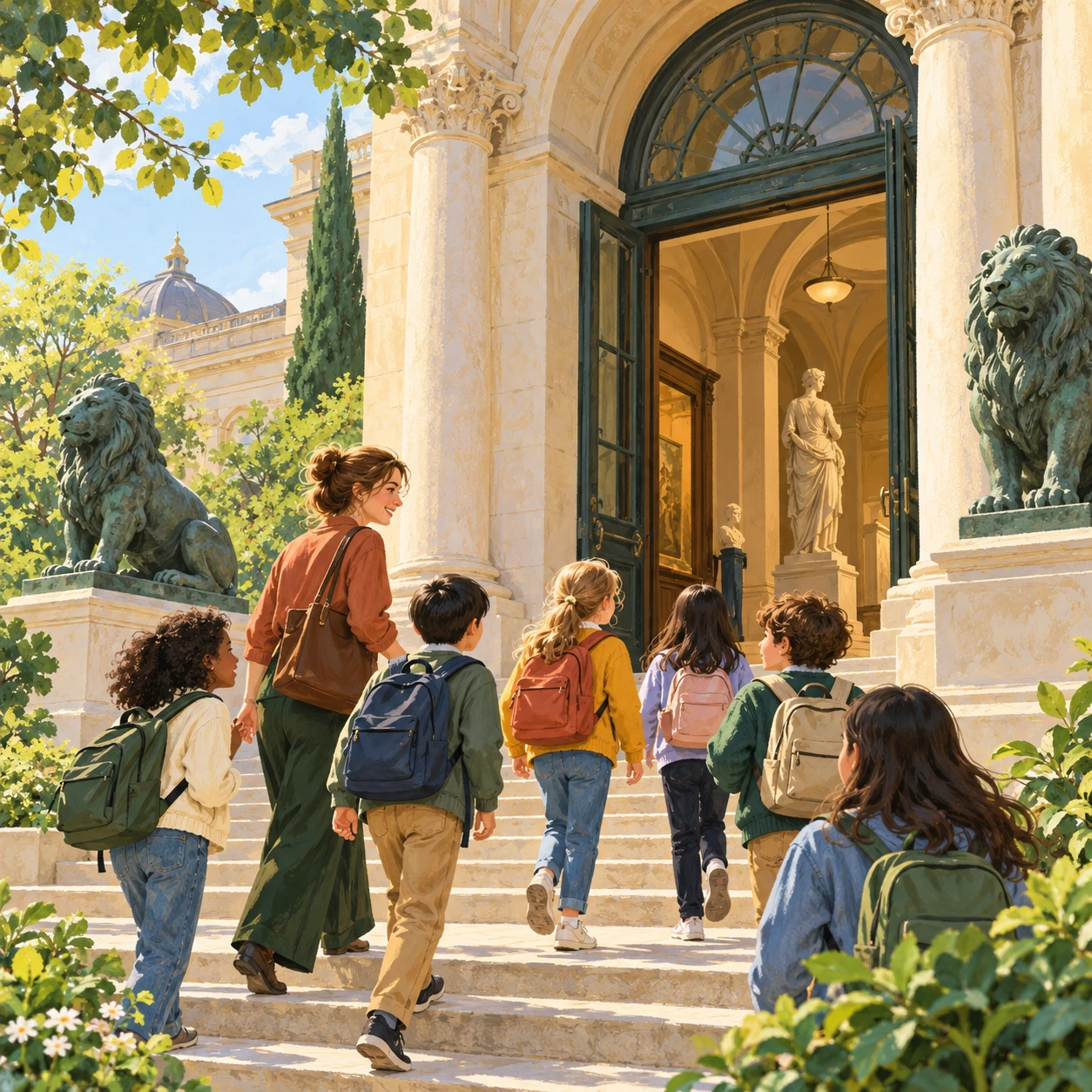
A school visit — context illustration
ListeningA1

Our museum visit

Listen to the original English recording, answer the questions, then open the transcript to check the evidence. These related questions use the same recording; the level is an editorial guide, not a certified result.

A little clarity first

Stated details · Conditions and permissions

Keep the requested person, time, place or amount attached to the correct event. Keep the stated condition or permission; a rule does not prove that an event happened.

The doors open at eight. The class starts at nine.

Stated details · Reasons

Keep the requested person, time, place or amount attached to the correct event. Use the reason actually given; a plausible reason from outside the text is not enough.

The doors open at eight. The class starts at nine.

Purpose and intended outcome

Ask what the person or message is trying to achieve, and for whom.

This note tells visitors where to wait.

Learning material
A school visit — context illustration
ListeningA1

Our museum visit

Listen to the original English recording, answer the questions, then open the transcript to check the evidence. These related questions use the same recording; the level is an editorial guide, not a certified result.

0/10
Questions
01 / 10D01Save it to find it in My collection.

Our museum visit

On which day is the museum visit?

Your answer
1 / 10

Your learning route

01
Step 1 · Warm-up

Warm-up

0/3
02
Step 2 · Build the skill

Stated details · Conditions and permissions

0/1

Keep the requested person, time, place or amount attached to the correct event. Keep the stated condition or permission; a rule does not prove that an event happened.

The doors open at eight. The class starts at nine.
03
Step 3 · Build the skill

Stated details · Reasons

0/1

Keep the requested person, time, place or amount attached to the correct event. Use the reason actually given; a plausible reason from outside the text is not enough.

The doors open at eight. The class starts at nine.
04
Step 4 · Build the skill

Purpose and intended outcome

0/1

Ask what the person or message is trying to achieve, and for whom.

This note tells visitors where to wait.
05
Step 5 · Related practice

Related practice

0/2
06
Step 6 · Text challenge

Text challenge

0/2
Practice notes in this unit

Make mistakes useful.

Keep your first attempt, check the evidence and try another question. A follow-up on the same material does not prove transfer to a new text.

0

No practice notes yet. Try a short warm-up.

Lesson map

A school visit

A1
A school visit

Lesson points

01

Stated details · Conditions and permissions

Keep the requested person, time, place or amount attached to the correct event. Keep the stated condition or permission; a rule does not prove that an event happened.

The doors open at eight. The class starts at nine.
02

Stated details · Reasons

Keep the requested person, time, place or amount attached to the correct event. Use the reason actually given; a plausible reason from outside the text is not enough.

The doors open at eight. The class starts at nine.
03

Purpose and intended outcome

Ask what the person or message is trying to achieve, and for whom.

This note tells visitors where to wait.

Questions & answers

Opening an answer records help for that question.

D01 · Warm-up

Our museum visit

On which day is the museum visit?

  1. Next Tuesday.
  2. Next Monday.
  3. Next Sunday.
  4. Next Friday.
Answer & explanation
Next Monday.

Answer: “Next Monday.”. Evidence: “our museum visit next Monday.”. Check “Next Tuesday.”: This is not the day stated for this event.

D02 · Warm-up

Our museum visit

Which room will the class visit first now?

  1. The cafe.
  2. The museum garden.
  3. The room about boats.
  4. The room about trains.
Answer & explanation
The room about trains.

Answer: “The room about trains.”. Evidence: “our first stop will be the room about trains.”. Check “The room about boats.”: This was the earlier plan, not the final one. Evidence: “We wanted to visit the room about boats first. That room is closed for cleaning”.

D03 · Warm-up

Our museum visit

Where should someone from home collect the pupils?

  1. At the bus station.
  2. At school.
  3. At the museum cafe.
  4. At the museum garden.
Answer & explanation
At school.

Answer: “At school.”. Evidence: “We will leave the museum at two and arrive back at school at three. Please ask someone at home to collect you from school then.”. Check “At the museum garden.”: This is not the place given for this action.

P01 · Build the skill

Our museum visit

What time should pupils come to school?

  1. At two.
  2. At nine.
  3. At eight forty.
  4. At three.
Answer & explanation
At eight forty.

Answer: “At eight forty.”. Evidence: “Please come to school at eight forty.”. Check “At three.”: This mixes up the time of this event with another time. Evidence: “We will leave the museum at two and arrive back at school at three.”.

P02 · Build the skill

Our museum visit

Why can the class not visit the boat room first?

  1. The guide only teaches in the garden.
  2. It is closed for cleaning.
  3. The bus will arrive too late for that room.
  4. The pupils need to eat lunch first.
Answer & explanation
It is closed for cleaning.

Answer: “It is closed for cleaning.”. Evidence: “That room is closed for cleaning”. Check “The guide only teaches in the garden.”: The text does not give this detail. Do not add it.

P03 · Build the skill

Our museum visit

Why is the teacher giving these plans now?

  1. So parents can join the museum tour.
  2. So pupils can order lunch from the cafe.
  3. So pupils have time to get ready.
  4. So pupils can finish their museum drawings today.
Answer & explanation
So pupils have time to get ready.

Answer: “So pupils have time to get ready.”. Evidence: “I am telling you these plans now so you have time to get ready.”. Check “So pupils can finish their museum drawings today.”: This is not what the message or text is mainly trying to do.

R01 · Related practice

Our museum visit

Where will pupils eat their lunch?

  1. In the museum garden.
  2. On the bus.
  3. At the museum cafe.
  4. In the train room.
Answer & explanation
In the museum garden.

Answer: “In the museum garden.”. Evidence: “We will eat in the museum garden, so we are not buying lunch at the cafe.”. Check “At the museum cafe.”: This is not the place given for this action.

R02 · Related practice

Our museum visit

What should pupils do before asking the guide a question?

  1. Put a hand up.
  2. Make a drawing.
  3. Finish lunch.
  4. Buy a ticket.
Answer & explanation
Put a hand up.

Answer: “Put a hand up.”. Evidence: “please put your hand up before you speak.”. Check “Make a drawing.”: This gives a different detail from the one asked for. Evidence: “After lunch, you will draw one thing you like in the museum.”.

X01 · Text challenge

Our museum visit

What do pupils need for the drawing activity?

  1. Coloured pens.
  2. A pencil.
  3. A bag of coloured pencils.
  4. A camera.
Answer & explanation
A pencil.

Answer: “A pencil.”. Evidence: “Bring a pencil. You do not need coloured pens because we are doing a simple pencil drawing.”. Check “Coloured pens.”: This is not required; the text asks for something else. Evidence: “You do not need coloured pens”.

X02 · Text challenge

Our museum visit

When will the class arrive back at school?

  1. At three.
  2. At two.
  3. At nine.
  4. At one.
Answer & explanation
At three.

Answer: “At three.”. Evidence: “We will leave the museum at two and arrive back at school at three.”. Check “At nine.”: This mixes up the time of this event with another time. Evidence: “The bus leaves at nine.”.