
B1

Reported Speech Übungen

Über diese Lektion

Reported Speech · B1. Für Aufgaben mit verlangter Zeitverschiebung: Simple Present → Simple Past; Present Continuous → Past Continuous; Present Perfect → Past Perfect; Simple Past → Past Perfect, wenn gefordert. Past Perfect bleibt normalerweise unverändert. Pronomen hängen davon ab, wer jetzt spricht und zuhört.

Gib Aussagen, Fragen und Aufforderungen aus einer neuen Perspektive wieder, ohne die Bedeutung zu verändern.

48 Aufgaben
Speichere es für deine Sammlung.
Wissensübersicht

Reported speech

Jetzt üben
Reported speech — Wissensübersicht

01Eine vergangene Perspektive wählen und Personen verfolgen

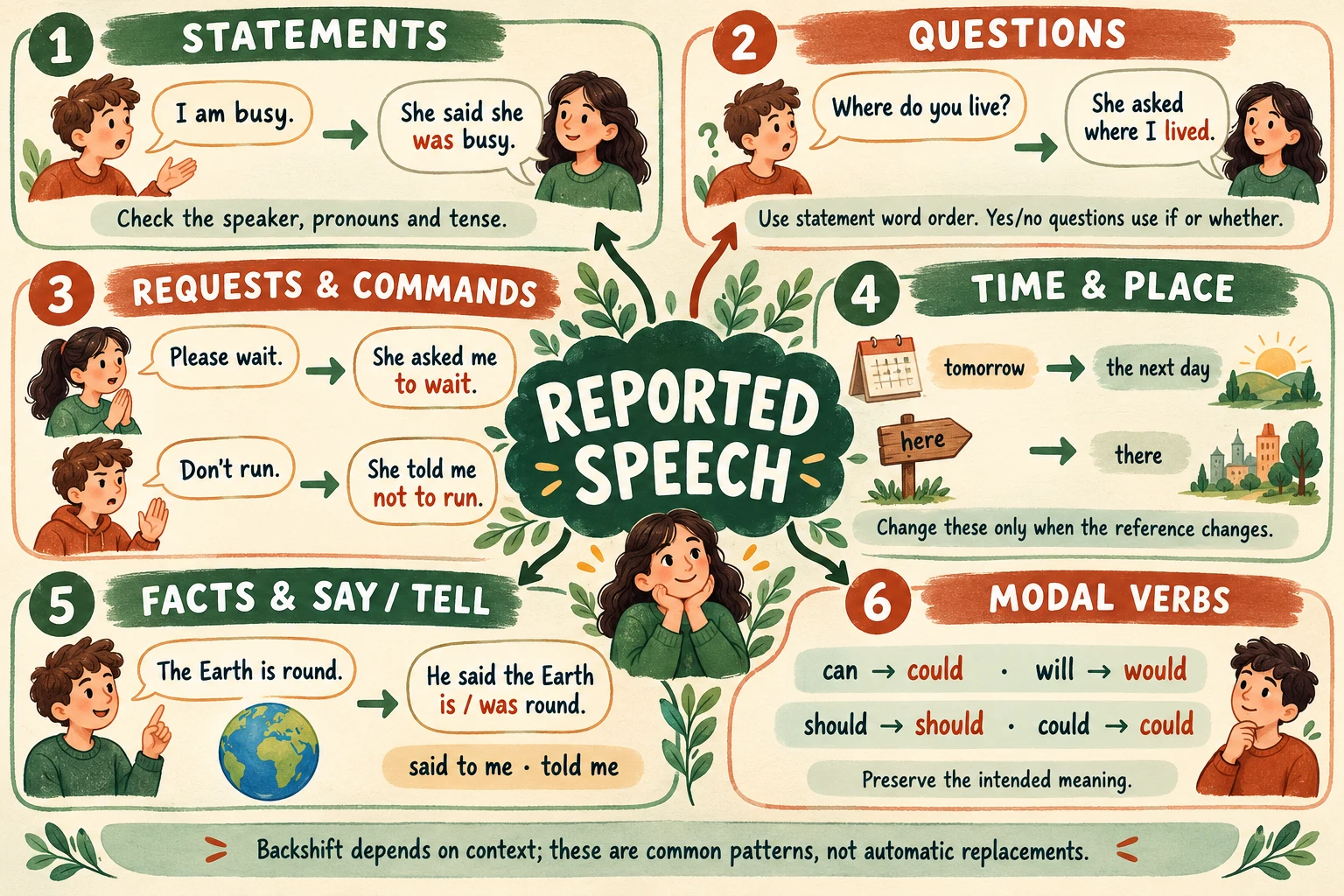
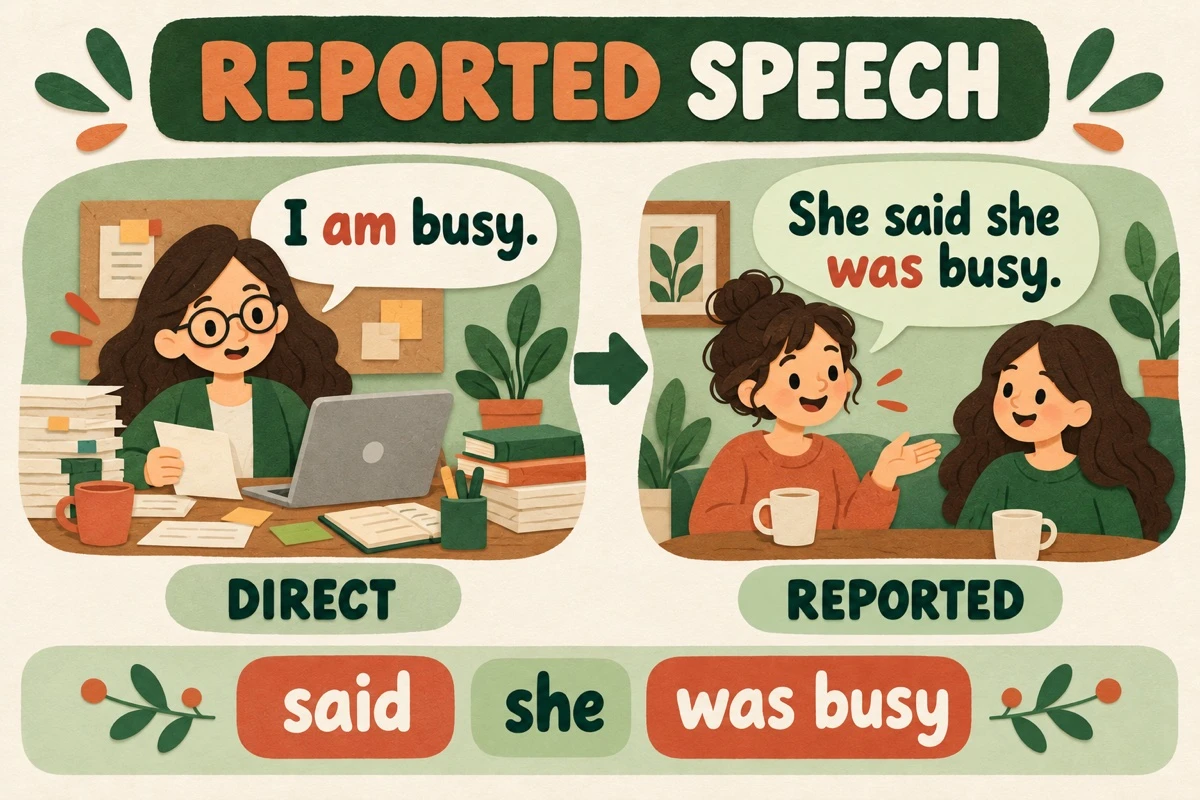
Für Aufgaben mit verlangter Zeitverschiebung: Simple Present → Simple Past; Present Continuous → Past Continuous; Present Perfect → Past Perfect; Simple Past → Past Perfect, wenn gefordert. Past Perfect bleibt normalerweise unverändert. Pronomen hängen davon ab, wer jetzt spricht und zuhört.

“I am busy.” → She said she was busy.
02Indirekte Fragen haben Aussagesatzstellung

Ergänzungsfrage: asked + Person + where/why/what time + Subjekt + Verb. Ja/Nein-Frage: asked + Person + if/whether + Subjekt + Verb. Entferne do/does/did, wenn es nur die direkte Frage bildet.

“Where do you live?” → She asked where I lived.

03Anweisungen mit einem Infinitiv wiedergeben

Bitte: asked + Person + to + Grundform. Anweisung: told + Person + to + Grundform. Verneinung: not to + Grundform. Auch to not + Grundform ist grammatisch. Eine höfliche Frage kann als Bitte dienen; bestimme vor der Musterwahl ihre Funktion.

“Please wait.” → She asked me to wait.

04Die tatsächliche Zeit und den Ort bewahren

Tomorrow kann zu the next/following day werden; yesterday zu the day before. Bei geändertem Bezug können here/these zu there/those werden. Das sind keine automatischen Ersetzungen. Ein genaues Datum oder ein ausdrücklicher Ort kann die Bedeutung ebenfalls erhalten.

tomorrow → the next day (when the time reference changes)

05Zeitverschiebung ist nicht immer zwingend

Bei einer weiterhin gültigen Tatsache können sowohl eine Präsensform als auch eine normale Zeitverschiebung korrekt sein. Ein berichtendes Verb im Präsens behält oft die gegenwärtige Perspektive. Verlangt eine Aufgabe eine Form, ist eine andere gültige Perspektive eine Aufgabenabweichung und nicht automatisch schlechtes Englisch. Say wird zu said (to somebody); tell zu told somebody, ohne to vor der Person.

“The Earth is round.” → He said the Earth is / was round.

06Die Bedeutung des Modalverbs bewahren

In normalen Vergangenheitsberichten wird can oft zu could und will zu would. Should, could, would und might bleiben normalerweise unverändert. Must für Verpflichtung kann zu had to werden und manchmal must bleiben. Must für eine Schlussfolgerung wird nicht mechanisch zu had to. May für Möglichkeit wird in einem Vergangenheitsbericht normalerweise zu might.

can → could · will → would · should → should

Illustrierte Übersicht

0/48
Aufgaben
01 / 48D01Speichere es für deine Sammlung.

On Monday, Ben (he) spoke to Maya. Maya is reporting his words on Tuesday, using normal past-time backshift.

“I am waiting for your email.”

Maya: Ben told me that ...

Deine Antwort
1 / 48

Dein Lernweg

01
Schritt 1 · Einstieg

Einstieg

0/6
02
Schritt 2 · Gezielt üben

Eine vergangene Perspektive wählen und Personen verfolgen

0/3

Für Aufgaben mit verlangter Zeitverschiebung: Simple Present → Simple Past; Present Continuous → Past Continuous; Present Perfect → Past Perfect; Simple Past → Past Perfect, wenn gefordert. Past Perfect bleibt normalerweise unverändert. Pronomen hängen davon ab, wer jetzt spricht und zuhört.

03
Schritt 3 · Gezielt üben

Indirekte Fragen haben Aussagesatzstellung

0/3

Ergänzungsfrage: asked + Person + where/why/what time + Subjekt + Verb. Ja/Nein-Frage: asked + Person + if/whether + Subjekt + Verb. Entferne do/does/did, wenn es nur die direkte Frage bildet.

04
Schritt 4 · Gezielt üben

Anweisungen mit einem Infinitiv wiedergeben

0/3

Bitte: asked + Person + to + Grundform. Anweisung: told + Person + to + Grundform. Verneinung: not to + Grundform. Auch to not + Grundform ist grammatisch. Eine höfliche Frage kann als Bitte dienen; bestimme vor der Musterwahl ihre Funktion.

05
Schritt 5 · Gezielt üben

Die tatsächliche Zeit und den Ort bewahren

0/3

Tomorrow kann zu the next/following day werden; yesterday zu the day before. Bei geändertem Bezug können here/these zu there/those werden. Das sind keine automatischen Ersetzungen. Ein genaues Datum oder ein ausdrücklicher Ort kann die Bedeutung ebenfalls erhalten.

06
Schritt 6 · Gezielt üben

Zeitverschiebung ist nicht immer zwingend

0/3

Bei einer weiterhin gültigen Tatsache können sowohl eine Präsensform als auch eine normale Zeitverschiebung korrekt sein. Ein berichtendes Verb im Präsens behält oft die gegenwärtige Perspektive. Verlangt eine Aufgabe eine Form, ist eine andere gültige Perspektive eine Aufgabenabweichung und nicht automatisch schlechtes Englisch. Say wird zu said (to somebody); tell zu told somebody, ohne to vor der Person.

07
Schritt 7 · Gezielt üben

Die Bedeutung des Modalverbs bewahren

0/3

In normalen Vergangenheitsberichten wird can oft zu could und will zu would. Should, could, would und might bleiben normalerweise unverändert. Must für Verpflichtung kann zu had to werden und manchmal must bleiben. Must für eine Schlussfolgerung wird nicht mechanisch zu had to. May für Möglichkeit wird in einem Vergangenheitsbericht normalerweise zu might.

08
Schritt 8 · Neue Situationen

Neue Situationen

0/16
09
Schritt 9 · Neue Herausforderung

Neue Herausforderung

0/8
Lernnotizen dieser Einheit

Aus Fehlern lernen.

Bewahre den ersten Versuch. Verstehe die Änderung. Prüfe sie in einer neuen Situation.

0

Noch keine Lernnotizen. Starte mit einem kurzen Einstieg.

Lernübersicht

Reported Speech

B1
Reported speech

Lektionspunkte

01

Eine vergangene Perspektive wählen und Personen verfolgen

Für Aufgaben mit verlangter Zeitverschiebung: Simple Present → Simple Past; Present Continuous → Past Continuous; Present Perfect → Past Perfect; Simple Past → Past Perfect, wenn gefordert. Past Perfect bleibt normalerweise unverändert. Pronomen hängen davon ab, wer jetzt spricht und zuhört.

02

Indirekte Fragen haben Aussagesatzstellung

Ergänzungsfrage: asked + Person + where/why/what time + Subjekt + Verb. Ja/Nein-Frage: asked + Person + if/whether + Subjekt + Verb. Entferne do/does/did, wenn es nur die direkte Frage bildet.

03

Anweisungen mit einem Infinitiv wiedergeben

Bitte: asked + Person + to + Grundform. Anweisung: told + Person + to + Grundform. Verneinung: not to + Grundform. Auch to not + Grundform ist grammatisch. Eine höfliche Frage kann als Bitte dienen; bestimme vor der Musterwahl ihre Funktion.

04

Die tatsächliche Zeit und den Ort bewahren

Tomorrow kann zu the next/following day werden; yesterday zu the day before. Bei geändertem Bezug können here/these zu there/those werden. Das sind keine automatischen Ersetzungen. Ein genaues Datum oder ein ausdrücklicher Ort kann die Bedeutung ebenfalls erhalten.

05

Zeitverschiebung ist nicht immer zwingend

Bei einer weiterhin gültigen Tatsache können sowohl eine Präsensform als auch eine normale Zeitverschiebung korrekt sein. Ein berichtendes Verb im Präsens behält oft die gegenwärtige Perspektive. Verlangt eine Aufgabe eine Form, ist eine andere gültige Perspektive eine Aufgabenabweichung und nicht automatisch schlechtes Englisch. Say wird zu said (to somebody); tell zu told somebody, ohne to vor der Person.

06

Die Bedeutung des Modalverbs bewahren

In normalen Vergangenheitsberichten wird can oft zu could und will zu would. Should, could, would und might bleiben normalerweise unverändert. Must für Verpflichtung kann zu had to werden und manchmal must bleiben. Must für eine Schlussfolgerung wird nicht mechanisch zu had to. May für Möglichkeit wird in einem Vergangenheitsbericht normalerweise zu might.

Fragen & Antworten

Das Öffnen einer Antwort wird für diese Aufgabe als Hilfe erfasst.

D01 · Einstieg

On Monday, Ben (he) spoke to Maya. Maya is reporting his words on Tuesday, using normal past-time backshift.

I am waiting for your email.

Maya: Ben told me that ...

  1. he was waiting for her email.
  2. I was waiting for his email.
  3. he had waited for my email.
  4. he was waiting for my email.
Antwort und Erklärung
he was waiting for my email.

Am waiting wird in der geforderten vergangenen Perspektive zu was waiting. Ben wird zu he; your email zu my email, weil jetzt Maya spricht.

D02 · Einstieg

A visitor asked this at the station yesterday. Report it using normal past-time backshift.

Where does the shuttle stop?

The visitor asked where ...

  1. the shuttle stopped.
  2. the shuttle had stopped.
  3. did the shuttle stop.
  4. the shuttle stops.
Antwort und Erklärung
the shuttle stopped.

Eine indirekte W-Frage behält where, hat aber Subjekt + Verb. Entferne does und verschiebe stops zu stopped.

D03 · Einstieg

A caretaker gave a group a negative instruction. Keep the negative meaning.

Don't move the boxes.

The caretaker told us ...

  1. to move the boxes.
  2. not move the boxes.
  3. don't move the boxes.
  4. not to move the boxes.
Antwort und Erklärung
not to move the boxes.

Eine verneinte Anweisung verwendet told + Person + not to + Grundform. Lass not nicht weg.

D04 · Einstieg

Lia (she) spoke on Monday 12 October. It is now Wednesday 14 October. Report her Monday plan with normal backshift.

I will send the file tomorrow.

On Monday, Lia said that ...

  1. she would send the file today.
  2. she had sent the file the following day.
  3. she would send the file the following day.
  4. she would send the file the following week.
Antwort und Erklärung
she would send the file the following day.

Tomorrow in der Montagsnachricht meint Dienstag, nicht den Mittwoch dieses Berichts. Will wird zu would. On Tuesday 13 October ist ebenfalls ein genauer Zeitbezug.

D05 · Einstieg

A guide said that the museum opens at ten. This timetable is still true. Compare Report 1: The guide said that the museum opens at ten. Report 2: The guide said that the museum opened at ten.

Which explanation is accurate?

  1. Report 2 proves that the museum no longer opens at ten.
  2. Both can be correct; Report 1 presents the timetable as still current.
  3. Only Report 2 is correct because every verb must change after said.
  4. Only Report 1 is correct because backshift is never allowed for facts.
Antwort und Erklärung
Both can be correct; Report 1 presents the timetable as still current.

Das Präsens opens kann eine weiterhin gültige Tatsache bewahren. Auch das zurückverschobene opened kann grammatisch sein. Opened allein beweist keine Änderung des Zeitplans.

D06 · Einstieg

Noah (he) spoke yesterday. Use normal past-time backshift to report his ability at that time.

I can repair the lock.

Noah said that ...

  1. he could repair the lock.
  2. he had to repair the lock.
  3. he can repair the lock.
  4. he would repair the lock.
Antwort und Erklärung
he could repair the lock.

Can wird zu could, wenn der verlangte Bericht auf seine damalige Fähigkeit zurückblickt. Had to würde Pflicht statt Fähigkeit ausdrücken.

P01 · Gezielt üben

Nia (she) made this statement last week while she still had the job. She has since left it. Report it using normal past-time backshift.

I work at weekends.

Nia said that ...

  1. she worked at weekends.
  2. I worked at weekends.
  3. she had worked at weekends.
  4. she works at weekends.
Antwort und Erklärung
she worked at weekends.

Work wird im vergangenen Bericht zu worked. Had worked fügt eine Vorvergangenheitsbeziehung hinzu, die diese Aussage im Simple Present nicht verlangt.

P02 · Gezielt üben

Ava (she) made this statement yesterday. Complete the report using the past perfect.

I have finished the survey.

Ava said that she ...

Antwort und Erklärung
had finished the survey.

Have finished wird zu had finished. Der vorgegebene Satzanfang enthält she bereits. Automatisch geprüft werden nur redaktionell kontrollierte Antworten. Eine andere grammatische Perspektive erfüllt diese Aufgabe eventuell nicht; unbekannte Formulierungen sind nicht automatisch falsch.

P03 · Gezielt üben

Omar (he) spoke to his colleague yesterday. For this exercise, backshift the past simple to the past perfect.

I left my keys at home.

Omar said that he ...

Antwort und Erklärung
had left his keys at home.

Gefordert sind left → had left und my → his. In manchen natürlichen Berichten kann das Simple Past bleiben; diese Aufgabe verlangt ausdrücklich das Past Perfect. Automatisch geprüft werden nur redaktionell kontrollierte Antworten. Eine andere grammatische Perspektive erfüllt diese Aufgabe eventuell nicht; unbekannte Formulierungen sind nicht automatisch falsch.

P04 · Gezielt üben

Mira (she) asked Dan this yesterday. Dan is reporting her question now. Use normal backshift.

Are you using my charger?

Dan: Mira asked me ...

Antwort und Erklärung
if I was using her charger.

Eine Ja/Nein-Frage braucht if oder whether. Verwende I was, nicht was I. My bezieht sich auf Mira und wird in Dans Bericht zu her. Automatisch geprüft werden nur redaktionell kontrollierte Antworten. Eine andere grammatische Perspektive erfüllt diese Aufgabe eventuell nicht; unbekannte Formulierungen sind nicht automatisch falsch.

Weitere gültige Antworten
  • whether I was using her charger.
  • if I was using Mira's charger.
  • whether I was using Mira's charger.
  • if I was using the charger she owned.
  • whether I was using the charger she owned.
  • whether or not I was using her charger.
  • whether or not I was using Mira's charger.
  • whether or not I was using the charger she owned.
P05 · Gezielt üben

Yesterday a coach asked Leo (he) about an earlier departure. Backshift did leave to had left.

Why did you leave early?

The coach asked Leo why ...

  1. he has left early.
  2. had he left early.
  3. if he had left early.
  4. he had left early.
Antwort und Erklärung
he had left early.

Die indirekte Frage hat he had left, nicht had he left. Der Trainer fragt nach einem Grund, daher muss why bleiben.

P06 · Gezielt üben

On Tuesday, Reece asked Ivy (she) about an earlier event. Ivy is reporting the question. Keep the original past perfect.

Had you seen the notice before Monday?

Ivy: Reece asked me ...

Antwort und Erklärung
whether I had seen the notice before Monday.

Verwende whether oder if und Aussagesatzstellung. Past Perfect bleibt normalerweise Past Perfect; es gibt keine weitere routinemäßige Zeitverschiebung. Automatisch geprüft werden nur redaktionell kontrollierte Antworten. Eine andere grammatische Perspektive erfüllt diese Aufgabe eventuell nicht; unbekannte Formulierungen sind nicht automatisch falsch.

Weitere gültige Antworten
  • if I had seen the notice before Monday.
  • whether I had seen the notice before that Monday.
  • if I had seen the notice before that Monday.
  • whether or not I had seen the notice before Monday.
  • whether or not I had seen the notice before that Monday.
P07 · Gezielt üben

A caretaker politely requested this of Max. Report the request with the infinitive construction after asked Max.

Please close the side gate.

The caretaker asked Max ...

Antwort und Erklärung
to close the side gate.

Eine Bitte wird mit asked + Person + to + Grundform wiedergegeben. Please wird häufig weggelassen, doch to please close the side gate ist ebenfalls natürlich höflich und wird anerkannt. Automatisch geprüft werden nur redaktionell kontrollierte Antworten. Eine andere grammatische Perspektive erfüllt diese Aufgabe eventuell nicht; unbekannte Formulierungen sind nicht automatisch falsch.

Weitere gültige Antworten
  • to please close the side gate.
  • to close the side gate, please.
P08 · Gezielt üben

Lina (she) asked Arun for his address. Arun is reporting her request with the infinitive construction after asked me.

Please email me your address.

Arun: Lina asked me ...

Antwort und Erklärung
to email her my address.

Me in Linas Worten meint Lina; your meint Arun. In Aruns Bericht werden daraus her und my. Automatisch geprüft werden nur redaktionell kontrollierte Antworten. Eine andere grammatische Perspektive erfüllt diese Aufgabe eventuell nicht; unbekannte Formulierungen sind nicht automatisch falsch.

Weitere gültige Antworten
  • to email Lina my address.
  • to email my address to her.
  • to email my address to Lina.
  • to please email her my address.
  • to email her my address, please.
P09 · Gezielt üben

A supervisor gave a negative instruction. Repair the reported sentence. Write the whole corrected sentence.

The supervisor told us to don't touch the switch.

Corrected report:

Antwort und Erklärung
The supervisor told us not to touch the switch.

Nach told us steht not to touch. Auch to not touch ist grammatisch und darf nicht als schlechtes Englisch bewertet werden. Automatisch geprüft werden nur redaktionell kontrollierte Antworten. Eine andere grammatische Perspektive erfüllt diese Aufgabe eventuell nicht; unbekannte Formulierungen sind nicht automatisch falsch.

Weitere gültige Antworten
  • The supervisor told us to not touch the switch.
P10 · Gezielt üben

On Tuesday, Ella (she) spoke to you at the library entrance. On Wednesday you report it from home. Use normal backshift; Friday is still the intended meeting day.

I will meet you here on Friday.

Ella said that ...

  1. she would meet me there on Friday.
  2. she would meet me there the next day.
  3. she had met me there on Friday.
  4. she would meet me here on Friday.
Antwort und Erklärung
she would meet me there on Friday.

Here wird zu there, weil der Bericht an einem anderen Ort erfolgt. Friday bleibt Friday: Der Bezug hat sich nicht geändert.

P11 · Gezielt üben

Finn (he) spoke to you on Monday 12 October. You report it on Wednesday 14 October. Use past perfect and keep the original event on Sunday 11 October.

I saw your tutor yesterday.

On Monday, Finn said that he ...

Antwort und Erklärung
had seen my tutor the day before.

Yesterday war aus Finns Montagsperspektive Sonntag. The day before oder ein ausdrücklich genanntes Sonntagsdatum bewahrt diesen Bezug. Automatisch geprüft werden nur redaktionell kontrollierte Antworten. Eine andere grammatische Perspektive erfüllt diese Aufgabe eventuell nicht; unbekannte Formulierungen sind nicht automatisch falsch.

Weitere gültige Antworten
  • had seen my tutor on Sunday 11 October.
  • had seen my tutor on Sunday.
  • had seen my tutor on 11 October.
  • had seen my tutor the previous day.
  • had seen my tutor on the day before.
P12 · Gezielt üben

An usher pointed at some seats in the theatre yesterday. You report it from home today. Use normal past-time backshift and identify the theatre seats without pretending you are pointing at them now.

These seats are reserved.

The usher said that ...

Antwort und Erklärung
those seats were reserved.

Those seats oder the seats bewahrt den Theaterbezug. Ein Perspektivwechsel kann these verändern; auch eine neutrale Nominalgruppe ist korrekt. Automatisch geprüft werden nur redaktionell kontrollierte Antworten. Eine andere grammatische Perspektive erfüllt diese Aufgabe eventuell nicht; unbekannte Formulierungen sind nicht automatisch falsch.

Weitere gültige Antworten
  • the seats were reserved.
  • the seats in the theatre were reserved.
  • those seats in the theatre were reserved.
P13 · Gezielt üben

A teacher said, "The school has a small library." The school still has it. You want to present that fact as current.

The school has a small library.

The teacher said that the school ...

Antwort und Erklärung
has a small library.

Has stellt die Tatsache als weiterhin aktuell dar. Had kann mit vergangener Perspektive ebenfalls grammatisch sein und bedeutet allein nicht, dass die Bibliothek verschwunden ist. Hier wird die gegenwärtige Perspektive verlangt. Automatisch geprüft werden nur redaktionell kontrollierte Antworten. Eine andere grammatische Perspektive erfüllt diese Aufgabe eventuell nicht; unbekannte Formulierungen sind nicht automatisch falsch.

P14 · Gezielt üben

Violet (she) is still on the bus and has just sent this message. Report it immediately with the present reporting verb says.

I am on the bus now.

Violet says that she ...

Antwort und Erklärung
is on the bus now.

Das berichtende Verb steht im Präsens, die Situation besteht noch. Daher gibt es hier keinen Grund, is zu was oder now zu then zu ändern. Automatisch geprüft werden nur redaktionell kontrollierte Antworten. Eine andere grammatische Perspektive erfüllt diese Aufgabe eventuell nicht; unbekannte Formulierungen sind nicht automatisch falsch.

Weitere gültige Antworten
  • is on the bus right now.
  • is on the bus at the moment.
P15 · Gezielt üben

Yesterday, Ben spoke to Jo. Jo is reporting it today. The pool’s timetable is still current. Choose a grammatical report.

The pool is closed on Mondays.

Jo's report:

  1. Ben told to me that the pool is closed on Mondays.
  2. Ben told that the pool is closed on Mondays.
  3. Ben said me that the pool was closed on Mondays.
  4. Ben told me that the pool was closed on Mondays.
Antwort und Erklärung
Ben told me that the pool was closed on Mondays.

Told braucht ein Zuhörerobjekt: told me. Said kann mit to me stehen, aber nicht direkt mit me. Told to me ist hier nicht das Standardmuster. Was closed ist eine gültige normale Zeitverschiebung, auch wenn der Zeitplan noch gilt.

P16 · Gezielt üben

Eli (he) made this promise yesterday. Use normal backshift.

I will help Nora.

Eli said that ...

  1. he would help Nora.
  2. he had helped Nora.
  3. he had to help Nora.
  4. he could help Nora.
Antwort und Erklärung
he would help Nora.

Would bewahrt das zukünftige Versprechen aus Elis damaliger Perspektive. Could macht daraus Fähigkeit oder Möglichkeit.

P17 · Gezielt üben

On Monday, Lena (she) described an obligation. You report it the following week, after the Friday deadline. Use had to in this exercise.

I must submit the form by Friday.

Lena said that she ...

Antwort und Erklärung
had to submit the form by that Friday.

Had to berichtet die vergangene Pflicht. That Friday macht die ursprüngliche Frist deutlich; by Friday ist im Kontext ebenfalls verständlich. Must kann in anderen Berichten bleiben, hier ist aber had to verlangt. Must für Schlussfolgerungen wird nicht mechanisch zu had to. Automatisch geprüft werden nur redaktionell kontrollierte Antworten. Eine andere grammatische Perspektive erfüllt diese Aufgabe eventuell nicht; unbekannte Formulierungen sind nicht automatisch falsch.

Weitere gültige Antworten
  • had to submit the form by Friday.
  • had to submit the form by the Friday of that week.
P18 · Gezielt üben

A tutor gave Iris this advice. Iris is reporting it.

You should save a copy.

Iris: The tutor said that I ...

Antwort und Erklärung
should save a copy.

Should bleibt bei wiedergegebenem Rat normalerweise should. Erfinde kein shoulded und mache aus dem Rat keine Pflicht. Automatisch geprüft werden nur redaktionell kontrollierte Antworten. Eine andere grammatische Perspektive erfüllt diese Aufgabe eventuell nicht; unbekannte Formulierungen sind nicht automatisch falsch.

R01 · Neue Situationen

Milo (he) spoke to Nia yesterday. Nia reports his words with normal past-time backshift.

I am taking your bike to the shop.

Nia: Milo told me that he ...

Antwort und Erklärung
was taking my bike to the shop.

Am taking wird zu was taking. Your meint Nia und wird zu my, wenn Nia berichtet. Dies prüft erneut den Wechsel des Possessivworts vom Zuhörer zum Berichtenden aus D01. Automatisch geprüft werden nur redaktionell kontrollierte Antworten. Eine andere grammatische Perspektive erfüllt diese Aufgabe eventuell nicht; unbekannte Formulierungen sind nicht automatisch falsch.

R02 · Neue Situationen

Rosa (she) spoke yesterday. Complete the report using the past perfect.

I have locked the door.

Rosa said that she ...

Antwort und Erklärung
had locked the door.

Have locked wird zu had locked. Die Bedeutung der abgeschlossenen Handlung bleibt erhalten. Automatisch geprüft werden nur redaktionell kontrollierte Antworten. Eine andere grammatische Perspektive erfüllt diese Aufgabe eventuell nicht; unbekannte Formulierungen sind nicht automatisch falsch.

R03 · Neue Situationen

An agent asked Iris (she) this yesterday. Iris reports it with normal backshift.

Where do you keep the tickets?

Iris: The agent asked me where ...

Antwort und Erklärung
I kept the tickets.

Where bleibt; die Wortfolge wird I kept. Do entfällt und keep wird zu kept zurückverschoben. Automatisch geprüft werden nur redaktionell kontrollierte Antworten. Eine andere grammatische Perspektive erfüllt diese Aufgabe eventuell nicht; unbekannte Formulierungen sind nicht automatisch falsch.

R04 · Neue Situationen

A tutor asked May this yesterday. May reports it. For this exercise, backshift the past simple to the past perfect.

Did you charge the tablet?

May: The tutor asked me ...

Antwort und Erklärung
if I had charged the tablet.

If oder whether leitet die Ja/Nein-Frage ein. Verwende I had charged, nicht had I charged. Automatisch geprüft werden nur redaktionell kontrollierte Antworten. Eine andere grammatische Perspektive erfüllt diese Aufgabe eventuell nicht; unbekannte Formulierungen sind nicht automatisch falsch.

Weitere gültige Antworten
  • whether I had charged the tablet.
  • whether I had charged the tablet or not.
  • if I had charged the tablet or not.
  • whether or not I had charged the tablet.
R05 · Neue Situationen

A coach made this request of Toby. Toby reports it with the infinitive construction after asked me.

Please bring your notebook.

Toby: The coach asked me ...

Antwort und Erklärung
to bring my notebook.

Verwende asked me to bring. Your meint Toby und wird in Tobys Bericht zu my. Höfliches please und bedeutungsgleiche Varianten mit bring along werden ebenfalls anerkannt. Automatisch geprüft werden nur redaktionell kontrollierte Antworten. Eine andere grammatische Perspektive erfüllt diese Aufgabe eventuell nicht; unbekannte Formulierungen sind nicht automatisch falsch.

Weitere gültige Antworten
  • to please bring my notebook.
  • to bring my notebook, please.
  • to bring along my notebook.
  • to bring my notebook along.
  • to bring my notebook along, please.
  • to bring along my notebook, please.
R06 · Neue Situationen

A ranger gave this instruction to your group. Keep the negative meaning.

Don't feed the birds.

The ranger told us ...

Antwort und Erklärung
not to feed the birds.

Verwende not to feed. Auch to not feed ist grammatisch, obwohl hier not to das hauptsächliche Lehrmuster ist. Automatisch geprüft werden nur redaktionell kontrollierte Antworten. Eine andere grammatische Perspektive erfüllt diese Aufgabe eventuell nicht; unbekannte Formulierungen sind nicht automatisch falsch.

Weitere gültige Antworten
  • to not feed the birds.
  • not to feed the birds, please.
R07 · Neue Situationen

Dana (she) spoke on Tuesday 3 November. You report it on Thursday 5 November with normal backshift. Preserve the planned return on Wednesday 4 November.

I will return tomorrow.

On Tuesday, Dana said that she ...

Antwort und Erklärung
would return the following day.

Tomorrow meinte Mittwoch. The following day, the next day oder das ausdrückliche Mittwochsdatum bewahrt den gemeinten Tag. Automatisch geprüft werden nur redaktionell kontrollierte Antworten. Eine andere grammatische Perspektive erfüllt diese Aufgabe eventuell nicht; unbekannte Formulierungen sind nicht automatisch falsch.

Weitere gültige Antworten
  • would return the next day.
  • would return on Wednesday 4 November.
  • would return on Wednesday.
  • would return on 4 November.
  • would return on the following day.
  • would return on the next day.
  • would return the day after she spoke.
R08 · Neue Situationen

On Monday, Kit (they) pointed at a desk in the office. On Tuesday you report it from home. Use the past perfect and preserve the office location without pretending you are still there.

I left the parcel here.

Kit said that they ...

Antwort und Erklärung
had left the parcel there.

Here im Büro wird von zu Hause aus zu there. At that desk ist ebenfalls ein genauer ausdrücklicher Bezug. Die verlangte Past-Perfect-Form ist had left. Automatisch geprüft werden nur redaktionell kontrollierte Antworten. Eine andere grammatische Perspektive erfüllt diese Aufgabe eventuell nicht; unbekannte Formulierungen sind nicht automatisch falsch.

Weitere gültige Antworten
  • had left the parcel at that desk.
  • had left the parcel at the desk in the office.
  • had left the parcel at the office desk.
R09 · Neue Situationen

Darius (he) said, "I work for a charity." He still has this job. Write two reports: one presenting the fact as current, and one using normal backshift.

I work for a charity.

Darius said that he ... [current] Darius said that he ... [backshifted]

Antwort und Erklärung
works for a charity. / worked for a charity.

Works stellt die Arbeit als aktuell dar; worked ist die vergangene Berichtsperspektive. Die Vergangenheitsform allein zeigt nicht, dass er die Hilfsorganisation verlassen hat. Automatisch geprüft werden nur redaktionell kontrollierte Antworten. Eine andere grammatische Perspektive erfüllt diese Aufgabe eventuell nicht; unbekannte Formulierungen sind nicht automatisch falsch.

R10 · Neue Situationen

The neighbour spoke to me yesterday. The cafe’s timetable is still current. A learner wrote: “The neighbour said me that the cafe is closed on Mondays.” Correct the whole report. Either a current or a normal past viewpoint is allowed.

The cafe is closed on Mondays.

Write the corrected full report.

Antwort und Erklärung
The neighbour told me that the cafe is closed on Mondays.

Verwende told me oder said to me; said me ist nicht das Standardmuster. Der aktuelle Zeitplan kann mit is closed oder dem normalen Rückschritt was closed berichtet werden. Beide bewahren hier die Bedeutung. Automatisch geprüft werden nur redaktionell kontrollierte Antworten. Eine andere grammatische Perspektive erfüllt diese Aufgabe eventuell nicht; unbekannte Formulierungen sind nicht automatisch falsch.

Weitere gültige Antworten
  • The neighbour told me that the cafe was closed on Mondays.
  • The neighbour told me the cafe is closed on Mondays.
  • The neighbour told me the cafe was closed on Mondays.
  • The neighbour said to me that the cafe is closed on Mondays.
  • The neighbour said to me that the cafe was closed on Mondays.
  • The neighbour said to me the cafe is closed on Mondays.
  • The neighbour said to me the cafe was closed on Mondays.
  • The neighbor told me that the cafe is closed on Mondays.
  • The neighbor told me that the cafe was closed on Mondays.
  • The neighbor told me the cafe is closed on Mondays.
  • The neighbor told me the cafe was closed on Mondays.
  • The neighbor said to me that the cafe is closed on Mondays.
  • The neighbor said to me that the cafe was closed on Mondays.
  • The neighbor said to me the cafe is closed on Mondays.
  • The neighbor said to me the cafe was closed on Mondays.
  • The neighbour told me that the café is closed on Mondays.
  • The neighbour told me that the café was closed on Mondays.
  • The neighbour told me the café is closed on Mondays.
  • The neighbour told me the café was closed on Mondays.
  • The neighbour said to me that the café is closed on Mondays.
  • The neighbour said to me that the café was closed on Mondays.
  • The neighbour said to me the café is closed on Mondays.
  • The neighbour said to me the café was closed on Mondays.
  • The neighbor told me that the café is closed on Mondays.
  • The neighbor told me that the café was closed on Mondays.
  • The neighbor told me the café is closed on Mondays.
  • The neighbor told me the café was closed on Mondays.
  • The neighbor said to me that the café is closed on Mondays.
  • The neighbor said to me that the café was closed on Mondays.
  • The neighbor said to me the café is closed on Mondays.
  • The neighbor said to me the café was closed on Mondays.
R11 · Neue Situationen

Ari (they) described an ability yesterday. Use normal past-time backshift.

I can carry the ladder.

Ari said that they ...

Antwort und Erklärung
could carry the ladder.

Can wird zu could, um die genannte Fähigkeit aus vergangener Perspektive zu berichten. Automatisch geprüft werden nur redaktionell kontrollierte Antworten. Eine andere grammatische Perspektive erfüllt diese Aufgabe eventuell nicht; unbekannte Formulierungen sind nicht automatisch falsch.

R12 · Neue Situationen

A tutor gave Zoe advice about a labelled folder. Zoe reports the advice.

You should check the label.

Zoe: The tutor said that I ...

Antwort und Erklärung
should check the label.

Should bleibt should, wenn Zoe den Rat berichtet. Automatisch geprüft werden nur redaktionell kontrollierte Antworten. Eine andere grammatische Perspektive erfüllt diese Aufgabe eventuell nicht; unbekannte Formulierungen sind nicht automatisch falsch.

R13 · Neue Situationen

Omar (he) made this promise to Rae yesterday. Rae reports it using normal backshift.

I will check your figures.

Rae: Omar said that he ...

Antwort und Erklärung
would check my figures.

Will wird zu would, um das frühere Versprechen zu berichten. Your meint Rae, daher sagt Rae my. Dies ist eine neue Reparaturaufgabe zu P16. Automatisch geprüft werden nur redaktionell kontrollierte Antworten. Eine andere grammatische Perspektive erfüllt diese Aufgabe eventuell nicht; unbekannte Formulierungen sind nicht automatisch falsch.

R14 · Neue Situationen

Alma (she) spoke on Friday about the following Tuesday’s deadline. You report it on the Wednesday after that deadline. Report the past obligation and preserve that original Tuesday.

I must return the key by Tuesday.

Alma said that she ...

Antwort und Erklärung
had to return the key by that Tuesday.

Had to bewahrt die vergangene Pflicht; that Tuesday nennt die Frist nach Almas Freitagsäußerung. Dies ist ein neuer Pflicht-und-Frist-Kontext zu P17. Automatisch geprüft werden nur redaktionell kontrollierte Antworten. Eine andere grammatische Perspektive erfüllt diese Aufgabe eventuell nicht; unbekannte Formulierungen sind nicht automatisch falsch.

Weitere gültige Antworten
  • had to return the key by the Tuesday after she spoke.
  • had to return the key by Tuesday.
  • had to return the key by the following Tuesday.
R15 · Neue Situationen

On Tuesday, Jay asked Robin about an earlier event. Robin reports the question. Keep the past perfect that is already in the original question.

Had you read the message before Monday?

Robin: Jay asked me ...

Antwort und Erklärung
if I had read the message before Monday.

Das Original enthält bereits had read. Behalte es, ergänze if oder whether und verwende Aussagesatzstellung: I had read, nicht had I read. Automatisch geprüft werden nur redaktionell kontrollierte Antworten. Eine andere grammatische Perspektive erfüllt diese Aufgabe eventuell nicht; unbekannte Formulierungen sind nicht automatisch falsch.

Weitere gültige Antworten
  • whether I had read the message before Monday.
  • if I had read the message before that Monday.
  • whether I had read the message before that Monday.
  • whether or not I had read the message before Monday.
  • whether or not I had read the message before that Monday.
R16 · Neue Situationen

Elena (she) has just sent this message and is still in the library. Report it immediately with the present reporting verb says.

I am in the library now.

Elena says that she ...

Antwort und Erklärung
is in the library now.

Says ist ein berichtendes Verb im Präsens und Elena ist noch dort. Behalte is und now. Die neue Aufgabe prüft gezielt P14 statt eines anderen Musters mit vergangenem Berichtsverb. Automatisch geprüft werden nur redaktionell kontrollierte Antworten. Eine andere grammatische Perspektive erfüllt diese Aufgabe eventuell nicht; unbekannte Formulierungen sind nicht automatisch falsch.

Weitere gültige Antworten
  • is in the library right now.
  • is in the library at the moment.
X01 · Neue Herausforderung

Noor (she) spoke to Cal yesterday. Cal reports her statement now using normal past-time backshift.

I have printed your map.

Cal: Noor said that she ...

Antwort und Erklärung
had printed my map.

Have printed wird zu had printed; your map meint Cal und wird in Cals Bericht zu my map. Automatisch geprüft werden nur redaktionell kontrollierte Antworten. Eine andere grammatische Perspektive erfüllt diese Aufgabe eventuell nicht; unbekannte Formulierungen sind nicht automatisch falsch.

X02 · Neue Herausforderung

A receptionist asked a visitor (he) this yesterday. Use normal backshift.

What time does your train arrive?

The receptionist asked the visitor what time ...

  1. his train had arrived.
  2. did his train arrive.
  3. his train arrived.
  4. your train arrived.
Antwort und Erklärung
his train arrived.

Nach what time steht his train arrived. Behalte weder does noch die direkte Fragewortstellung.

X03 · Neue Herausforderung

Yesterday, Sam asked Alex (they) about an earlier document check. Alex reports it now. In this exercise, backshift the past simple to the past perfect.

Did you check the dates?

Alex: Sam asked me ...

Antwort und Erklärung
whether I had checked the dates.

If und whether sind beide gültig. Das verlangte Past Perfect lautet I had checked; es bleibt keine Frageinversion. Automatisch geprüft werden nur redaktionell kontrollierte Antworten. Eine andere grammatische Perspektive erfüllt diese Aufgabe eventuell nicht; unbekannte Formulierungen sind nicht automatisch falsch.

Weitere gültige Antworten
  • if I had checked the dates.
  • whether I had checked the dates or not.
  • if I had checked the dates or not.
  • whether or not I had checked the dates.
X04 · Neue Herausforderung

A manager gave a group this instruction. Report the negative instruction.

Don't leave the window open.

The manager told us ...

Antwort und Erklärung
not to leave the window open.

Bewahre not und verwende nach told us einen Infinitiv. Auch to not leave ist grammatisch. Automatisch geprüft werden nur redaktionell kontrollierte Antworten. Eine andere grammatische Perspektive erfüllt diese Aufgabe eventuell nicht; unbekannte Formulierungen sind nicht automatisch falsch.

Weitere gültige Antworten
  • to not leave the window open.
X05 · Neue Herausforderung

On Thursday, Ada (she) spoke to you at the sports centre. On Saturday you report it from home. The planned event is Friday. Use normal backshift.

I will wait for you here tomorrow.

On Thursday, Ada said that ...

Antwort und Erklärung
she would wait for me there the following day.

Here meint das Sportzentrum; tomorrow meint Freitag relativ zu den Worten vom Donnerstag. The next day oder on Friday bewahrt ebenfalls das Datum. Automatisch geprüft werden nur redaktionell kontrollierte Antworten. Eine andere grammatische Perspektive erfüllt diese Aufgabe eventuell nicht; unbekannte Formulierungen sind nicht automatisch falsch.

Weitere gültige Antworten
  • she would wait for me there the next day.
  • she would wait for me there on Friday.
  • she would wait for me at the sports centre on Friday.
  • she would wait for me at the sports centre the following day.
  • she would wait for me at the sports centre the next day.
  • she would wait for me there on the Friday after she spoke.
X06 · Neue Herausforderung

A guide told you that the community hall has two exits. Both exits are still there. Pass this information to a friend who is visiting today. A current or a backshifted viewpoint is acceptable.

The community hall has two exits.

The guide said that the community hall ...

Antwort und Erklärung
has two exits.

Has stellt die Information als aktuell dar. Auch had ist eine gültige zurückverschobene Wiedergabe und bedeutet nicht, dass ein Ausgang verschwunden ist. Beide bewahren die gegebene Tatsache. Automatisch geprüft werden nur redaktionell kontrollierte Antworten. Eine andere grammatische Perspektive erfüllt diese Aufgabe eventuell nicht; unbekannte Formulierungen sind nicht automatisch falsch.

Weitere gültige Antworten
  • had two exits.
X07 · Neue Herausforderung

Pavel (he) spoke to a colleague yesterday about a meeting. Report both parts with normal past-time backshift, keeping the ability and possibility meanings.

I can explain the route, but I may arrive late.

Pavel said that he ...

Antwort und Erklärung
could explain the route, but he might arrive late.

Can wird für Fähigkeit zu could; may für Möglichkeit wird in diesem vergangenen Bericht zu might. Bewahre den Gegensatz mit but. He darf im zweiten Teilsatz wiederholt oder weggelassen werden, weil Pavel bei beiden Handlungen das Subjekt ist. Automatisch geprüft werden nur redaktionell kontrollierte Antworten. Eine andere grammatische Perspektive erfüllt diese Aufgabe eventuell nicht; unbekannte Formulierungen sind nicht automatisch falsch.

Weitere gültige Antworten
  • could explain the route but he might arrive late.
  • could explain the route, but might arrive late.
  • could explain the route but might arrive late.
X08 · Neue Herausforderung

Optional extension. A designer proposed an action for the whole team. Report the suggestion rather than quoting Let's.

Let's use a larger label.

The designer suggested ...

Antwort und Erklärung
using a larger label.

Suggested + -ing und suggested that + Teilsatz können beide den Vorschlag wiedergeben. Suggested us to use ist hier nicht das passende Muster. Diese Einzelaufgabe ist eine Erweiterung, kein Nachweis für B2. Automatisch geprüft werden nur redaktionell kontrollierte Antworten. Eine andere grammatische Perspektive erfüllt diese Aufgabe eventuell nicht; unbekannte Formulierungen sind nicht automatisch falsch.

Weitere gültige Antworten
  • that we use a larger label.
  • that we should use a larger label.
  • we use a larger label.
  • we should use a larger label.
  • our using a larger label.
  • that the team use a larger label.
  • that the team should use a larger label.