
B1

Reported speech: exercícios

Sobre esta lição

Reported speech · B1. Nas tarefas que pedem recuo temporal: presente simples → passado simples; presente contínuo → passado contínuo; present perfect → past perfect; passado simples → past perfect quando solicitado. O past perfect normalmente se mantém. Os pronomes dependem de quem fala e ouve agora.

Mantenha o sentido ao relatar afirmações, perguntas e instruções de outra perspectiva.

48 questões
Salve para encontrar em Minha coleção.
Mapa de conceitos

Reported speech

Começar a praticar
Reported speech — Mapa de conceitos

01Escolha uma perspectiva passada e acompanhe as pessoas

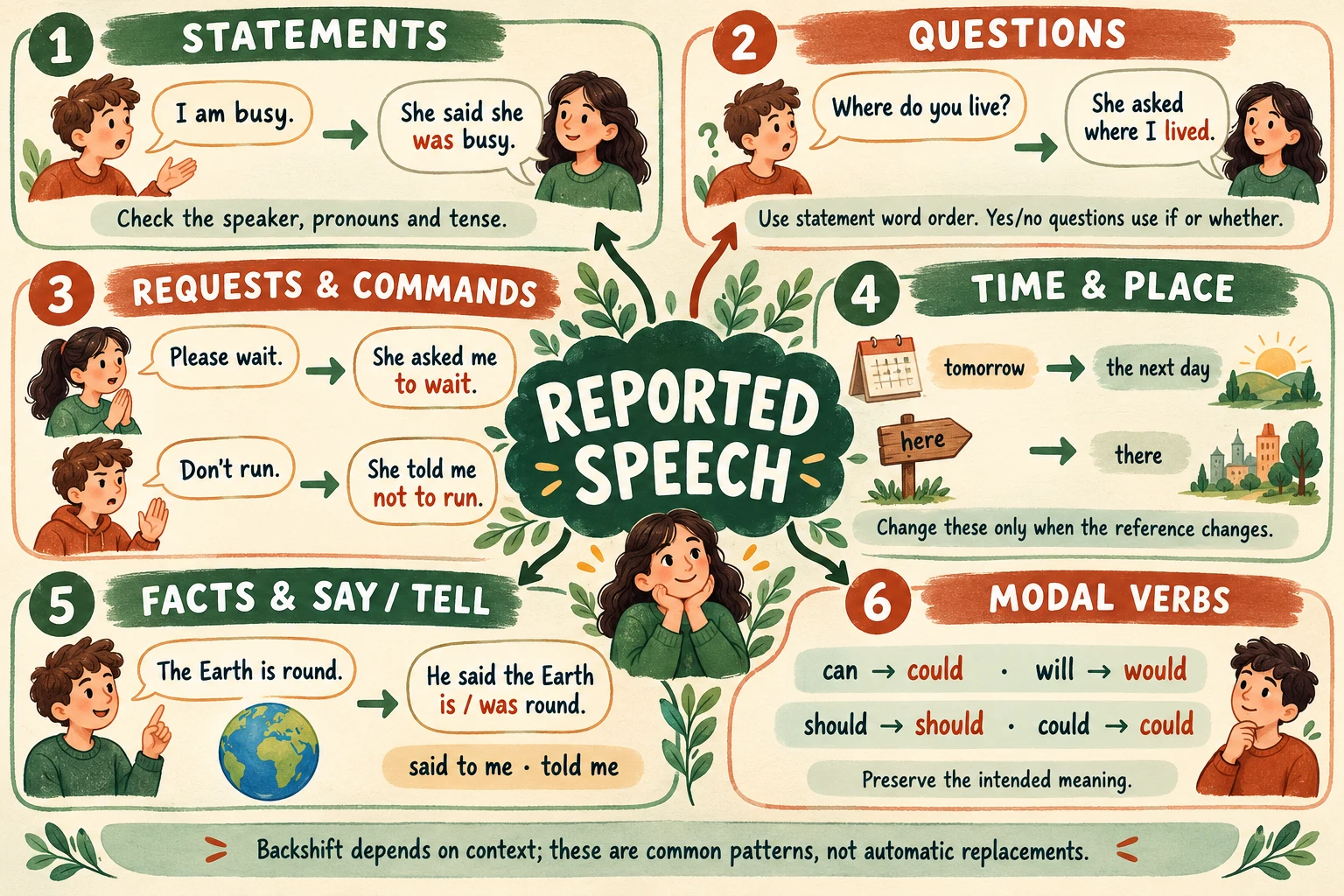
Nas tarefas que pedem recuo temporal: presente simples → passado simples; presente contínuo → passado contínuo; present perfect → past perfect; passado simples → past perfect quando solicitado. O past perfect normalmente se mantém. Os pronomes dependem de quem fala e ouve agora.

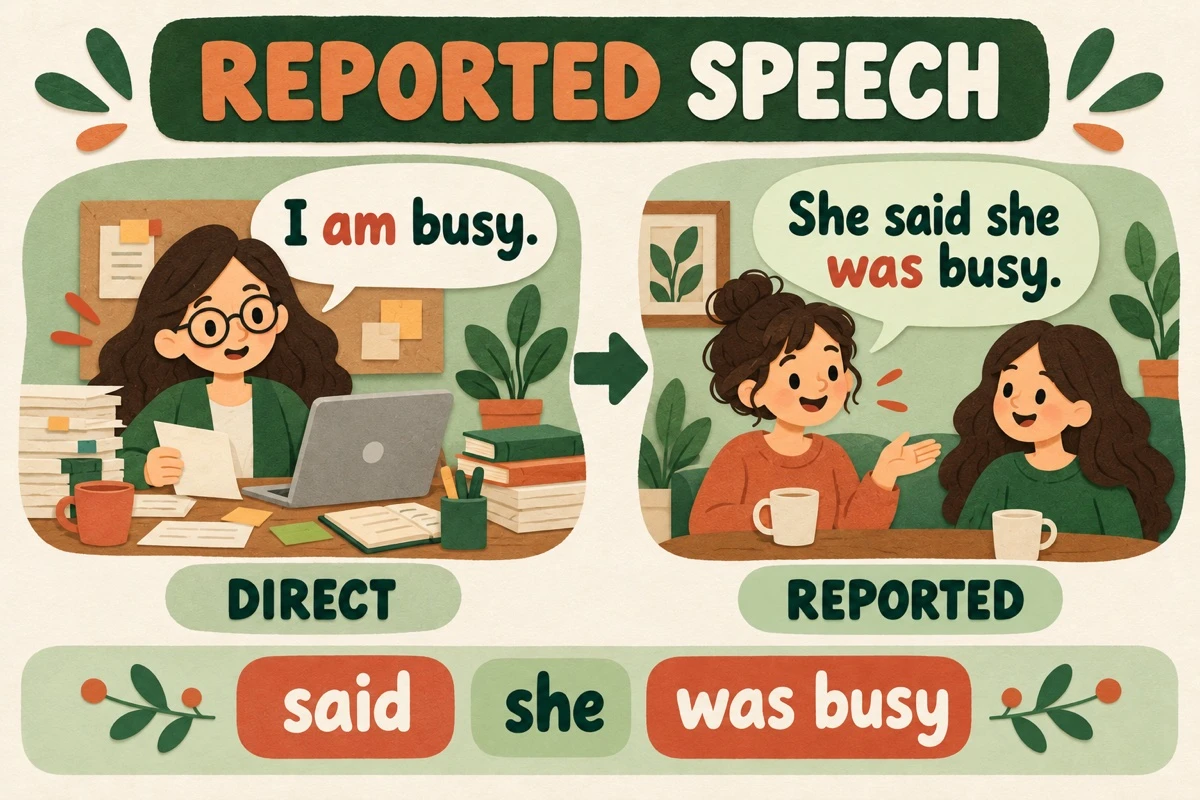
“I am busy.” → She said she was busy.
02Perguntas indiretas usam a ordem de uma afirmação

Pergunta com palavra interrogativa: asked + pessoa + where/why/what time + sujeito + verbo. Pergunta de sim ou não: asked + pessoa + if/whether + sujeito + verbo. Retire do/does/did usados apenas para formar a pergunta direta.

“Where do you live?” → She asked where I lived.

03Relate instruções com infinitivo

Pedido: asked + pessoa + to + forma base. Instrução: told + pessoa + to + forma base. Negativa: not to + forma base. To not + forma base também é gramatical. Uma pergunta educada pode funcionar como pedido; identifique a função antes de escolher a estrutura.

“Please wait.” → She asked me to wait.

04Preserve o tempo e o lugar reais

Tomorrow pode virar the next/following day; yesterday, the day before. Here/these podem precisar virar there/those quando a referência muda. Não são trocas automáticas. Uma data ou um lugar explícitos também podem preservar o sentido.

tomorrow → the next day (when the time reference changes)

05O recuo temporal nem sempre é obrigatório

Para um fato ainda verdadeiro, tanto uma forma presente quanto o recuo temporal normal podem estar corretos. Um verbo introdutor no presente costuma manter a perspectiva atual. Se a tarefa pede uma forma, outra perspectiva válida foge da instrução, mas não é automaticamente inglês incorreto. Say passa a said (to somebody); tell, a told somebody, sem to antes da pessoa.

“The Earth is round.” → He said the Earth is / was round.

06Preserve o sentido do verbo modal

Em relatos comuns no passado, can costuma virar could e will, would. Should, could, would e might normalmente não mudam. Must de obrigação pode virar had to e às vezes permanecer must. Must de dedução não é convertido mecanicamente em had to. May de possibilidade normalmente vira might em um relato passado.

can → could · will → would · should → should

Guia ilustrado

0/48
Questões
01 / 48D01Salve para encontrar em Minha coleção.

On Monday, Ben (he) spoke to Maya. Maya is reporting his words on Tuesday, using normal past-time backshift.

“I am waiting for your email.”

Maya: Ben told me that ...

Sua resposta
1 / 48

Seu caminho de aprendizagem

01
Etapa 1 · Aquecimento

Aquecimento

0/6
02
Etapa 2 · Praticar a habilidade

Escolha uma perspectiva passada e acompanhe as pessoas

0/3

Nas tarefas que pedem recuo temporal: presente simples → passado simples; presente contínuo → passado contínuo; present perfect → past perfect; passado simples → past perfect quando solicitado. O past perfect normalmente se mantém. Os pronomes dependem de quem fala e ouve agora.

03
Etapa 3 · Praticar a habilidade

Perguntas indiretas usam a ordem de uma afirmação

0/3

Pergunta com palavra interrogativa: asked + pessoa + where/why/what time + sujeito + verbo. Pergunta de sim ou não: asked + pessoa + if/whether + sujeito + verbo. Retire do/does/did usados apenas para formar a pergunta direta.

04
Etapa 4 · Praticar a habilidade

Relate instruções com infinitivo

0/3

Pedido: asked + pessoa + to + forma base. Instrução: told + pessoa + to + forma base. Negativa: not to + forma base. To not + forma base também é gramatical. Uma pergunta educada pode funcionar como pedido; identifique a função antes de escolher a estrutura.

05
Etapa 5 · Praticar a habilidade

Preserve o tempo e o lugar reais

0/3

Tomorrow pode virar the next/following day; yesterday, the day before. Here/these podem precisar virar there/those quando a referência muda. Não são trocas automáticas. Uma data ou um lugar explícitos também podem preservar o sentido.

06
Etapa 6 · Praticar a habilidade

O recuo temporal nem sempre é obrigatório

0/3

Para um fato ainda verdadeiro, tanto uma forma presente quanto o recuo temporal normal podem estar corretos. Um verbo introdutor no presente costuma manter a perspectiva atual. Se a tarefa pede uma forma, outra perspectiva válida foge da instrução, mas não é automaticamente inglês incorreto. Say passa a said (to somebody); tell, a told somebody, sem to antes da pessoa.

07
Etapa 7 · Praticar a habilidade

Preserve o sentido do verbo modal

0/3

Em relatos comuns no passado, can costuma virar could e will, would. Should, could, would e might normalmente não mudam. Must de obrigação pode virar had to e às vezes permanecer must. Must de dedução não é convertido mecanicamente em had to. May de possibilidade normalmente vira might em um relato passado.

08
Etapa 8 · Novos contextos

Novos contextos

0/16
09
Etapa 9 · Um novo desafio

Um novo desafio

0/8
Revisões desta unidade

Transforme erros em aprendizado.

Guarde a primeira tentativa, entenda a mudança e confira em outra situação.

0

Ainda não há revisões. Faça um aquecimento curto.

Mapa da aula

Reported speech

B1
Reported speech

Pontos da aula

01

Escolha uma perspectiva passada e acompanhe as pessoas

Nas tarefas que pedem recuo temporal: presente simples → passado simples; presente contínuo → passado contínuo; present perfect → past perfect; passado simples → past perfect quando solicitado. O past perfect normalmente se mantém. Os pronomes dependem de quem fala e ouve agora.

02

Perguntas indiretas usam a ordem de uma afirmação

Pergunta com palavra interrogativa: asked + pessoa + where/why/what time + sujeito + verbo. Pergunta de sim ou não: asked + pessoa + if/whether + sujeito + verbo. Retire do/does/did usados apenas para formar a pergunta direta.

03

Relate instruções com infinitivo

Pedido: asked + pessoa + to + forma base. Instrução: told + pessoa + to + forma base. Negativa: not to + forma base. To not + forma base também é gramatical. Uma pergunta educada pode funcionar como pedido; identifique a função antes de escolher a estrutura.

04

Preserve o tempo e o lugar reais

Tomorrow pode virar the next/following day; yesterday, the day before. Here/these podem precisar virar there/those quando a referência muda. Não são trocas automáticas. Uma data ou um lugar explícitos também podem preservar o sentido.

05

O recuo temporal nem sempre é obrigatório

Para um fato ainda verdadeiro, tanto uma forma presente quanto o recuo temporal normal podem estar corretos. Um verbo introdutor no presente costuma manter a perspectiva atual. Se a tarefa pede uma forma, outra perspectiva válida foge da instrução, mas não é automaticamente inglês incorreto. Say passa a said (to somebody); tell, a told somebody, sem to antes da pessoa.

06

Preserve o sentido do verbo modal

Em relatos comuns no passado, can costuma virar could e will, would. Should, could, would e might normalmente não mudam. Must de obrigação pode virar had to e às vezes permanecer must. Must de dedução não é convertido mecanicamente em had to. May de possibilidade normalmente vira might em um relato passado.

Perguntas e respostas

Abrir uma resposta registra ajuda para essa questão.

D01 · Aquecimento

On Monday, Ben (he) spoke to Maya. Maya is reporting his words on Tuesday, using normal past-time backshift.

I am waiting for your email.

Maya: Ben told me that ...

  1. he was waiting for her email.
  2. I was waiting for his email.
  3. he had waited for my email.
  4. he was waiting for my email.
Resposta e explicação
he was waiting for my email.

Am waiting vira was waiting na perspectiva passada pedida. Ben vira he; your email vira my email porque Maya fala agora.

D02 · Aquecimento

A visitor asked this at the station yesterday. Report it using normal past-time backshift.

Where does the shuttle stop?

The visitor asked where ...

  1. the shuttle stopped.
  2. the shuttle had stopped.
  3. did the shuttle stop.
  4. the shuttle stops.
Resposta e explicação
the shuttle stopped.

Uma pergunta indireta com palavra interrogativa mantém where, mas usa sujeito + verbo. Retire does e recue stops para stopped.

D03 · Aquecimento

A caretaker gave a group a negative instruction. Keep the negative meaning.

Don't move the boxes.

The caretaker told us ...

  1. to move the boxes.
  2. not move the boxes.
  3. don't move the boxes.
  4. not to move the boxes.
Resposta e explicação
not to move the boxes.

Uma instrução negativa usa told + pessoa + not to + forma base. Não retire not.

D04 · Aquecimento

Lia (she) spoke on Monday 12 October. It is now Wednesday 14 October. Report her Monday plan with normal backshift.

I will send the file tomorrow.

On Monday, Lia said that ...

  1. she would send the file today.
  2. she had sent the file the following day.
  3. she would send the file the following day.
  4. she would send the file the following week.
Resposta e explicação
she would send the file the following day.

Tomorrow na mensagem de segunda-feira significa terça-feira, não a quarta-feira do relato. Will vira would. On Tuesday 13 October também é uma referência temporal correta.

D05 · Aquecimento

A guide said that the museum opens at ten. This timetable is still true. Compare Report 1: The guide said that the museum opens at ten. Report 2: The guide said that the museum opened at ten.

Which explanation is accurate?

  1. Report 2 proves that the museum no longer opens at ten.
  2. Both can be correct; Report 1 presents the timetable as still current.
  3. Only Report 2 is correct because every verb must change after said.
  4. Only Report 1 is correct because backshift is never allowed for facts.
Resposta e explicação
Both can be correct; Report 1 presents the timetable as still current.

O presente opens pode preservar um fato ainda verdadeiro. Opened com recuo temporal também pode ser gramatical. Opened sozinho não prova que o horário mudou.

D06 · Aquecimento

Noah (he) spoke yesterday. Use normal past-time backshift to report his ability at that time.

I can repair the lock.

Noah said that ...

  1. he could repair the lock.
  2. he had to repair the lock.
  3. he can repair the lock.
  4. he would repair the lock.
Resposta e explicação
he could repair the lock.

Can vira could quando o relato pedido olha para a capacidade naquele momento. Had to expressaria obrigação, não capacidade.

P01 · Praticar a habilidade

Nia (she) made this statement last week while she still had the job. She has since left it. Report it using normal past-time backshift.

I work at weekends.

Nia said that ...

  1. she worked at weekends.
  2. I worked at weekends.
  3. she had worked at weekends.
  4. she works at weekends.
Resposta e explicação
she worked at weekends.

Work vira worked no relato passado. Had worked acrescenta uma relação de passado anterior que esta afirmação no presente simples não exige.

P02 · Praticar a habilidade

Ava (she) made this statement yesterday. Complete the report using the past perfect.

I have finished the survey.

Ava said that she ...

Resposta e explicação
had finished the survey.

Have finished vira had finished. O início da frase já traz she. Só respostas revisadas são verificadas automaticamente. Outra perspectiva gramatical pode não cumprir esta tarefa, mas uma formulação desconhecida não está automaticamente errada.

P03 · Praticar a habilidade

Omar (he) spoke to his colleague yesterday. For this exercise, backshift the past simple to the past perfect.

I left my keys at home.

Omar said that he ...

Resposta e explicação
had left his keys at home.

A transformação pedida é left → had left e my → his. O passado simples pode permanecer em alguns relatos naturais; esta tarefa pede explicitamente past perfect. Só respostas revisadas são verificadas automaticamente. Outra perspectiva gramatical pode não cumprir esta tarefa, mas uma formulação desconhecida não está automaticamente errada.

P04 · Praticar a habilidade

Mira (she) asked Dan this yesterday. Dan is reporting her question now. Use normal backshift.

Are you using my charger?

Dan: Mira asked me ...

Resposta e explicação
if I was using her charger.

Uma pergunta de sim ou não precisa de if ou whether. Use I was, não was I. My se refere a Mira e vira her no relato de Dan. Só respostas revisadas são verificadas automaticamente. Outra perspectiva gramatical pode não cumprir esta tarefa, mas uma formulação desconhecida não está automaticamente errada.

Outras respostas aceitas
  • whether I was using her charger.
  • if I was using Mira's charger.
  • whether I was using Mira's charger.
  • if I was using the charger she owned.
  • whether I was using the charger she owned.
  • whether or not I was using her charger.
  • whether or not I was using Mira's charger.
  • whether or not I was using the charger she owned.
P05 · Praticar a habilidade

Yesterday a coach asked Leo (he) about an earlier departure. Backshift did leave to had left.

Why did you leave early?

The coach asked Leo why ...

  1. he has left early.
  2. had he left early.
  3. if he had left early.
  4. he had left early.
Resposta e explicação
he had left early.

A pergunta indireta usa he had left, não had he left. O treinador pede uma razão, por isso why deve permanecer.

P06 · Praticar a habilidade

On Tuesday, Reece asked Ivy (she) about an earlier event. Ivy is reporting the question. Keep the original past perfect.

Had you seen the notice before Monday?

Ivy: Reece asked me ...

Resposta e explicação
whether I had seen the notice before Monday.

Use whether ou if e a ordem de uma afirmação. O past perfect normalmente permanece; não há outro recuo temporal de rotina. Só respostas revisadas são verificadas automaticamente. Outra perspectiva gramatical pode não cumprir esta tarefa, mas uma formulação desconhecida não está automaticamente errada.

Outras respostas aceitas
  • if I had seen the notice before Monday.
  • whether I had seen the notice before that Monday.
  • if I had seen the notice before that Monday.
  • whether or not I had seen the notice before Monday.
  • whether or not I had seen the notice before that Monday.
P07 · Praticar a habilidade

A caretaker politely requested this of Max. Report the request with the infinitive construction after asked Max.

Please close the side gate.

The caretaker asked Max ...

Resposta e explicação
to close the side gate.

Um pedido é relatado com asked + pessoa + to + forma base. Please costuma ser omitido, mas to please close the side gate também é uma forma educada natural e recebe crédito. Só respostas revisadas são verificadas automaticamente. Outra perspectiva gramatical pode não cumprir esta tarefa, mas uma formulação desconhecida não está automaticamente errada.

Outras respostas aceitas
  • to please close the side gate.
  • to close the side gate, please.
P08 · Praticar a habilidade

Lina (she) asked Arun for his address. Arun is reporting her request with the infinitive construction after asked me.

Please email me your address.

Arun: Lina asked me ...

Resposta e explicação
to email her my address.

Me nas palavras de Lina se refere a Lina; your se refere a Arun. No relato de Arun, viram her e my. Só respostas revisadas são verificadas automaticamente. Outra perspectiva gramatical pode não cumprir esta tarefa, mas uma formulação desconhecida não está automaticamente errada.

Outras respostas aceitas
  • to email Lina my address.
  • to email my address to her.
  • to email my address to Lina.
  • to please email her my address.
  • to email her my address, please.
P09 · Praticar a habilidade

A supervisor gave a negative instruction. Repair the reported sentence. Write the whole corrected sentence.

The supervisor told us to don't touch the switch.

Corrected report:

Resposta e explicação
The supervisor told us not to touch the switch.

Depois de told us, use not to touch. To not touch também é gramatical e não deve ser marcado como inglês incorreto. Só respostas revisadas são verificadas automaticamente. Outra perspectiva gramatical pode não cumprir esta tarefa, mas uma formulação desconhecida não está automaticamente errada.

Outras respostas aceitas
  • The supervisor told us to not touch the switch.
P10 · Praticar a habilidade

On Tuesday, Ella (she) spoke to you at the library entrance. On Wednesday you report it from home. Use normal backshift; Friday is still the intended meeting day.

I will meet you here on Friday.

Ella said that ...

  1. she would meet me there on Friday.
  2. she would meet me there the next day.
  3. she had met me there on Friday.
  4. she would meet me here on Friday.
Resposta e explicação
she would meet me there on Friday.

Here vira there porque o relato é feito em outro lugar. Friday continua Friday: a referência não mudou.

P11 · Praticar a habilidade

Finn (he) spoke to you on Monday 12 October. You report it on Wednesday 14 October. Use past perfect and keep the original event on Sunday 11 October.

I saw your tutor yesterday.

On Monday, Finn said that he ...

Resposta e explicação
had seen my tutor the day before.

Yesterday era domingo em relação às palavras de Finn na segunda-feira. The day before ou uma data explícita de domingo preserva essa referência. Só respostas revisadas são verificadas automaticamente. Outra perspectiva gramatical pode não cumprir esta tarefa, mas uma formulação desconhecida não está automaticamente errada.

Outras respostas aceitas
  • had seen my tutor on Sunday 11 October.
  • had seen my tutor on Sunday.
  • had seen my tutor on 11 October.
  • had seen my tutor the previous day.
  • had seen my tutor on the day before.
P12 · Praticar a habilidade

An usher pointed at some seats in the theatre yesterday. You report it from home today. Use normal past-time backshift and identify the theatre seats without pretending you are pointing at them now.

These seats are reserved.

The usher said that ...

Resposta e explicação
those seats were reserved.

Those seats ou the seats mantém a referência ao teatro. A mudança de perspectiva pode alterar these, mas uma expressão nominal neutra também é precisa. Só respostas revisadas são verificadas automaticamente. Outra perspectiva gramatical pode não cumprir esta tarefa, mas uma formulação desconhecida não está automaticamente errada.

Outras respostas aceitas
  • the seats were reserved.
  • the seats in the theatre were reserved.
  • those seats in the theatre were reserved.
P13 · Praticar a habilidade

A teacher said, "The school has a small library." The school still has it. You want to present that fact as current.

The school has a small library.

The teacher said that the school ...

Resposta e explicação
has a small library.

Has apresenta o fato como atual. Had também pode ser gramatical na perspectiva passada; sozinho, não indica que a biblioteca deixou de existir. Esta tarefa pede a perspectiva atual. Só respostas revisadas são verificadas automaticamente. Outra perspectiva gramatical pode não cumprir esta tarefa, mas uma formulação desconhecida não está automaticamente errada.

P14 · Praticar a habilidade

Violet (she) is still on the bus and has just sent this message. Report it immediately with the present reporting verb says.

I am on the bus now.

Violet says that she ...

Resposta e explicação
is on the bus now.

O verbo introdutor está no presente e a situação continua atual; aqui não há motivo para mudar is para was ou now para then. Só respostas revisadas são verificadas automaticamente. Outra perspectiva gramatical pode não cumprir esta tarefa, mas uma formulação desconhecida não está automaticamente errada.

Outras respostas aceitas
  • is on the bus right now.
  • is on the bus at the moment.
P15 · Praticar a habilidade

Yesterday, Ben spoke to Jo. Jo is reporting it today. The pool’s timetable is still current. Choose a grammatical report.

The pool is closed on Mondays.

Jo's report:

  1. Ben told to me that the pool is closed on Mondays.
  2. Ben told that the pool is closed on Mondays.
  3. Ben said me that the pool was closed on Mondays.
  4. Ben told me that the pool was closed on Mondays.
Resposta e explicação
Ben told me that the pool was closed on Mondays.

Told exige um objeto que indique o ouvinte: told me. Said pode receber to me, mas não me diretamente. Told to me não é o padrão usual. Was closed é um recuo temporal normal válido, mesmo com o horário ainda vigente.

P16 · Praticar a habilidade

Eli (he) made this promise yesterday. Use normal backshift.

I will help Nora.

Eli said that ...

  1. he would help Nora.
  2. he had helped Nora.
  3. he had to help Nora.
  4. he could help Nora.
Resposta e explicação
he would help Nora.

Would mantém a promessa futura da perspectiva anterior de Eli. Could muda o sentido para capacidade ou possibilidade.

P17 · Praticar a habilidade

On Monday, Lena (she) described an obligation. You report it the following week, after the Friday deadline. Use had to in this exercise.

I must submit the form by Friday.

Lena said that she ...

Resposta e explicação
had to submit the form by that Friday.

Had to relata a obrigação passada. That Friday explicita o prazo original; by Friday também é compreensível neste contexto. Must pode permanecer em outros relatos, mas esta tarefa pede had to. Must de dedução não vira had to mecanicamente. Só respostas revisadas são verificadas automaticamente. Outra perspectiva gramatical pode não cumprir esta tarefa, mas uma formulação desconhecida não está automaticamente errada.

Outras respostas aceitas
  • had to submit the form by Friday.
  • had to submit the form by the Friday of that week.
P18 · Praticar a habilidade

A tutor gave Iris this advice. Iris is reporting it.

You should save a copy.

Iris: The tutor said that I ...

Resposta e explicação
should save a copy.

Should normalmente permanece ao relatar um conselho. Não invente shoulded nem troque conselho por obrigação. Só respostas revisadas são verificadas automaticamente. Outra perspectiva gramatical pode não cumprir esta tarefa, mas uma formulação desconhecida não está automaticamente errada.

R01 · Novos contextos

Milo (he) spoke to Nia yesterday. Nia reports his words with normal past-time backshift.

I am taking your bike to the shop.

Nia: Milo told me that he ...

Resposta e explicação
was taking my bike to the shop.

Am taking vira was taking. Your se refere a Nia e vira my quando ela relata. Isso retesta a mudança de possessivo de D01, quando o ouvinte se torna quem relata. Só respostas revisadas são verificadas automaticamente. Outra perspectiva gramatical pode não cumprir esta tarefa, mas uma formulação desconhecida não está automaticamente errada.

R02 · Novos contextos

Rosa (she) spoke yesterday. Complete the report using the past perfect.

I have locked the door.

Rosa said that she ...

Resposta e explicação
had locked the door.

Have locked vira had locked. O sentido da ação concluída se mantém. Só respostas revisadas são verificadas automaticamente. Outra perspectiva gramatical pode não cumprir esta tarefa, mas uma formulação desconhecida não está automaticamente errada.

R03 · Novos contextos

An agent asked Iris (she) this yesterday. Iris reports it with normal backshift.

Where do you keep the tickets?

Iris: The agent asked me where ...

Resposta e explicação
I kept the tickets.

Where permanece; a ordem vira I kept. Do desaparece e keep recua para kept. Só respostas revisadas são verificadas automaticamente. Outra perspectiva gramatical pode não cumprir esta tarefa, mas uma formulação desconhecida não está automaticamente errada.

R04 · Novos contextos

A tutor asked May this yesterday. May reports it. For this exercise, backshift the past simple to the past perfect.

Did you charge the tablet?

May: The tutor asked me ...

Resposta e explicação
if I had charged the tablet.

If ou whether introduz a pergunta de sim ou não. Use I had charged, não had I charged. Só respostas revisadas são verificadas automaticamente. Outra perspectiva gramatical pode não cumprir esta tarefa, mas uma formulação desconhecida não está automaticamente errada.

Outras respostas aceitas
  • whether I had charged the tablet.
  • whether I had charged the tablet or not.
  • if I had charged the tablet or not.
  • whether or not I had charged the tablet.
R05 · Novos contextos

A coach made this request of Toby. Toby reports it with the infinitive construction after asked me.

Please bring your notebook.

Toby: The coach asked me ...

Resposta e explicação
to bring my notebook.

Use asked me to bring. Your se refere a Toby e vira my no relato dele. Please de cortesia e variantes com bring along que mantêm o sentido também são aceitos. Só respostas revisadas são verificadas automaticamente. Outra perspectiva gramatical pode não cumprir esta tarefa, mas uma formulação desconhecida não está automaticamente errada.

Outras respostas aceitas
  • to please bring my notebook.
  • to bring my notebook, please.
  • to bring along my notebook.
  • to bring my notebook along.
  • to bring my notebook along, please.
  • to bring along my notebook, please.
R06 · Novos contextos

A ranger gave this instruction to your group. Keep the negative meaning.

Don't feed the birds.

The ranger told us ...

Resposta e explicação
not to feed the birds.

Use not to feed. To not feed também é gramatical, embora not to seja o padrão principal ensinado aqui. Só respostas revisadas são verificadas automaticamente. Outra perspectiva gramatical pode não cumprir esta tarefa, mas uma formulação desconhecida não está automaticamente errada.

Outras respostas aceitas
  • to not feed the birds.
  • not to feed the birds, please.
R07 · Novos contextos

Dana (she) spoke on Tuesday 3 November. You report it on Thursday 5 November with normal backshift. Preserve the planned return on Wednesday 4 November.

I will return tomorrow.

On Tuesday, Dana said that she ...

Resposta e explicação
would return the following day.

Tomorrow se referia à quarta-feira. The following day, the next day ou a data explícita da quarta preserva o dia pretendido. Só respostas revisadas são verificadas automaticamente. Outra perspectiva gramatical pode não cumprir esta tarefa, mas uma formulação desconhecida não está automaticamente errada.

Outras respostas aceitas
  • would return the next day.
  • would return on Wednesday 4 November.
  • would return on Wednesday.
  • would return on 4 November.
  • would return on the following day.
  • would return on the next day.
  • would return the day after she spoke.
R08 · Novos contextos

On Monday, Kit (they) pointed at a desk in the office. On Tuesday you report it from home. Use the past perfect and preserve the office location without pretending you are still there.

I left the parcel here.

Kit said that they ...

Resposta e explicação
had left the parcel there.

Here no escritório vira there no relato feito de casa. At that desk também é uma referência explícita precisa. O recuo pedido para past perfect é had left. Só respostas revisadas são verificadas automaticamente. Outra perspectiva gramatical pode não cumprir esta tarefa, mas uma formulação desconhecida não está automaticamente errada.

Outras respostas aceitas
  • had left the parcel at that desk.
  • had left the parcel at the desk in the office.
  • had left the parcel at the office desk.
R09 · Novos contextos

Darius (he) said, "I work for a charity." He still has this job. Write two reports: one presenting the fact as current, and one using normal backshift.

I work for a charity.

Darius said that he ... [current] Darius said that he ... [backshifted]

Resposta e explicação
works for a charity. / worked for a charity.

Works apresenta o emprego como atual; worked é a perspectiva passada do relato. O passado sozinho não indica que ele deixou a instituição de caridade. Só respostas revisadas são verificadas automaticamente. Outra perspectiva gramatical pode não cumprir esta tarefa, mas uma formulação desconhecida não está automaticamente errada.

R10 · Novos contextos

The neighbour spoke to me yesterday. The cafe’s timetable is still current. A learner wrote: “The neighbour said me that the cafe is closed on Mondays.” Correct the whole report. Either a current or a normal past viewpoint is allowed.

The cafe is closed on Mondays.

Write the corrected full report.

Resposta e explicação
The neighbour told me that the cafe is closed on Mondays.

Use told me ou said to me; said me não é o padrão usual. O horário atual pode ser relatado com is closed ou com o recuo normal was closed. Ambos mantêm o sentido neste contexto. Só respostas revisadas são verificadas automaticamente. Outra perspectiva gramatical pode não cumprir esta tarefa, mas uma formulação desconhecida não está automaticamente errada.

Outras respostas aceitas
  • The neighbour told me that the cafe was closed on Mondays.
  • The neighbour told me the cafe is closed on Mondays.
  • The neighbour told me the cafe was closed on Mondays.
  • The neighbour said to me that the cafe is closed on Mondays.
  • The neighbour said to me that the cafe was closed on Mondays.
  • The neighbour said to me the cafe is closed on Mondays.
  • The neighbour said to me the cafe was closed on Mondays.
  • The neighbor told me that the cafe is closed on Mondays.
  • The neighbor told me that the cafe was closed on Mondays.
  • The neighbor told me the cafe is closed on Mondays.
  • The neighbor told me the cafe was closed on Mondays.
  • The neighbor said to me that the cafe is closed on Mondays.
  • The neighbor said to me that the cafe was closed on Mondays.
  • The neighbor said to me the cafe is closed on Mondays.
  • The neighbor said to me the cafe was closed on Mondays.
  • The neighbour told me that the café is closed on Mondays.
  • The neighbour told me that the café was closed on Mondays.
  • The neighbour told me the café is closed on Mondays.
  • The neighbour told me the café was closed on Mondays.
  • The neighbour said to me that the café is closed on Mondays.
  • The neighbour said to me that the café was closed on Mondays.
  • The neighbour said to me the café is closed on Mondays.
  • The neighbour said to me the café was closed on Mondays.
  • The neighbor told me that the café is closed on Mondays.
  • The neighbor told me that the café was closed on Mondays.
  • The neighbor told me the café is closed on Mondays.
  • The neighbor told me the café was closed on Mondays.
  • The neighbor said to me that the café is closed on Mondays.
  • The neighbor said to me that the café was closed on Mondays.
  • The neighbor said to me the café is closed on Mondays.
  • The neighbor said to me the café was closed on Mondays.
R11 · Novos contextos

Ari (they) described an ability yesterday. Use normal past-time backshift.

I can carry the ladder.

Ari said that they ...

Resposta e explicação
could carry the ladder.

Can vira could para relatar a capacidade indicada da perspectiva passada. Só respostas revisadas são verificadas automaticamente. Outra perspectiva gramatical pode não cumprir esta tarefa, mas uma formulação desconhecida não está automaticamente errada.

R12 · Novos contextos

A tutor gave Zoe advice about a labelled folder. Zoe reports the advice.

You should check the label.

Zoe: The tutor said that I ...

Resposta e explicação
should check the label.

Should permanece quando Zoe relata o conselho. Só respostas revisadas são verificadas automaticamente. Outra perspectiva gramatical pode não cumprir esta tarefa, mas uma formulação desconhecida não está automaticamente errada.

R13 · Novos contextos

Omar (he) made this promise to Rae yesterday. Rae reports it using normal backshift.

I will check your figures.

Rae: Omar said that he ...

Resposta e explicação
would check my figures.

Will vira would para relatar a promessa anterior. Your se refere a Rae, que por isso usa my. É uma nova tarefa de correção para P16. Só respostas revisadas são verificadas automaticamente. Outra perspectiva gramatical pode não cumprir esta tarefa, mas uma formulação desconhecida não está automaticamente errada.

R14 · Novos contextos

Alma (she) spoke on Friday about the following Tuesday’s deadline. You report it on the Wednesday after that deadline. Report the past obligation and preserve that original Tuesday.

I must return the key by Tuesday.

Alma said that she ...

Resposta e explicação
had to return the key by that Tuesday.

Had to mantém a obrigação passada; that Tuesday identifica o prazo após a fala de Alma na sexta-feira. É um novo contexto de obrigação e prazo para P17. Só respostas revisadas são verificadas automaticamente. Outra perspectiva gramatical pode não cumprir esta tarefa, mas uma formulação desconhecida não está automaticamente errada.

Outras respostas aceitas
  • had to return the key by the Tuesday after she spoke.
  • had to return the key by Tuesday.
  • had to return the key by the following Tuesday.
R15 · Novos contextos

On Tuesday, Jay asked Robin about an earlier event. Robin reports the question. Keep the past perfect that is already in the original question.

Had you read the message before Monday?

Robin: Jay asked me ...

Resposta e explicação
if I had read the message before Monday.

O original já usa had read. Mantenha, acrescente if ou whether e use a ordem de afirmação: I had read, não had I read. Só respostas revisadas são verificadas automaticamente. Outra perspectiva gramatical pode não cumprir esta tarefa, mas uma formulação desconhecida não está automaticamente errada.

Outras respostas aceitas
  • whether I had read the message before Monday.
  • if I had read the message before that Monday.
  • whether I had read the message before that Monday.
  • whether or not I had read the message before Monday.
  • whether or not I had read the message before that Monday.
R16 · Novos contextos

Elena (she) has just sent this message and is still in the library. Report it immediately with the present reporting verb says.

I am in the library now.

Elena says that she ...

Resposta e explicação
is in the library now.

Says é um verbo introdutor no presente e Elena ainda está lá. Mantenha is e now. Esta nova tarefa retesta P14, não outro padrão de fato relatado no passado. Só respostas revisadas são verificadas automaticamente. Outra perspectiva gramatical pode não cumprir esta tarefa, mas uma formulação desconhecida não está automaticamente errada.

Outras respostas aceitas
  • is in the library right now.
  • is in the library at the moment.
X01 · Um novo desafio

Noor (she) spoke to Cal yesterday. Cal reports her statement now using normal past-time backshift.

I have printed your map.

Cal: Noor said that she ...

Resposta e explicação
had printed my map.

Have printed vira had printed; your map se refere a Cal e vira my map no relato de Cal. Só respostas revisadas são verificadas automaticamente. Outra perspectiva gramatical pode não cumprir esta tarefa, mas uma formulação desconhecida não está automaticamente errada.

X02 · Um novo desafio

A receptionist asked a visitor (he) this yesterday. Use normal backshift.

What time does your train arrive?

The receptionist asked the visitor what time ...

  1. his train had arrived.
  2. did his train arrive.
  3. his train arrived.
  4. your train arrived.
Resposta e explicação
his train arrived.

Depois de what time, use his train arrived. Não mantenha does nem a ordem de pergunta direta.

X03 · Um novo desafio

Yesterday, Sam asked Alex (they) about an earlier document check. Alex reports it now. In this exercise, backshift the past simple to the past perfect.

Did you check the dates?

Alex: Sam asked me ...

Resposta e explicação
whether I had checked the dates.

If e whether são válidos. O past perfect pedido é I had checked; não permanece inversão de pergunta. Só respostas revisadas são verificadas automaticamente. Outra perspectiva gramatical pode não cumprir esta tarefa, mas uma formulação desconhecida não está automaticamente errada.

Outras respostas aceitas
  • if I had checked the dates.
  • whether I had checked the dates or not.
  • if I had checked the dates or not.
  • whether or not I had checked the dates.
X04 · Um novo desafio

A manager gave a group this instruction. Report the negative instruction.

Don't leave the window open.

The manager told us ...

Resposta e explicação
not to leave the window open.

Mantenha not e use infinitivo após told us. To not leave também é gramatical. Só respostas revisadas são verificadas automaticamente. Outra perspectiva gramatical pode não cumprir esta tarefa, mas uma formulação desconhecida não está automaticamente errada.

Outras respostas aceitas
  • to not leave the window open.
X05 · Um novo desafio

On Thursday, Ada (she) spoke to you at the sports centre. On Saturday you report it from home. The planned event is Friday. Use normal backshift.

I will wait for you here tomorrow.

On Thursday, Ada said that ...

Resposta e explicação
she would wait for me there the following day.

Here significa o centro esportivo; tomorrow é sexta-feira em relação à fala de quinta. The next day ou on Friday também preserva a data. Só respostas revisadas são verificadas automaticamente. Outra perspectiva gramatical pode não cumprir esta tarefa, mas uma formulação desconhecida não está automaticamente errada.

Outras respostas aceitas
  • she would wait for me there the next day.
  • she would wait for me there on Friday.
  • she would wait for me at the sports centre on Friday.
  • she would wait for me at the sports centre the following day.
  • she would wait for me at the sports centre the next day.
  • she would wait for me there on the Friday after she spoke.
X06 · Um novo desafio

A guide told you that the community hall has two exits. Both exits are still there. Pass this information to a friend who is visiting today. A current or a backshifted viewpoint is acceptable.

The community hall has two exits.

The guide said that the community hall ...

Resposta e explicação
has two exits.

Has apresenta a informação como atual. Had também é um relato válido com recuo temporal; não significa que uma saída desapareceu. Ambos mantêm o fato dado. Só respostas revisadas são verificadas automaticamente. Outra perspectiva gramatical pode não cumprir esta tarefa, mas uma formulação desconhecida não está automaticamente errada.

Outras respostas aceitas
  • had two exits.
X07 · Um novo desafio

Pavel (he) spoke to a colleague yesterday about a meeting. Report both parts with normal past-time backshift, keeping the ability and possibility meanings.

I can explain the route, but I may arrive late.

Pavel said that he ...

Resposta e explicação
could explain the route, but he might arrive late.

Can vira could para capacidade; may vira might para possibilidade neste relato passado. Mantenha o contraste com but. Repetir he na segunda oração é opcional porque Pavel é o sujeito das duas ações. Só respostas revisadas são verificadas automaticamente. Outra perspectiva gramatical pode não cumprir esta tarefa, mas uma formulação desconhecida não está automaticamente errada.

Outras respostas aceitas
  • could explain the route but he might arrive late.
  • could explain the route, but might arrive late.
  • could explain the route but might arrive late.
X08 · Um novo desafio

Optional extension. A designer proposed an action for the whole team. Report the suggestion rather than quoting Let's.

Let's use a larger label.

The designer suggested ...

Resposta e explicação
using a larger label.

Suggested + -ing e suggested that + oração podem relatar a proposta. Suggested us to use não é a estrutura apropriada aqui. Este único item é uma extensão, não uma comprovação de nível B2. Só respostas revisadas são verificadas automaticamente. Outra perspectiva gramatical pode não cumprir esta tarefa, mas uma formulação desconhecida não está automaticamente errada.

Outras respostas aceitas
  • that we use a larger label.
  • that we should use a larger label.
  • we use a larger label.
  • we should use a larger label.
  • our using a larger label.
  • that the team use a larger label.
  • that the team should use a larger label.