
B1

Reported speech: ejercicios

Sobre esta lección

Reported speech · B1. En las tareas que piden cambio temporal: presente simple → pasado simple; presente continuo → pasado continuo; presente perfecto → pasado perfecto; pasado simple → pasado perfecto cuando se solicite. El pasado perfecto normalmente se mantiene. Los pronombres dependen de quién habla y escucha ahora.

Conserva el significado al pasar afirmaciones, preguntas e instrucciones a otra perspectiva.

48 preguntas
Guárdalo para encontrarlo en Mi colección.
Mapa de conceptos

Reported speech

Empezar a practicar
Reported speech — Mapa de conceptos

01Elige una perspectiva pasada y sigue las referencias personales

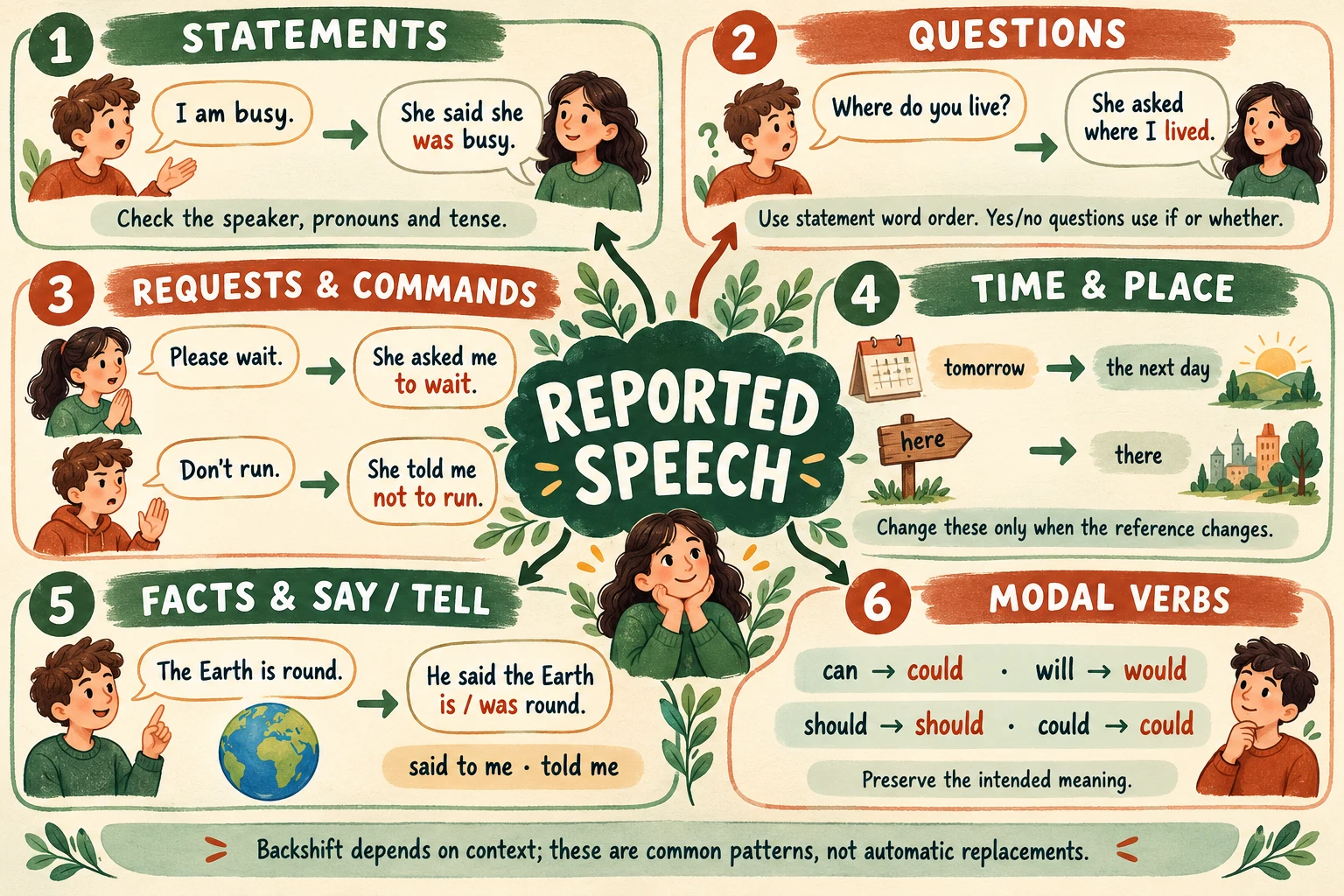
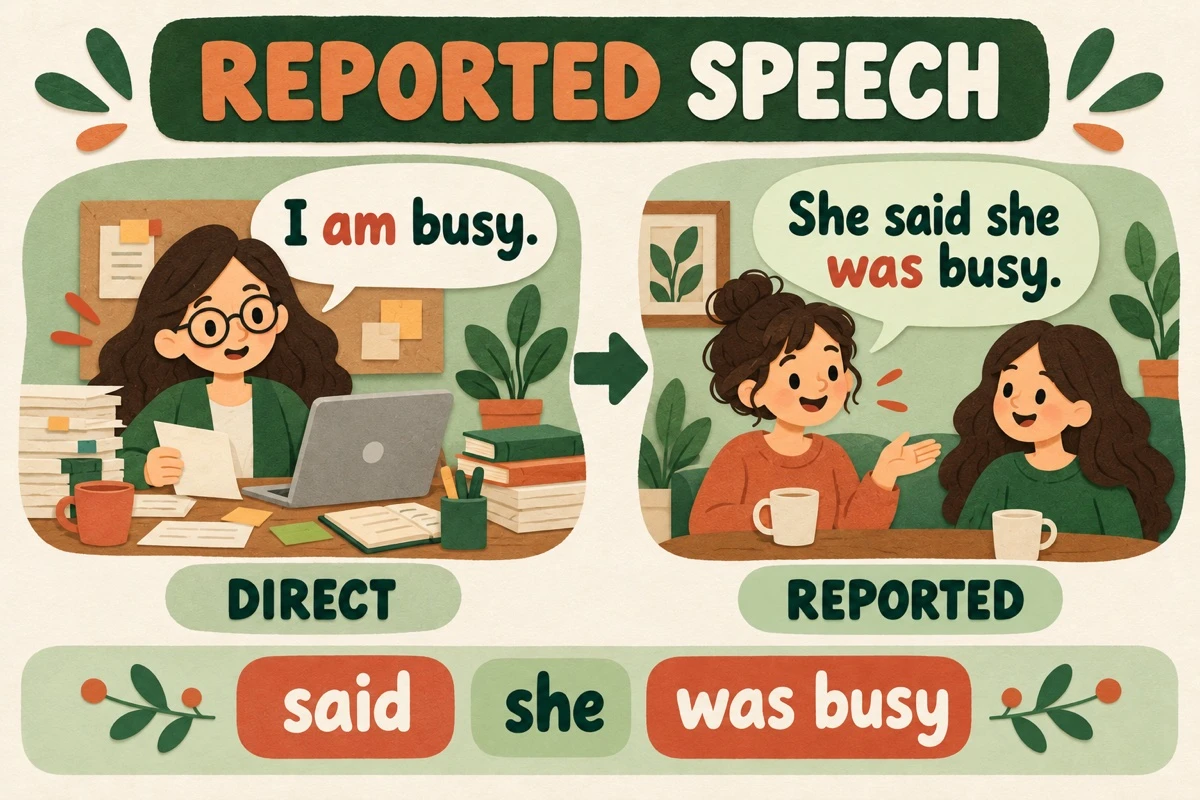
En las tareas que piden cambio temporal: presente simple → pasado simple; presente continuo → pasado continuo; presente perfecto → pasado perfecto; pasado simple → pasado perfecto cuando se solicite. El pasado perfecto normalmente se mantiene. Los pronombres dependen de quién habla y escucha ahora.

“I am busy.” → She said she was busy.
02Las preguntas indirectas usan el orden de una afirmación

Pregunta con interrogativo: asked + persona + where/why/what time + sujeto + verbo. Pregunta de sí o no: asked + persona + if/whether + sujeto + verbo. Elimina do/does/did si solo sirven para formar la pregunta directa.

“Where do you live?” → She asked where I lived.

03Transmite instrucciones con un infinitivo

Petición: asked + persona + to + verbo base. Instrucción: told + persona + to + verbo base. Negativa: not to + verbo base. To not + verbo base también es gramatical. Una pregunta cortés puede funcionar como petición; identifica su función antes de elegir el patrón.

“Please wait.” → She asked me to wait.

04Conserva el tiempo y lugar reales

Tomorrow puede pasar a the next/following day; yesterday, a the day before. Here/these pueden necesitar there/those si cambia la referencia. No son sustituciones automáticas. Una fecha o un lugar explícitos también pueden conservar el significado.

tomorrow → the next day (when the time reference changes)

05El cambio temporal no siempre es obligatorio

Con un hecho que sigue vigente, pueden ser correctas tanto una forma presente como el cambio temporal normal. Un verbo introductor en presente suele mantener la perspectiva actual. Si la tarea exige una forma, otra perspectiva válida no cumple la consigna, pero no es automáticamente mal inglés. Say pasa a said (to somebody); tell, a told somebody, sin to ante la persona.

“The Earth is round.” → He said the Earth is / was round.

06Conserva el significado del modal

En el relato normal desde el pasado, can suele pasar a could y will a would. Should, could, would y might normalmente no cambian. Must de obligación puede pasar a had to y a veces mantenerse. Must de deducción no se convierte mecánicamente en had to. May de posibilidad suele pasar a might en un relato pasado.

can → could · will → would · should → should

Guía ilustrada

0/48
Preguntas
01 / 48D01Guárdalo para encontrarlo en Mi colección.

On Monday, Ben (he) spoke to Maya. Maya is reporting his words on Tuesday, using normal past-time backshift.

“I am waiting for your email.”

Maya: Ben told me that ...

Tu respuesta
1 / 48

Tu ruta de aprendizaje

01
Paso 1 · Calentamiento

Calentamiento

0/6
02
Paso 2 · Practicar la habilidad

Elige una perspectiva pasada y sigue las referencias personales

0/3

En las tareas que piden cambio temporal: presente simple → pasado simple; presente continuo → pasado continuo; presente perfecto → pasado perfecto; pasado simple → pasado perfecto cuando se solicite. El pasado perfecto normalmente se mantiene. Los pronombres dependen de quién habla y escucha ahora.

03
Paso 3 · Practicar la habilidad

Las preguntas indirectas usan el orden de una afirmación

0/3

Pregunta con interrogativo: asked + persona + where/why/what time + sujeto + verbo. Pregunta de sí o no: asked + persona + if/whether + sujeto + verbo. Elimina do/does/did si solo sirven para formar la pregunta directa.

04
Paso 4 · Practicar la habilidad

Transmite instrucciones con un infinitivo

0/3

Petición: asked + persona + to + verbo base. Instrucción: told + persona + to + verbo base. Negativa: not to + verbo base. To not + verbo base también es gramatical. Una pregunta cortés puede funcionar como petición; identifica su función antes de elegir el patrón.

05
Paso 5 · Practicar la habilidad

Conserva el tiempo y lugar reales

0/3

Tomorrow puede pasar a the next/following day; yesterday, a the day before. Here/these pueden necesitar there/those si cambia la referencia. No son sustituciones automáticas. Una fecha o un lugar explícitos también pueden conservar el significado.

06
Paso 6 · Practicar la habilidad

El cambio temporal no siempre es obligatorio

0/3

Con un hecho que sigue vigente, pueden ser correctas tanto una forma presente como el cambio temporal normal. Un verbo introductor en presente suele mantener la perspectiva actual. Si la tarea exige una forma, otra perspectiva válida no cumple la consigna, pero no es automáticamente mal inglés. Say pasa a said (to somebody); tell, a told somebody, sin to ante la persona.

07
Paso 7 · Practicar la habilidad

Conserva el significado del modal

0/3

En el relato normal desde el pasado, can suele pasar a could y will a would. Should, could, would y might normalmente no cambian. Must de obligación puede pasar a had to y a veces mantenerse. Must de deducción no se convierte mecánicamente en had to. May de posibilidad suele pasar a might en un relato pasado.

08
Paso 8 · Nuevos contextos

Nuevos contextos

0/16
09
Paso 9 · Un nuevo reto

Un nuevo reto

0/8
Repasos de esta unidad

Haz que los errores sirvan.

Conserva el primer intento, entiende el cambio y compruébalo en otra situación.

0

Aún no hay repasos. Prueba un calentamiento corto.

Mapa de la lección

Reported speech

B1
Reported speech

Puntos de la lección

01

Elige una perspectiva pasada y sigue las referencias personales

En las tareas que piden cambio temporal: presente simple → pasado simple; presente continuo → pasado continuo; presente perfecto → pasado perfecto; pasado simple → pasado perfecto cuando se solicite. El pasado perfecto normalmente se mantiene. Los pronombres dependen de quién habla y escucha ahora.

02

Las preguntas indirectas usan el orden de una afirmación

Pregunta con interrogativo: asked + persona + where/why/what time + sujeto + verbo. Pregunta de sí o no: asked + persona + if/whether + sujeto + verbo. Elimina do/does/did si solo sirven para formar la pregunta directa.

03

Transmite instrucciones con un infinitivo

Petición: asked + persona + to + verbo base. Instrucción: told + persona + to + verbo base. Negativa: not to + verbo base. To not + verbo base también es gramatical. Una pregunta cortés puede funcionar como petición; identifica su función antes de elegir el patrón.

04

Conserva el tiempo y lugar reales

Tomorrow puede pasar a the next/following day; yesterday, a the day before. Here/these pueden necesitar there/those si cambia la referencia. No son sustituciones automáticas. Una fecha o un lugar explícitos también pueden conservar el significado.

05

El cambio temporal no siempre es obligatorio

Con un hecho que sigue vigente, pueden ser correctas tanto una forma presente como el cambio temporal normal. Un verbo introductor en presente suele mantener la perspectiva actual. Si la tarea exige una forma, otra perspectiva válida no cumple la consigna, pero no es automáticamente mal inglés. Say pasa a said (to somebody); tell, a told somebody, sin to ante la persona.

06

Conserva el significado del modal

En el relato normal desde el pasado, can suele pasar a could y will a would. Should, could, would y might normalmente no cambian. Must de obligación puede pasar a had to y a veces mantenerse. Must de deducción no se convierte mecánicamente en had to. May de posibilidad suele pasar a might en un relato pasado.

Preguntas y respuestas

Abrir una respuesta registra ayuda para esa pregunta.

D01 · Calentamiento

On Monday, Ben (he) spoke to Maya. Maya is reporting his words on Tuesday, using normal past-time backshift.

I am waiting for your email.

Maya: Ben told me that ...

  1. he was waiting for her email.
  2. I was waiting for his email.
  3. he had waited for my email.
  4. he was waiting for my email.
Respuesta y explicación
he was waiting for my email.

Am waiting pasa a was waiting en la perspectiva pasada solicitada. Ben pasa a he; your email pasa a my email porque ahora habla Maya.

D02 · Calentamiento

A visitor asked this at the station yesterday. Report it using normal past-time backshift.

Where does the shuttle stop?

The visitor asked where ...

  1. the shuttle stopped.
  2. the shuttle had stopped.
  3. did the shuttle stop.
  4. the shuttle stops.
Respuesta y explicación
the shuttle stopped.

Una pregunta indirecta con interrogativo conserva where, pero usa sujeto + verbo. Elimina does y cambia stops a stopped.

D03 · Calentamiento

A caretaker gave a group a negative instruction. Keep the negative meaning.

Don't move the boxes.

The caretaker told us ...

  1. to move the boxes.
  2. not move the boxes.
  3. don't move the boxes.
  4. not to move the boxes.
Respuesta y explicación
not to move the boxes.

Una instrucción negativa usa told + persona + not to + verbo base. No omitas not.

D04 · Calentamiento

Lia (she) spoke on Monday 12 October. It is now Wednesday 14 October. Report her Monday plan with normal backshift.

I will send the file tomorrow.

On Monday, Lia said that ...

  1. she would send the file today.
  2. she had sent the file the following day.
  3. she would send the file the following day.
  4. she would send the file the following week.
Respuesta y explicación
she would send the file the following day.

Tomorrow en el mensaje del lunes significa martes, no el miércoles de este relato. Will pasa a would. On Tuesday 13 October también indica el momento correcto.

D05 · Calentamiento

A guide said that the museum opens at ten. This timetable is still true. Compare Report 1: The guide said that the museum opens at ten. Report 2: The guide said that the museum opened at ten.

Which explanation is accurate?

  1. Report 2 proves that the museum no longer opens at ten.
  2. Both can be correct; Report 1 presents the timetable as still current.
  3. Only Report 2 is correct because every verb must change after said.
  4. Only Report 1 is correct because backshift is never allowed for facts.
Respuesta y explicación
Both can be correct; Report 1 presents the timetable as still current.

El presente opens puede conservar un hecho aún vigente. Opened con cambio temporal también puede ser gramatical. Opened por sí solo no demuestra que el horario cambiara.

D06 · Calentamiento

Noah (he) spoke yesterday. Use normal past-time backshift to report his ability at that time.

I can repair the lock.

Noah said that ...

  1. he could repair the lock.
  2. he had to repair the lock.
  3. he can repair the lock.
  4. he would repair the lock.
Respuesta y explicación
he could repair the lock.

Can pasa a could al mirar su capacidad desde el pasado solicitado. Had to expresaría obligación, no capacidad.

P01 · Practicar la habilidad

Nia (she) made this statement last week while she still had the job. She has since left it. Report it using normal past-time backshift.

I work at weekends.

Nia said that ...

  1. she worked at weekends.
  2. I worked at weekends.
  3. she had worked at weekends.
  4. she works at weekends.
Respuesta y explicación
she worked at weekends.

Work pasa a worked en el relato pasado. Had worked añade una relación de anterioridad que esta afirmación en presente simple no necesita.

P02 · Practicar la habilidad

Ava (she) made this statement yesterday. Complete the report using the past perfect.

I have finished the survey.

Ava said that she ...

Respuesta y explicación
had finished the survey.

Have finished pasa a had finished. El inicio dado ya incluye she. Solo se comprueban automáticamente respuestas revisadas. Otro punto de vista gramatical puede no cumplir esta tarea, pero una redacción desconocida no es automáticamente incorrecta.

P03 · Practicar la habilidad

Omar (he) spoke to his colleague yesterday. For this exercise, backshift the past simple to the past perfect.

I left my keys at home.

Omar said that he ...

Respuesta y explicación
had left his keys at home.

Se pide left → had left y my → his. El pasado simple puede mantenerse en algunos relatos naturales; aquí se pide expresamente pasado perfecto. Solo se comprueban automáticamente respuestas revisadas. Otro punto de vista gramatical puede no cumplir esta tarea, pero una redacción desconocida no es automáticamente incorrecta.

P04 · Practicar la habilidad

Mira (she) asked Dan this yesterday. Dan is reporting her question now. Use normal backshift.

Are you using my charger?

Dan: Mira asked me ...

Respuesta y explicación
if I was using her charger.

Una pregunta de sí o no necesita if o whether. Usa I was, no was I. My se refiere a Mira y pasa a her en el relato de Dan. Solo se comprueban automáticamente respuestas revisadas. Otro punto de vista gramatical puede no cumplir esta tarea, pero una redacción desconocida no es automáticamente incorrecta.

Otras respuestas aceptadas
  • whether I was using her charger.
  • if I was using Mira's charger.
  • whether I was using Mira's charger.
  • if I was using the charger she owned.
  • whether I was using the charger she owned.
  • whether or not I was using her charger.
  • whether or not I was using Mira's charger.
  • whether or not I was using the charger she owned.
P05 · Practicar la habilidad

Yesterday a coach asked Leo (he) about an earlier departure. Backshift did leave to had left.

Why did you leave early?

The coach asked Leo why ...

  1. he has left early.
  2. had he left early.
  3. if he had left early.
  4. he had left early.
Respuesta y explicación
he had left early.

La pregunta indirecta usa he had left, no had he left. El entrenador pide una razón, así que debe mantenerse why.

P06 · Practicar la habilidad

On Tuesday, Reece asked Ivy (she) about an earlier event. Ivy is reporting the question. Keep the original past perfect.

Had you seen the notice before Monday?

Ivy: Reece asked me ...

Respuesta y explicación
whether I had seen the notice before Monday.

Usa whether o if y orden de afirmación. El pasado perfecto normalmente se mantiene; no hay otro cambio temporal rutinario. Solo se comprueban automáticamente respuestas revisadas. Otro punto de vista gramatical puede no cumplir esta tarea, pero una redacción desconocida no es automáticamente incorrecta.

Otras respuestas aceptadas
  • if I had seen the notice before Monday.
  • whether I had seen the notice before that Monday.
  • if I had seen the notice before that Monday.
  • whether or not I had seen the notice before Monday.
  • whether or not I had seen the notice before that Monday.
P07 · Practicar la habilidad

A caretaker politely requested this of Max. Report the request with the infinitive construction after asked Max.

Please close the side gate.

The caretaker asked Max ...

Respuesta y explicación
to close the side gate.

Una petición se transmite con asked + persona + to + verbo base. Suele omitirse please, pero to please close the side gate también es una forma cortés natural y se acepta. Solo se comprueban automáticamente respuestas revisadas. Otro punto de vista gramatical puede no cumplir esta tarea, pero una redacción desconocida no es automáticamente incorrecta.

Otras respuestas aceptadas
  • to please close the side gate.
  • to close the side gate, please.
P08 · Practicar la habilidad

Lina (she) asked Arun for his address. Arun is reporting her request with the infinitive construction after asked me.

Please email me your address.

Arun: Lina asked me ...

Respuesta y explicación
to email her my address.

Me en las palabras de Lina se refiere a Lina; your, a Arun. En el relato de Arun pasan a her y my. Solo se comprueban automáticamente respuestas revisadas. Otro punto de vista gramatical puede no cumplir esta tarea, pero una redacción desconocida no es automáticamente incorrecta.

Otras respuestas aceptadas
  • to email Lina my address.
  • to email my address to her.
  • to email my address to Lina.
  • to please email her my address.
  • to email her my address, please.
P09 · Practicar la habilidad

A supervisor gave a negative instruction. Repair the reported sentence. Write the whole corrected sentence.

The supervisor told us to don't touch the switch.

Corrected report:

Respuesta y explicación
The supervisor told us not to touch the switch.

Después de told us, usa not to touch. To not touch también es gramatical y no debe calificarse como mal inglés. Solo se comprueban automáticamente respuestas revisadas. Otro punto de vista gramatical puede no cumplir esta tarea, pero una redacción desconocida no es automáticamente incorrecta.

Otras respuestas aceptadas
  • The supervisor told us to not touch the switch.
P10 · Practicar la habilidad

On Tuesday, Ella (she) spoke to you at the library entrance. On Wednesday you report it from home. Use normal backshift; Friday is still the intended meeting day.

I will meet you here on Friday.

Ella said that ...

  1. she would meet me there on Friday.
  2. she would meet me there the next day.
  3. she had met me there on Friday.
  4. she would meet me here on Friday.
Respuesta y explicación
she would meet me there on Friday.

Here pasa a there porque se relata desde otro lugar. Friday sigue siendo Friday: su referencia no ha cambiado.

P11 · Practicar la habilidad

Finn (he) spoke to you on Monday 12 October. You report it on Wednesday 14 October. Use past perfect and keep the original event on Sunday 11 October.

I saw your tutor yesterday.

On Monday, Finn said that he ...

Respuesta y explicación
had seen my tutor the day before.

Yesterday era domingo con respecto a las palabras de Finn del lunes. The day before o una fecha dominical explícita conserva esa referencia. Solo se comprueban automáticamente respuestas revisadas. Otro punto de vista gramatical puede no cumplir esta tarea, pero una redacción desconocida no es automáticamente incorrecta.

Otras respuestas aceptadas
  • had seen my tutor on Sunday 11 October.
  • had seen my tutor on Sunday.
  • had seen my tutor on 11 October.
  • had seen my tutor the previous day.
  • had seen my tutor on the day before.
P12 · Practicar la habilidad

An usher pointed at some seats in the theatre yesterday. You report it from home today. Use normal past-time backshift and identify the theatre seats without pretending you are pointing at them now.

These seats are reserved.

The usher said that ...

Respuesta y explicación
those seats were reserved.

Those seats o the seats conserva la referencia al teatro. El cambio de perspectiva puede modificar these, pero un sintagma nominal neutro también es preciso. Solo se comprueban automáticamente respuestas revisadas. Otro punto de vista gramatical puede no cumplir esta tarea, pero una redacción desconocida no es automáticamente incorrecta.

Otras respuestas aceptadas
  • the seats were reserved.
  • the seats in the theatre were reserved.
  • those seats in the theatre were reserved.
P13 · Practicar la habilidad

A teacher said, "The school has a small library." The school still has it. You want to present that fact as current.

The school has a small library.

The teacher said that the school ...

Respuesta y explicación
has a small library.

Has presenta el hecho como vigente. Had también puede ser gramatical desde una perspectiva pasada; no implica por sí solo que la biblioteca haya desaparecido. Esta tarea pide la perspectiva actual. Solo se comprueban automáticamente respuestas revisadas. Otro punto de vista gramatical puede no cumplir esta tarea, pero una redacción desconocida no es automáticamente incorrecta.

P14 · Practicar la habilidad

Violet (she) is still on the bus and has just sent this message. Report it immediately with the present reporting verb says.

I am on the bus now.

Violet says that she ...

Respuesta y explicación
is on the bus now.

El verbo introductor está en presente y la situación sigue vigente; aquí no hay razón para cambiar is a was ni now a then. Solo se comprueban automáticamente respuestas revisadas. Otro punto de vista gramatical puede no cumplir esta tarea, pero una redacción desconocida no es automáticamente incorrecta.

Otras respuestas aceptadas
  • is on the bus right now.
  • is on the bus at the moment.
P15 · Practicar la habilidad

Yesterday, Ben spoke to Jo. Jo is reporting it today. The pool’s timetable is still current. Choose a grammatical report.

The pool is closed on Mondays.

Jo's report:

  1. Ben told to me that the pool is closed on Mondays.
  2. Ben told that the pool is closed on Mondays.
  3. Ben said me that the pool was closed on Mondays.
  4. Ben told me that the pool was closed on Mondays.
Respuesta y explicación
Ben told me that the pool was closed on Mondays.

Told necesita un objeto que indique al oyente: told me. Said puede llevar to me, pero no me directamente. Told to me no es el patrón estándar. Was closed es un cambio temporal normal válido aunque el horario siga vigente.

P16 · Practicar la habilidad

Eli (he) made this promise yesterday. Use normal backshift.

I will help Nora.

Eli said that ...

  1. he would help Nora.
  2. he had helped Nora.
  3. he had to help Nora.
  4. he could help Nora.
Respuesta y explicación
he would help Nora.

Would conserva la promesa futura desde la perspectiva anterior de Eli. Could la convierte en capacidad o posibilidad.

P17 · Practicar la habilidad

On Monday, Lena (she) described an obligation. You report it the following week, after the Friday deadline. Use had to in this exercise.

I must submit the form by Friday.

Lena said that she ...

Respuesta y explicación
had to submit the form by that Friday.

Had to expresa la obligación pasada. That Friday explicita el plazo original; by Friday también se entiende en este contexto. Must puede mantenerse en otros relatos, pero aquí se pide had to. Must de deducción no se transforma mecánicamente en had to. Solo se comprueban automáticamente respuestas revisadas. Otro punto de vista gramatical puede no cumplir esta tarea, pero una redacción desconocida no es automáticamente incorrecta.

Otras respuestas aceptadas
  • had to submit the form by Friday.
  • had to submit the form by the Friday of that week.
P18 · Practicar la habilidad

A tutor gave Iris this advice. Iris is reporting it.

You should save a copy.

Iris: The tutor said that I ...

Respuesta y explicación
should save a copy.

Should normalmente se mantiene al transmitir consejos. No inventes shoulded ni sustituyas un consejo por una obligación. Solo se comprueban automáticamente respuestas revisadas. Otro punto de vista gramatical puede no cumplir esta tarea, pero una redacción desconocida no es automáticamente incorrecta.

R01 · Nuevos contextos

Milo (he) spoke to Nia yesterday. Nia reports his words with normal past-time backshift.

I am taking your bike to the shop.

Nia: Milo told me that he ...

Respuesta y explicación
was taking my bike to the shop.

Am taking pasa a was taking. Your se refiere a Nia y pasa a my cuando ella relata. Se vuelve a comprobar el cambio posesivo del oyente al narrador de D01. Solo se comprueban automáticamente respuestas revisadas. Otro punto de vista gramatical puede no cumplir esta tarea, pero una redacción desconocida no es automáticamente incorrecta.

R02 · Nuevos contextos

Rosa (she) spoke yesterday. Complete the report using the past perfect.

I have locked the door.

Rosa said that she ...

Respuesta y explicación
had locked the door.

Have locked pasa a had locked. Se conserva el sentido de la acción completada. Solo se comprueban automáticamente respuestas revisadas. Otro punto de vista gramatical puede no cumplir esta tarea, pero una redacción desconocida no es automáticamente incorrecta.

R03 · Nuevos contextos

An agent asked Iris (she) this yesterday. Iris reports it with normal backshift.

Where do you keep the tickets?

Iris: The agent asked me where ...

Respuesta y explicación
I kept the tickets.

Se mantiene where; el orden pasa a I kept. Desaparece do y keep cambia a kept. Solo se comprueban automáticamente respuestas revisadas. Otro punto de vista gramatical puede no cumplir esta tarea, pero una redacción desconocida no es automáticamente incorrecta.

R04 · Nuevos contextos

A tutor asked May this yesterday. May reports it. For this exercise, backshift the past simple to the past perfect.

Did you charge the tablet?

May: The tutor asked me ...

Respuesta y explicación
if I had charged the tablet.

If o whether introduce la pregunta de sí o no. Usa I had charged, no had I charged. Solo se comprueban automáticamente respuestas revisadas. Otro punto de vista gramatical puede no cumplir esta tarea, pero una redacción desconocida no es automáticamente incorrecta.

Otras respuestas aceptadas
  • whether I had charged the tablet.
  • whether I had charged the tablet or not.
  • if I had charged the tablet or not.
  • whether or not I had charged the tablet.
R05 · Nuevos contextos

A coach made this request of Toby. Toby reports it with the infinitive construction after asked me.

Please bring your notebook.

Toby: The coach asked me ...

Respuesta y explicación
to bring my notebook.

Usa asked me to bring. Your se refiere a Toby y pasa a my en su relato. También se aceptan please cortés y variantes con bring along que conservan el sentido. Solo se comprueban automáticamente respuestas revisadas. Otro punto de vista gramatical puede no cumplir esta tarea, pero una redacción desconocida no es automáticamente incorrecta.

Otras respuestas aceptadas
  • to please bring my notebook.
  • to bring my notebook, please.
  • to bring along my notebook.
  • to bring my notebook along.
  • to bring my notebook along, please.
  • to bring along my notebook, please.
R06 · Nuevos contextos

A ranger gave this instruction to your group. Keep the negative meaning.

Don't feed the birds.

The ranger told us ...

Respuesta y explicación
not to feed the birds.

Usa not to feed. To not feed también es gramatical, aunque not to es el patrón principal que se enseña aquí. Solo se comprueban automáticamente respuestas revisadas. Otro punto de vista gramatical puede no cumplir esta tarea, pero una redacción desconocida no es automáticamente incorrecta.

Otras respuestas aceptadas
  • to not feed the birds.
  • not to feed the birds, please.
R07 · Nuevos contextos

Dana (she) spoke on Tuesday 3 November. You report it on Thursday 5 November with normal backshift. Preserve the planned return on Wednesday 4 November.

I will return tomorrow.

On Tuesday, Dana said that she ...

Respuesta y explicación
would return the following day.

Tomorrow se refería al miércoles. The following day, the next day o la fecha explícita del miércoles conservan el día previsto. Solo se comprueban automáticamente respuestas revisadas. Otro punto de vista gramatical puede no cumplir esta tarea, pero una redacción desconocida no es automáticamente incorrecta.

Otras respuestas aceptadas
  • would return the next day.
  • would return on Wednesday 4 November.
  • would return on Wednesday.
  • would return on 4 November.
  • would return on the following day.
  • would return on the next day.
  • would return the day after she spoke.
R08 · Nuevos contextos

On Monday, Kit (they) pointed at a desk in the office. On Tuesday you report it from home. Use the past perfect and preserve the office location without pretending you are still there.

I left the parcel here.

Kit said that they ...

Respuesta y explicación
had left the parcel there.

Here en la oficina pasa a there al relatar desde casa. At that desk también es una referencia explícita precisa. El cambio a pasado perfecto solicitado es had left. Solo se comprueban automáticamente respuestas revisadas. Otro punto de vista gramatical puede no cumplir esta tarea, pero una redacción desconocida no es automáticamente incorrecta.

Otras respuestas aceptadas
  • had left the parcel at that desk.
  • had left the parcel at the desk in the office.
  • had left the parcel at the office desk.
R09 · Nuevos contextos

Darius (he) said, "I work for a charity." He still has this job. Write two reports: one presenting the fact as current, and one using normal backshift.

I work for a charity.

Darius said that he ... [current] Darius said that he ... [backshifted]

Respuesta y explicación
works for a charity. / worked for a charity.

Works presenta el empleo como actual; worked usa la perspectiva pasada. El pasado por sí solo no demuestra que haya dejado la organización benéfica. Solo se comprueban automáticamente respuestas revisadas. Otro punto de vista gramatical puede no cumplir esta tarea, pero una redacción desconocida no es automáticamente incorrecta.

R10 · Nuevos contextos

The neighbour spoke to me yesterday. The cafe’s timetable is still current. A learner wrote: “The neighbour said me that the cafe is closed on Mondays.” Correct the whole report. Either a current or a normal past viewpoint is allowed.

The cafe is closed on Mondays.

Write the corrected full report.

Respuesta y explicación
The neighbour told me that the cafe is closed on Mondays.

Usa told me o said to me; said me no es el patrón estándar. El horario vigente puede transmitirse con is closed o con el cambio normal was closed. Ambos conservan el sentido aquí. Solo se comprueban automáticamente respuestas revisadas. Otro punto de vista gramatical puede no cumplir esta tarea, pero una redacción desconocida no es automáticamente incorrecta.

Otras respuestas aceptadas
  • The neighbour told me that the cafe was closed on Mondays.
  • The neighbour told me the cafe is closed on Mondays.
  • The neighbour told me the cafe was closed on Mondays.
  • The neighbour said to me that the cafe is closed on Mondays.
  • The neighbour said to me that the cafe was closed on Mondays.
  • The neighbour said to me the cafe is closed on Mondays.
  • The neighbour said to me the cafe was closed on Mondays.
  • The neighbor told me that the cafe is closed on Mondays.
  • The neighbor told me that the cafe was closed on Mondays.
  • The neighbor told me the cafe is closed on Mondays.
  • The neighbor told me the cafe was closed on Mondays.
  • The neighbor said to me that the cafe is closed on Mondays.
  • The neighbor said to me that the cafe was closed on Mondays.
  • The neighbor said to me the cafe is closed on Mondays.
  • The neighbor said to me the cafe was closed on Mondays.
  • The neighbour told me that the café is closed on Mondays.
  • The neighbour told me that the café was closed on Mondays.
  • The neighbour told me the café is closed on Mondays.
  • The neighbour told me the café was closed on Mondays.
  • The neighbour said to me that the café is closed on Mondays.
  • The neighbour said to me that the café was closed on Mondays.
  • The neighbour said to me the café is closed on Mondays.
  • The neighbour said to me the café was closed on Mondays.
  • The neighbor told me that the café is closed on Mondays.
  • The neighbor told me that the café was closed on Mondays.
  • The neighbor told me the café is closed on Mondays.
  • The neighbor told me the café was closed on Mondays.
  • The neighbor said to me that the café is closed on Mondays.
  • The neighbor said to me that the café was closed on Mondays.
  • The neighbor said to me the café is closed on Mondays.
  • The neighbor said to me the café was closed on Mondays.
R11 · Nuevos contextos

Ari (they) described an ability yesterday. Use normal past-time backshift.

I can carry the ladder.

Ari said that they ...

Respuesta y explicación
could carry the ladder.

Can pasa a could para transmitir la capacidad indicada desde el pasado. Solo se comprueban automáticamente respuestas revisadas. Otro punto de vista gramatical puede no cumplir esta tarea, pero una redacción desconocida no es automáticamente incorrecta.

R12 · Nuevos contextos

A tutor gave Zoe advice about a labelled folder. Zoe reports the advice.

You should check the label.

Zoe: The tutor said that I ...

Respuesta y explicación
should check the label.

Should se mantiene cuando Zoe transmite el consejo. Solo se comprueban automáticamente respuestas revisadas. Otro punto de vista gramatical puede no cumplir esta tarea, pero una redacción desconocida no es automáticamente incorrecta.

R13 · Nuevos contextos

Omar (he) made this promise to Rae yesterday. Rae reports it using normal backshift.

I will check your figures.

Rae: Omar said that he ...

Respuesta y explicación
would check my figures.

Will pasa a would para transmitir la promesa anterior. Your se refiere a Rae, por eso Rae usa my. Es una nueva tarea de reparación de P16. Solo se comprueban automáticamente respuestas revisadas. Otro punto de vista gramatical puede no cumplir esta tarea, pero una redacción desconocida no es automáticamente incorrecta.

R14 · Nuevos contextos

Alma (she) spoke on Friday about the following Tuesday’s deadline. You report it on the Wednesday after that deadline. Report the past obligation and preserve that original Tuesday.

I must return the key by Tuesday.

Alma said that she ...

Respuesta y explicación
had to return the key by that Tuesday.

Had to conserva la obligación pasada; that Tuesday identifica el plazo posterior a las palabras de Alma del viernes. Es un contexto nuevo de obligación y plazo para P17. Solo se comprueban automáticamente respuestas revisadas. Otro punto de vista gramatical puede no cumplir esta tarea, pero una redacción desconocida no es automáticamente incorrecta.

Otras respuestas aceptadas
  • had to return the key by the Tuesday after she spoke.
  • had to return the key by Tuesday.
  • had to return the key by the following Tuesday.
R15 · Nuevos contextos

On Tuesday, Jay asked Robin about an earlier event. Robin reports the question. Keep the past perfect that is already in the original question.

Had you read the message before Monday?

Robin: Jay asked me ...

Respuesta y explicación
if I had read the message before Monday.

El original ya usa had read. Mantenlo, añade if o whether y usa orden de afirmación: I had read, no had I read. Solo se comprueban automáticamente respuestas revisadas. Otro punto de vista gramatical puede no cumplir esta tarea, pero una redacción desconocida no es automáticamente incorrecta.

Otras respuestas aceptadas
  • whether I had read the message before Monday.
  • if I had read the message before that Monday.
  • whether I had read the message before that Monday.
  • whether or not I had read the message before Monday.
  • whether or not I had read the message before that Monday.
R16 · Nuevos contextos

Elena (she) has just sent this message and is still in the library. Report it immediately with the present reporting verb says.

I am in the library now.

Elena says that she ...

Respuesta y explicación
is in the library now.

Says es presente y Elena sigue allí. Mantén is y now. Esta nueva tarea vuelve a comprobar P14, no otro patrón de hechos con verbo introductor pasado. Solo se comprueban automáticamente respuestas revisadas. Otro punto de vista gramatical puede no cumplir esta tarea, pero una redacción desconocida no es automáticamente incorrecta.

Otras respuestas aceptadas
  • is in the library right now.
  • is in the library at the moment.
X01 · Un nuevo reto

Noor (she) spoke to Cal yesterday. Cal reports her statement now using normal past-time backshift.

I have printed your map.

Cal: Noor said that she ...

Respuesta y explicación
had printed my map.

Have printed pasa a had printed; your map se refiere a Cal y pasa a my map en su relato. Solo se comprueban automáticamente respuestas revisadas. Otro punto de vista gramatical puede no cumplir esta tarea, pero una redacción desconocida no es automáticamente incorrecta.

X02 · Un nuevo reto

A receptionist asked a visitor (he) this yesterday. Use normal backshift.

What time does your train arrive?

The receptionist asked the visitor what time ...

  1. his train had arrived.
  2. did his train arrive.
  3. his train arrived.
  4. your train arrived.
Respuesta y explicación
his train arrived.

Después de what time, usa his train arrived. No mantengas does ni el orden de pregunta directa.

X03 · Un nuevo reto

Yesterday, Sam asked Alex (they) about an earlier document check. Alex reports it now. In this exercise, backshift the past simple to the past perfect.

Did you check the dates?

Alex: Sam asked me ...

Respuesta y explicación
whether I had checked the dates.

If y whether son válidos. El pasado perfecto pedido es I had checked; no se conserva la inversión interrogativa. Solo se comprueban automáticamente respuestas revisadas. Otro punto de vista gramatical puede no cumplir esta tarea, pero una redacción desconocida no es automáticamente incorrecta.

Otras respuestas aceptadas
  • if I had checked the dates.
  • whether I had checked the dates or not.
  • if I had checked the dates or not.
  • whether or not I had checked the dates.
X04 · Un nuevo reto

A manager gave a group this instruction. Report the negative instruction.

Don't leave the window open.

The manager told us ...

Respuesta y explicación
not to leave the window open.

Conserva not y usa un infinitivo tras told us. To not leave también es gramatical. Solo se comprueban automáticamente respuestas revisadas. Otro punto de vista gramatical puede no cumplir esta tarea, pero una redacción desconocida no es automáticamente incorrecta.

Otras respuestas aceptadas
  • to not leave the window open.
X05 · Un nuevo reto

On Thursday, Ada (she) spoke to you at the sports centre. On Saturday you report it from home. The planned event is Friday. Use normal backshift.

I will wait for you here tomorrow.

On Thursday, Ada said that ...

Respuesta y explicación
she would wait for me there the following day.

Here significa el centro deportivo; tomorrow es viernes respecto a las palabras del jueves. The next day u on Friday también conservan la fecha. Solo se comprueban automáticamente respuestas revisadas. Otro punto de vista gramatical puede no cumplir esta tarea, pero una redacción desconocida no es automáticamente incorrecta.

Otras respuestas aceptadas
  • she would wait for me there the next day.
  • she would wait for me there on Friday.
  • she would wait for me at the sports centre on Friday.
  • she would wait for me at the sports centre the following day.
  • she would wait for me at the sports centre the next day.
  • she would wait for me there on the Friday after she spoke.
X06 · Un nuevo reto

A guide told you that the community hall has two exits. Both exits are still there. Pass this information to a friend who is visiting today. A current or a backshifted viewpoint is acceptable.

The community hall has two exits.

The guide said that the community hall ...

Respuesta y explicación
has two exits.

Has presenta la información como actual. Had también es un relato válido con cambio temporal; no significa que desapareciera una salida. Ambos conservan el hecho dado. Solo se comprueban automáticamente respuestas revisadas. Otro punto de vista gramatical puede no cumplir esta tarea, pero una redacción desconocida no es automáticamente incorrecta.

Otras respuestas aceptadas
  • had two exits.
X07 · Un nuevo reto

Pavel (he) spoke to a colleague yesterday about a meeting. Report both parts with normal past-time backshift, keeping the ability and possibility meanings.

I can explain the route, but I may arrive late.

Pavel said that he ...

Respuesta y explicación
could explain the route, but he might arrive late.

Can pasa a could para capacidad; may pasa a might para posibilidad en este relato pasado. Conserva el contraste con but. Repetir he en la segunda cláusula es opcional porque Pavel es el sujeto de ambas acciones. Solo se comprueban automáticamente respuestas revisadas. Otro punto de vista gramatical puede no cumplir esta tarea, pero una redacción desconocida no es automáticamente incorrecta.

Otras respuestas aceptadas
  • could explain the route but he might arrive late.
  • could explain the route, but might arrive late.
  • could explain the route but might arrive late.
X08 · Un nuevo reto

Optional extension. A designer proposed an action for the whole team. Report the suggestion rather than quoting Let's.

Let's use a larger label.

The designer suggested ...

Respuesta y explicación
using a larger label.

Suggested + -ing y suggested that + oración pueden transmitir la propuesta. Suggested us to use no es el patrón adecuado aquí. Esta única tarea es una ampliación, no una prueba de nivel B2. Solo se comprueban automáticamente respuestas revisadas. Otro punto de vista gramatical puede no cumplir esta tarea, pero una redacción desconocida no es automáticamente incorrecta.

Otras respuestas aceptadas
  • that we use a larger label.
  • that we should use a larger label.
  • we use a larger label.
  • we should use a larger label.
  • our using a larger label.
  • that the team use a larger label.
  • that the team should use a larger label.