01Routines and repetition
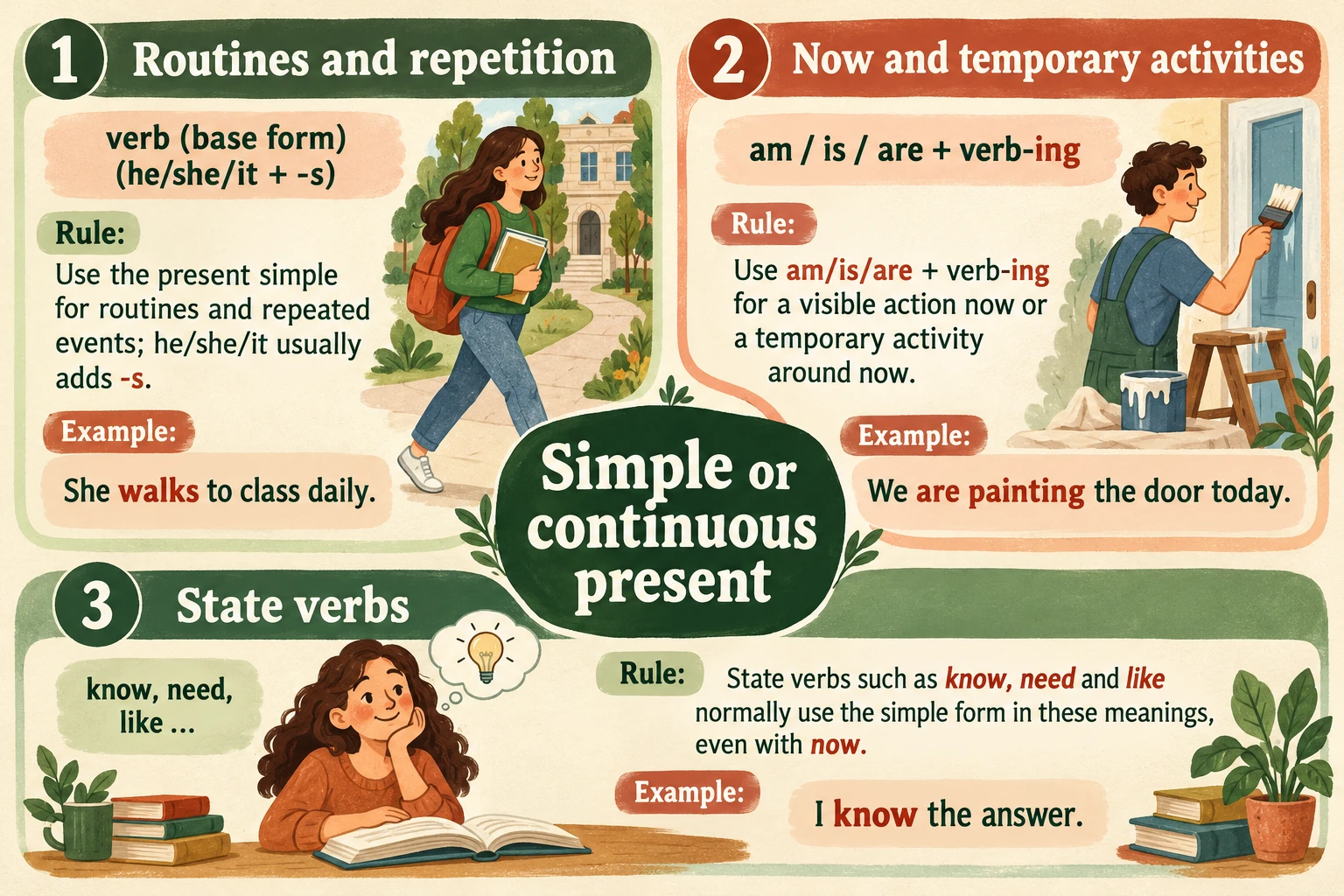
Use the present simple for routines and repeated events; he/she/it usually adds -s.
She walks to class daily.
Simple or continuous present · A1. Use the present simple for routines and repeated events; he/she/it usually adds -s.
Practise Simple or continuous present in short situations. Read the clue, choose or write a form, then check the reason. The level is an editorial guide.
Use the present simple for routines and repeated events; he/she/it usually adds -s.
She walks to class daily.Use am/is/are + verb-ing for a visible action now or a temporary activity around now.
We are painting the door today.State verbs such as know, need and like normally use the simple form in these meanings, even with now.
I know the answer.
Every Monday, Ben ___ to work. (cycle)
Use the present simple for routines and repeated events; he/she/it usually adds -s.
She walks to class daily.Use am/is/are + verb-ing for a visible action now or a temporary activity around now.
We are painting the door today.State verbs such as know, need and like normally use the simple form in these meanings, even with now.
I know the answer.Keep the first try. Understand the change. Check it in a fresh situation.
No practice notes yet. Try a short warm-up.
Use the present simple for routines and repeated events; he/she/it usually adds -s.
She walks to class daily.Use am/is/are + verb-ing for a visible action now or a temporary activity around now.
We are painting the door today.State verbs such as know, need and like normally use the simple form in these meanings, even with now.
I know the answer.Opening an answer records help for that question.
Every Monday, Ben ___ to work. (cycle)
Look at “Every Monday, Ben ___ to work. (cycle)”. Use the present simple for routines and repeated events; he/she/it usually adds -s. Complete sentence: “Every Monday, Ben cycles to work. (cycle)”.
Be quiet! The baby ___ now. (sleep)
Look at “Be quiet! The baby ___ now. (sleep)”. Use am/is/are + verb-ing for a visible action now or a temporary activity around now. Complete sentence: “Be quiet! The baby is sleeping now. (sleep)”.
I ___ your address now; you told me yesterday. (know)
Look at “I ___ your address now; you told me yesterday. (know)”. State verbs such as know, need and like normally use the simple form in these meanings, even with now. Complete sentence: “I know your address now; you told me yesterday. (know)”.
My parents ___ coffee every morning. (drink)
Reference completion: “My parents drink coffee every morning. (drink)”. Use the present simple for routines and repeated events; he/she/it usually adds -s.
I usually work at home, but this week I ___ in the office. (work)
Look at “I usually work at home, but this week I ___ in the office. (work)”. Use am/is/are + verb-ing for a visible action now or a temporary activity around now. Complete sentence: “I usually work at home, but this week I am working in the office. (work)”.
We ___ a larger table; this one is too small. (need)
Look at “We ___ a larger table; this one is too small. (need)”. State verbs such as know, need and like normally use the simple form in these meanings, even with now. Complete sentence: “We need a larger table; this one is too small. (need)”.
This bus ___ here at six every day. (stop)
Reference completion: “This bus stops here at six every day. (stop)”. Use the present simple for routines and repeated events; he/she/it usually adds -s.
Kai ___ his grandmother every Sunday. (visit)
Look at “Kai ___ his grandmother every Sunday. (visit)”. Use the present simple for routines and repeated events; he/she/it usually adds -s. Complete sentence: “Kai visits his grandmother every Sunday. (visit)”.
Look at Mia! She ___ a kite. (fly)
Look at “Look at Mia! She ___ a kite. (fly)”. Use am/is/are + verb-ing for a visible action now or a temporary activity around now. Complete sentence: “Look at Mia! She is flying a kite. (fly)”.
Sara ___ this song. It is her favourite. (like)
Reference completion: “Sara likes this song. It is her favourite. (like)”. State verbs such as know, need and like normally use the simple form in these meanings, even with now.
The shop is closed for repairs, so we ___ online this month. (sell)
Look at “The shop is closed for repairs, so we ___ online this month. (sell)”. Use am/is/are + verb-ing for a visible action now or a temporary activity around now. Complete sentence: “The shop is closed for repairs, so we are selling online this month. (sell)”.
This soup ___ wonderful. I can smell the garlic. (smell)
Reference completion: “This soup smells wonderful. I can smell the garlic. (smell)”. State verbs such as know, need and like normally use the simple form in these meanings, even with now.