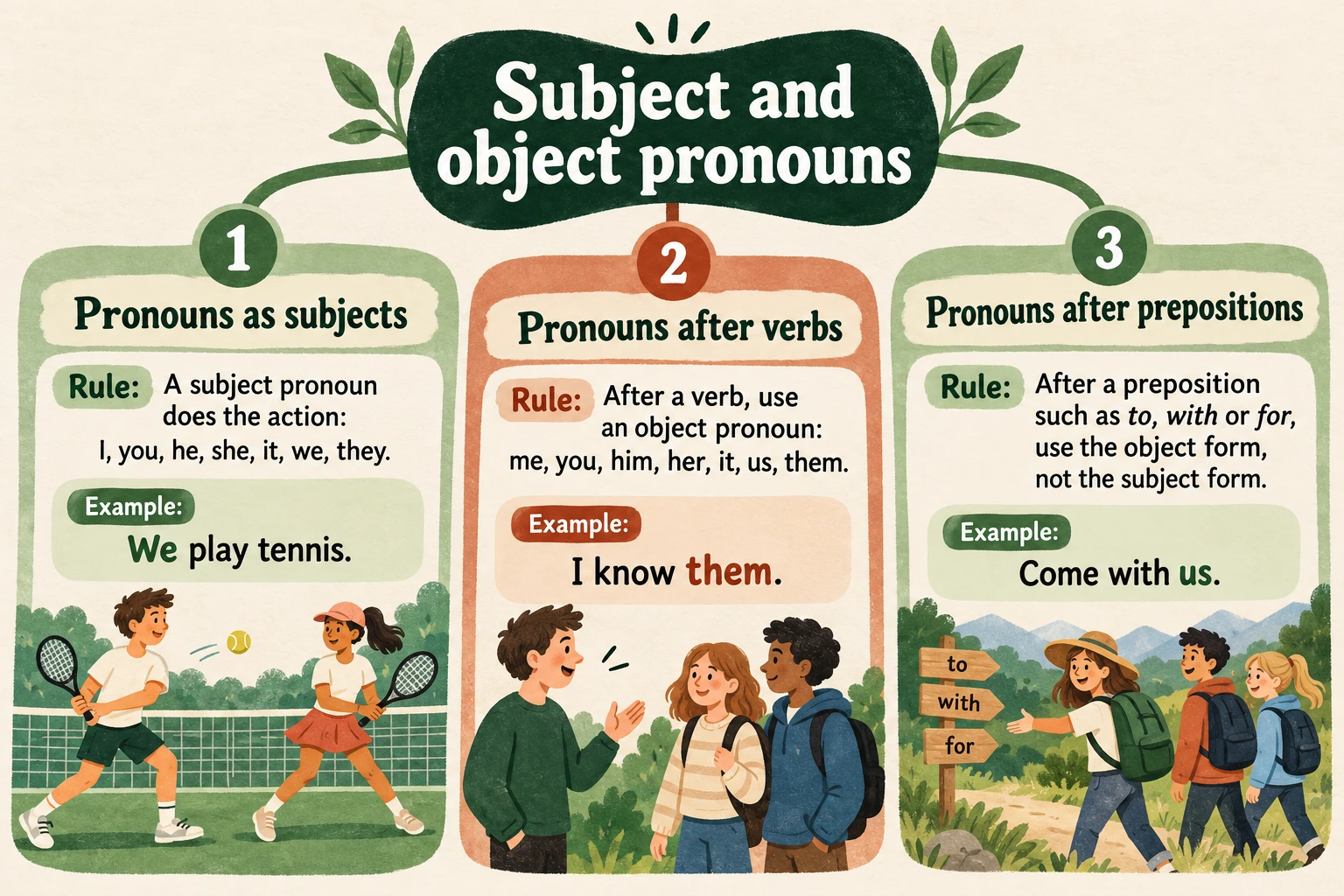
01Pronouns as subjects
A subject pronoun does the action: I, you, he, she, it, we, they.
We play tennis.
Subject and object pronouns · A1. A subject pronoun does the action: I, you, he, she, it, we, they.
Practise Subject and object pronouns in short situations. Read the clue, choose or write a form, then check the reason. The level is an editorial guide.
A subject pronoun does the action: I, you, he, she, it, we, they.
We play tennis.After a verb, use an object pronoun: me, you, him, her, it, us, them.
I know them.After a preposition such as to, with or for, use the object form, not the subject form.
Come with us.
My name is Rosa. ___ work at the museum.
A subject pronoun does the action: I, you, he, she, it, we, they.
We play tennis.After a verb, use an object pronoun: me, you, him, her, it, us, them.
I know them.After a preposition such as to, with or for, use the object form, not the subject form.
Come with us.Keep the first try. Understand the change. Check it in a fresh situation.
No practice notes yet. Try a short warm-up.
A subject pronoun does the action: I, you, he, she, it, we, they.
We play tennis.After a verb, use an object pronoun: me, you, him, her, it, us, them.
I know them.After a preposition such as to, with or for, use the object form, not the subject form.
Come with us.Opening an answer records help for that question.
My name is Rosa. ___ work at the museum.
Look at “My name is Rosa. ___ work at the museum.”. A subject pronoun does the action: I, you, he, she, it, we, they. Complete sentence: “My name is Rosa. I work at the museum.”.
Tom is waiting. Please call ___.
Look at “Tom is waiting. Please call ___.”. After a verb, use an object pronoun: me, you, him, her, it, us, them. Complete sentence: “Tom is waiting. Please call him.”.
The tickets are for Anna and me. They are for ___.
Look at “The tickets are for Anna and me. They are for ___.”. After a preposition such as to, with or for, use the object form, not the subject form. Complete sentence: “The tickets are for Anna and me. They are for us.”.
My brother and I live together. ___ live on King Street.
Reference completion: “My brother and I live together. We live on King Street.”. A subject pronoun does the action: I, you, he, she, it, we, they.
These are my keys. Please give ___ back.
Look at “These are my keys. Please give ___ back.”. After a verb, use an object pronoun: me, you, him, her, it, us, them. Complete sentence: “These are my keys. Please give them back.”.
I am going with Sara. I am going with ___.
Look at “I am going with Sara. I am going with ___.”. After a preposition such as to, with or for, use the object form, not the subject form. Complete sentence: “I am going with Sara. I am going with her.”.
The cat is hungry. ___ wants some food.
The cat is one animal. It is the neutral reference; he or she also works for a cat whose sex is known. All three take wants. Also accepted in this task: He / She. These are reviewed alternatives, not an exhaustive list of all possible English.
My parents are here. ___ are in the kitchen.
Look at “My parents are here. ___ are in the kitchen.”. A subject pronoun does the action: I, you, he, she, it, we, they. Complete sentence: “My parents are here. They are in the kitchen.”.
I cannot hear the radio. Please turn ___ up.
Look at “I cannot hear the radio. Please turn ___ up.”. After a verb, use an object pronoun: me, you, him, her, it, us, them. Complete sentence: “I cannot hear the radio. Please turn it up.”.
This parcel is for my brother. It is for ___.
Reference completion: “This parcel is for my brother. It is for him.”. After a preposition such as to, with or for, use the object form, not the subject form.
We need a photo of our whole group, including me. Can you take a photo of ___?
Look at “We need a photo of our whole group, including me. Can you take a photo of ___?”. After a verb, use an object pronoun: me, you, him, her, it, us, them. Complete sentence: “We need a photo of everyone. Can you take a photo of us?”.
Lena is new here. Please sit next to ___.
Reference completion: “Lena is new here. Please sit next to her.”. After a preposition such as to, with or for, use the object form, not the subject form. Lena’s pronouns are not specified. Them is also accepted as the object form of singular they. After next to use the object form, not the subject form.