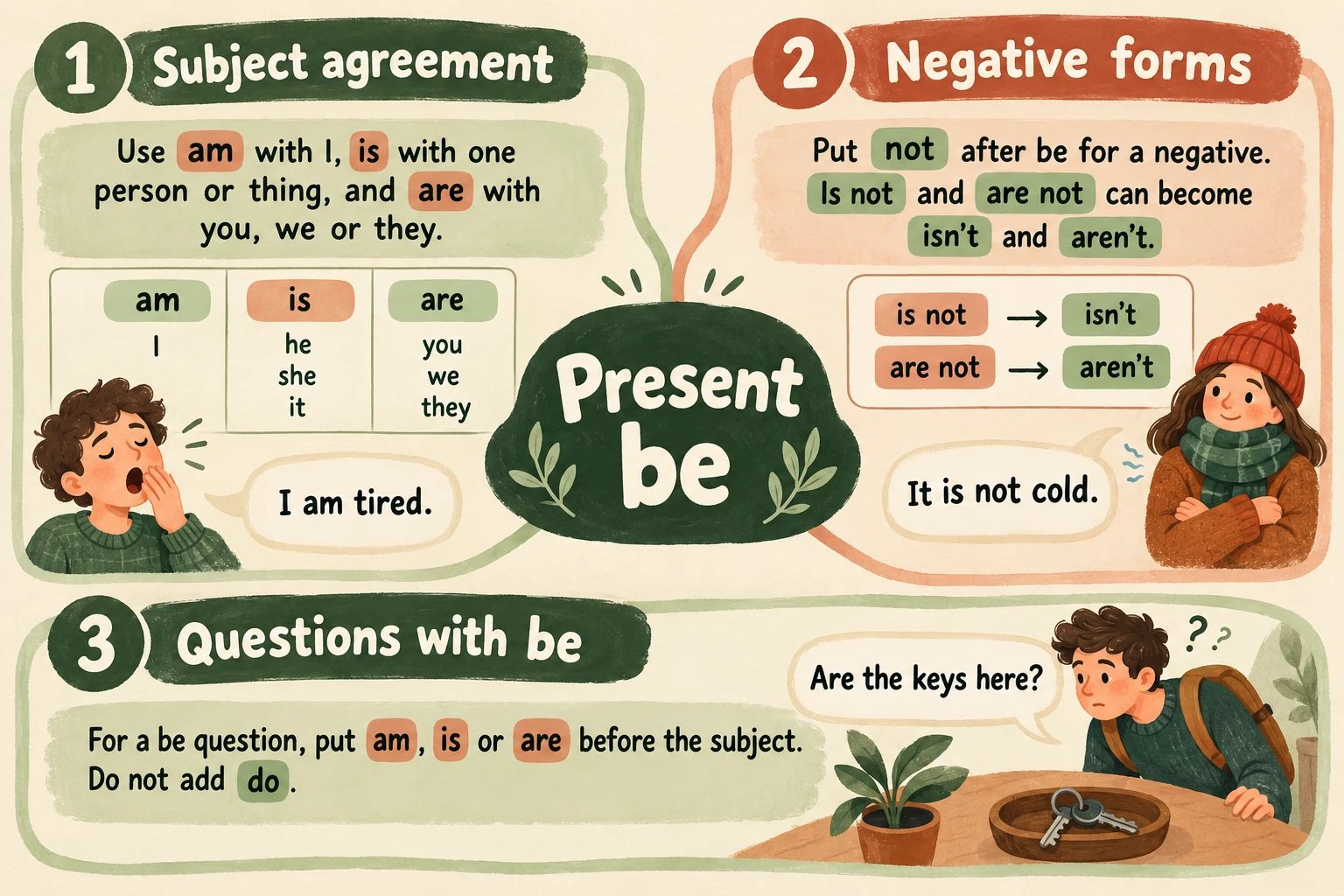
01Subject agreement
Use am with I, is with one person or thing, and are with you, we or they.
I am · you/we/they are · he/she/it is
Present be · A1. Use am with I, is with one person or thing, and are with you, we or they.
Practise Present be in short situations. Read the clue, choose or write a form, then check the reason. The level is an editorial guide.
Use am with I, is with one person or thing, and are with you, we or they.
I am · you/we/they are · he/she/it isPut not after be for a negative. Is not and are not can become isn’t and aren’t.
am/is/are + notFor a be question, put am, is or are before the subject. Do not add do.
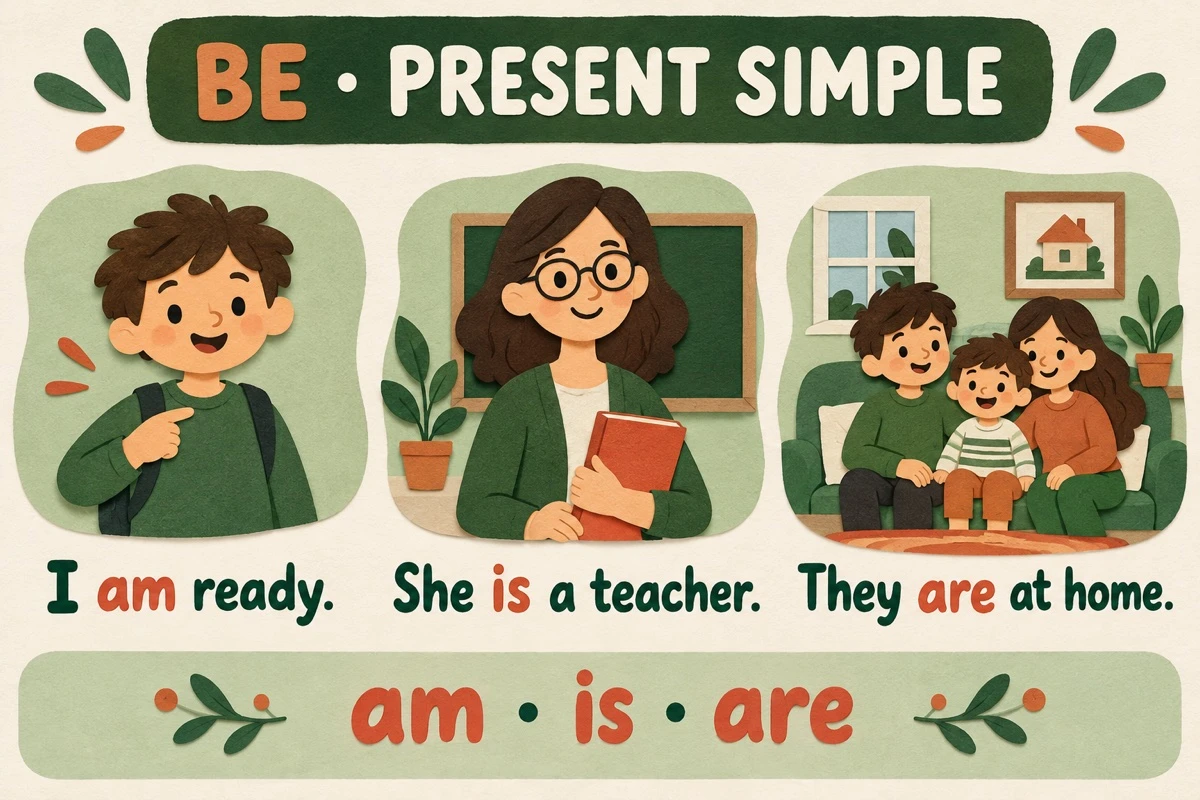
Am/Is/Are + subject …?I am ready.She is ready.They are ready.
I am not ready.She is not ready.They are not ready.
Am I ready?Is she ready?Are they ready?
Yes, I am.Yes, she is.No, they aren’t.
I ___ the new student in room 4.
Use am with I, is with one person or thing, and are with you, we or they.
I am tired.Put not after be for a negative. Is not and are not can become isn’t and aren’t.
It is not cold.For a be question, put am, is or are before the subject. Do not add do.
Are the keys here?Keep the first try. Understand the change. Check it in a fresh situation.
No practice notes yet. Try a short warm-up.
Use am with I, is with one person or thing, and are with you, we or they.
I am tired.Put not after be for a negative. Is not and are not can become isn’t and aren’t.
It is not cold.For a be question, put am, is or are before the subject. Do not add do.
Are the keys here?Opening an answer records help for that question.
I ___ the new student in room 4.
Look at “I ___ the new student in room 4.”. “I” goes with am; he/she/it and singular nouns go with is; you/we/they and plural nouns go with are. Put not after be for a negative state. Complete sentence: “I am the new student in room 4.”.
The library is closed, so it ___ open today.
Look at “The library is closed, so it ___ open today.”. “I” goes with am; he/she/it and singular nouns go with is; you/we/they and plural nouns go with are. Put not after be for a negative state. Complete sentence: “The library is closed, so it is not open today.”.
___ your parents at home now?
Look at “___ your parents at home now?”. “I” goes with am; he/she/it and singular nouns go with is; you/we/they and plural nouns go with are. Put not after be for a negative state. Complete sentence: “Are your parents at home now?”.
My sister ___ a bus driver.
Reference completion: “My sister is a bus driver.”. Use am with I, is with one person or thing, and are with you, we or they. Also accepted in this task: 's. These are reviewed alternatives, not an exhaustive list of all possible English.
We are on holiday; we ___ at work today.
Look at “We are on holiday; we ___ at work today.”. “I” goes with am; he/she/it and singular nouns go with is; you/we/they and plural nouns go with are. Put not after be for a negative state. Complete sentence: “We are on holiday; we are not at work today.”.
___ I in the right queue for tickets?
Look at “___ I in the right queue for tickets?”. “I” goes with am; he/she/it and singular nouns go with is; you/we/they and plural nouns go with are. Put not after be for a negative state. Complete sentence: “Am I in the right queue for tickets?”.
These seats ___ free; nobody is sitting here.
Reference completion: “These seats are free; nobody is sitting here.”. Use am with I, is with one person or thing, and are with you, we or they.
The two boxes ___ heavy.
Look at “The two boxes ___ heavy.”. “I” goes with am; he/she/it and singular nouns go with is; you/we/they and plural nouns go with are. Put not after be for a negative state. Complete sentence: “The two boxes are heavy.”.
Ben and I are students; we ___ teachers.
Look at “Ben and I are students; we ___ teachers.”. “I” goes with am; he/she/it and singular nouns go with is; you/we/they and plural nouns go with are. Put not after be for a negative state. Complete sentence: “Ben and I are students; we are not teachers.”.
___ the station near this hotel?
Reference completion: “Is the station near this hotel?”. For a be question, put am, is or are before the subject. Do not add do.
The lights are off. The shop ___ open.
Look at “The lights are off. The shop ___ open.”. “I” goes with am; he/she/it and singular nouns go with is; you/we/they and plural nouns go with are. Put not after be for a negative state. Complete sentence: “The lights are off. The shop is not open.”.
___ you ready to order, madam?
Reference completion: “Are you ready to order, madam?”. For a be question, put am, is or are before the subject. Do not add do.