01My, your, his and her
Use my, your, his or her before a noun to show the owner. Choose the owner’s form, not the thing’s gender.
This is my desk.
Possessive adjectives · A1. Use my, your, his or her before a noun to show the owner. Choose the owner’s form, not the thing’s gender.
Practise Possessive adjectives in short situations. Read the clue, choose or write a form, then check the reason. The level is an editorial guide.
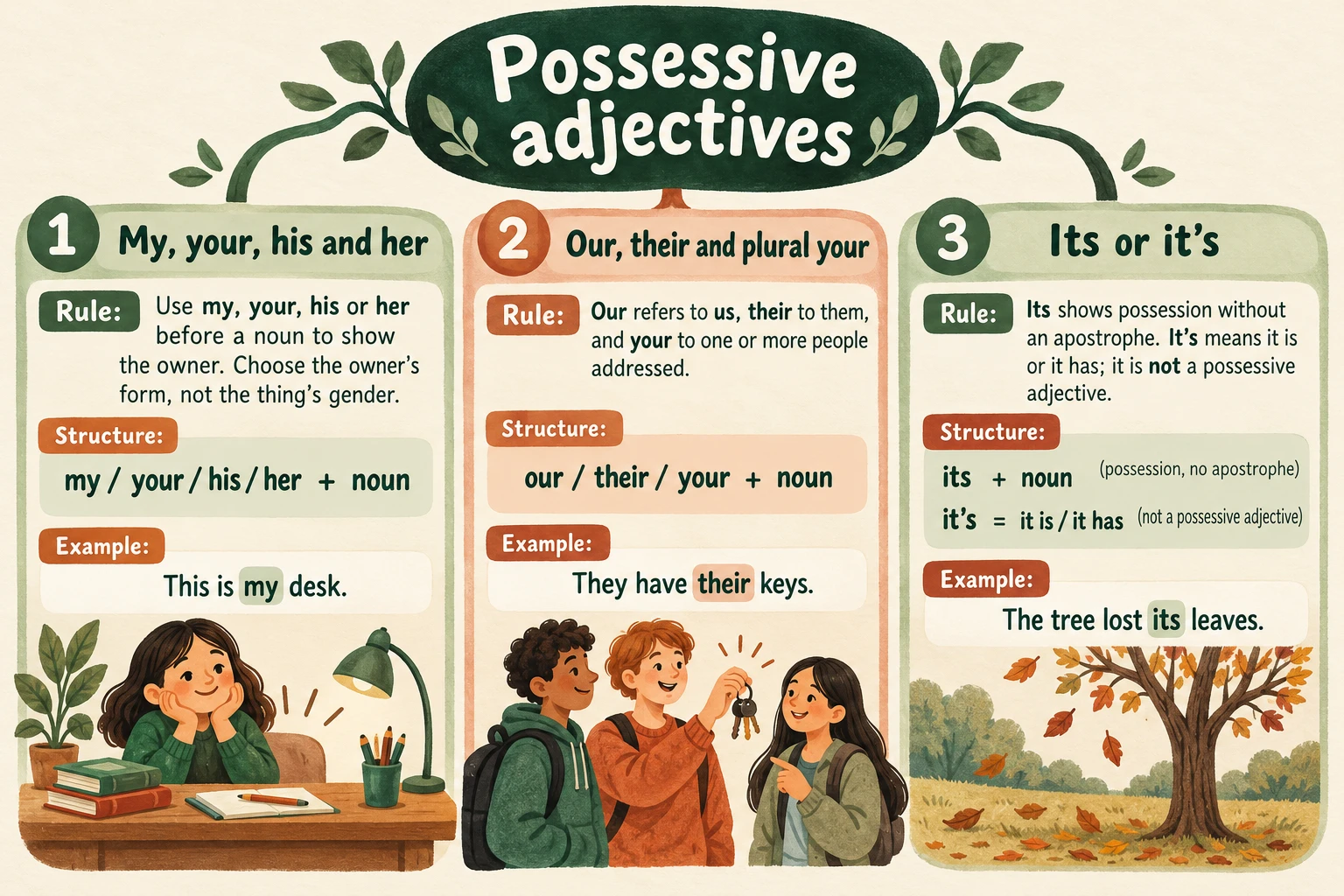
Use my, your, his or her before a noun to show the owner. Choose the owner’s form, not the thing’s gender.
This is my desk.Our refers to us, their to them, and your to one or more people addressed.
They have their keys.Its shows possession without an apostrophe. It’s means it is or it has; it is not a possessive adjective.
The tree lost its leaves.
I am looking for ___ phone. It belongs to me.
Use my, your, his or her before a noun to show the owner. Choose the owner’s form, not the thing’s gender.
This is my desk.Our refers to us, their to them, and your to one or more people addressed.
They have their keys.Its shows possession without an apostrophe. It’s means it is or it has; it is not a possessive adjective.
The tree lost its leaves.Keep the first try. Understand the change. Check it in a fresh situation.
No practice notes yet. Try a short warm-up.
Use my, your, his or her before a noun to show the owner. Choose the owner’s form, not the thing’s gender.
This is my desk.Our refers to us, their to them, and your to one or more people addressed.
They have their keys.Its shows possession without an apostrophe. It’s means it is or it has; it is not a possessive adjective.
The tree lost its leaves.Opening an answer records help for that question.
I am looking for ___ phone. It belongs to me.
Look at “I am looking for ___ phone. It belongs to me.”. Use my, your, his or her before a noun to show the owner. Choose the owner’s form, not the thing’s gender. Complete sentence: “I am looking for my phone. It belongs to me.”.
We live here. This is ___ flat.
Look at “We live here. This is ___ flat.”. Our refers to us, their to them, and your to one or more people addressed. Complete sentence: “We live here. This is our flat.”.
The dog is eating ___ food.
Look at “The dog is eating ___ food.”. Its shows possession without an apostrophe. It’s means it is or it has; it is not a possessive adjective. Complete sentence: “The dog is eating its food.”.
Maria is a teacher. ___ classroom is upstairs.
Reference completion: “Maria is a teacher. Her classroom is upstairs.”. Use my, your, his or her before a noun to show the owner. Choose the owner’s form, not the thing’s gender.
The boys have a tent. ___ tent is blue.
Look at “The boys have a tent. ___ tent is blue.”. Our refers to us, their to them, and your to one or more people addressed. Complete sentence: “The boys have a tent. Their tent is blue.”.
This robot can move ___ arms.
Look at “This robot can move ___ arms.”. Its shows possession without an apostrophe. It’s means it is or it has; it is not a possessive adjective. Complete sentence: “This robot can move its arms.”.
You own this bike. Is this ___ helmet too?
Reference completion: “You own this bike. Is this your helmet too?”. Use my, your, his or her before a noun to show the owner. Choose the owner’s form, not the thing’s gender.
Leo left ___ coat on the bus. It is Leo’s own coat, and he needs it tonight.
Look at “Leo left ___ coat on the bus. It is Leo’s own coat, and he needs it tonight.”. Use my, your, his or her before a noun to show the owner. Choose the owner’s form, not the thing’s gender. Complete sentence: “Leo left his coat on the bus. He needs it tonight.”.
You and Eva are invited. Bring ___ tickets: the tickets belonging to you and Eva.
Look at “You and Eva are invited. Bring ___ tickets: the tickets belonging to you and Eva.”. Our refers to us, their to them, and your to one or more people addressed. Complete sentence: “You and Eva are invited. Bring your tickets.”.
The hotel has changed ___ name.
Reference completion: “The hotel has changed its name.”. Its shows possession without an apostrophe. It’s means it is or it has; it is not a possessive adjective.
The children are in class. ___ bags are by the door.
Look at “The children are in class. ___ bags are by the door.”. Our refers to us, their to them, and your to one or more people addressed. Complete sentence: “The children are in class. Their bags are by the door.”.
The bird hurt ___ wing.
Reference completion: “The bird hurt its wing.”. Its shows possession without an apostrophe. It’s means it is or it has; it is not a possessive adjective. Also accepted in this task: his / her. These are reviewed alternatives, not an exhaustive list of all possible English.