01Regular plurals: -s and -es
Most countable nouns add -s in the plural. After endings such as -sh, -ch, -s and -x, add -es.
Two cups are clean.
Singular and plural nouns · A1. Most countable nouns add -s in the plural. After endings such as -sh, -ch, -s and -x, add -es.
Practise Singular and plural nouns in short situations. Read the clue, choose or write a form, then check the reason. The level is an editorial guide.
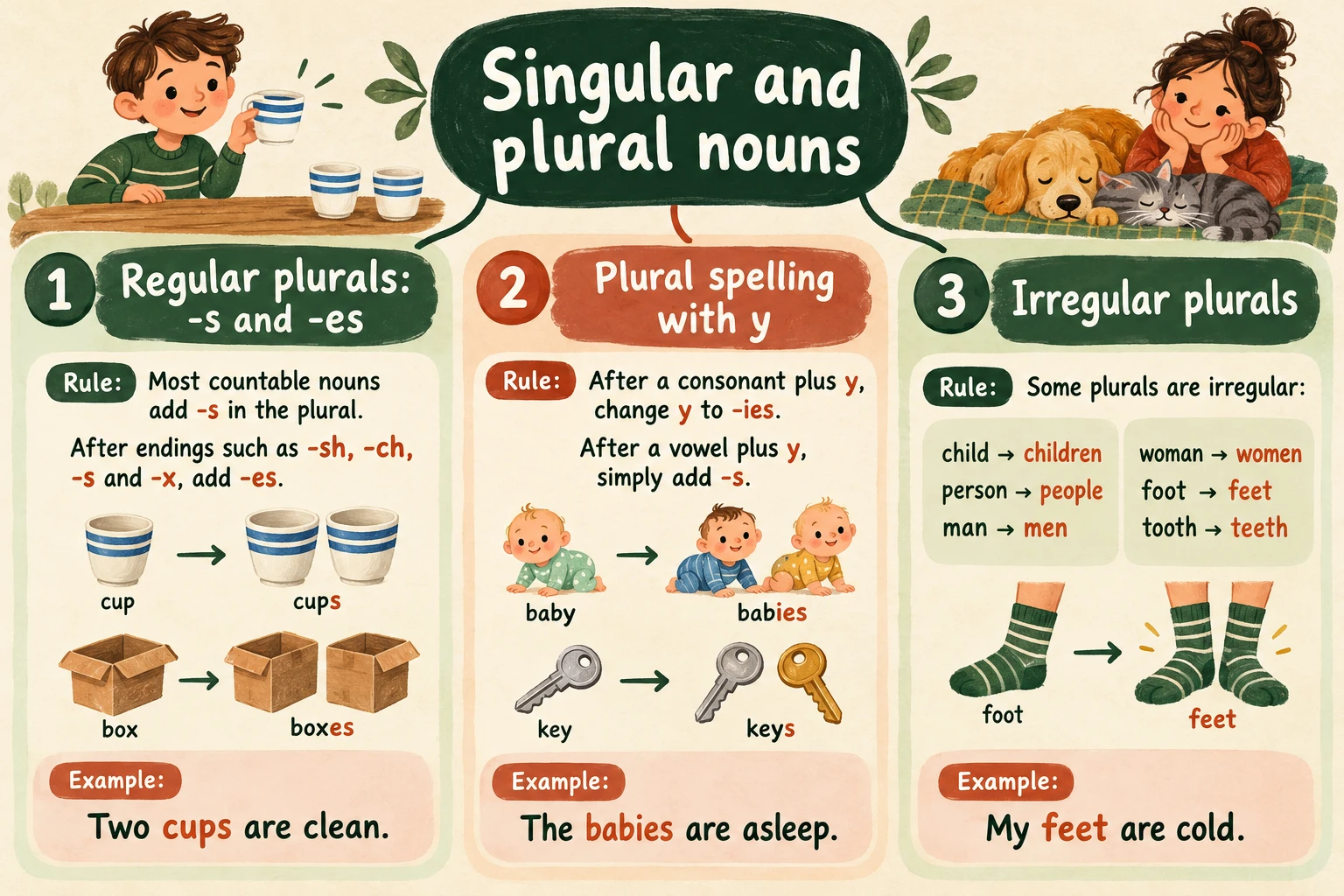
Most countable nouns add -s in the plural. After endings such as -sh, -ch, -s and -x, add -es.
Two cups are clean.After a consonant plus y, change y to -ies. After a vowel plus y, simply add -s.
The babies are asleep.Some plurals are irregular: child→children, person→people, man→men, woman→women, foot→feet, tooth→teeth.
My feet are cold.
The removal team carried three large ___ upstairs. (box)
Most countable nouns add -s in the plural. After endings such as -sh, -ch, -s and -x, add -es.
Two cups are clean.After a consonant plus y, change y to -ies. After a vowel plus y, simply add -s.
The babies are asleep.Some plurals are irregular: child→children, person→people, man→men, woman→women, foot→feet, tooth→teeth.
My feet are cold.Keep the first try. Understand the change. Check it in a fresh situation.
No practice notes yet. Try a short warm-up.
Most countable nouns add -s in the plural. After endings such as -sh, -ch, -s and -x, add -es.
Two cups are clean.After a consonant plus y, change y to -ies. After a vowel plus y, simply add -s.
The babies are asleep.Some plurals are irregular: child→children, person→people, man→men, woman→women, foot→feet, tooth→teeth.
My feet are cold.Opening an answer records help for that question.
The removal team carried three large ___ upstairs. (box)
Look at “The removal team carried three large ___ upstairs. (box)”. Most countable nouns add -s in the plural. After endings such as -sh, -ch, -s and -x, add -es. Complete sentence: “The removal team carried three large boxes upstairs. (box)”.
Our street has two new ___. (family)
Look at “Our street has two new ___. (family)”. After a consonant plus y, change y to -ies. After a vowel plus y, simply add -s. Complete sentence: “Our street has two new families. (family)”.
The school has sixty ___. (child)
Look at “The school has sixty ___. (child)”. Some plurals are irregular: child→children, person→people, man→men, woman→women, foot→feet, tooth→teeth. Complete sentence: “The school has sixty children. (child)”.
There are four ___ on this route. (bus)
Reference completion: “There are four buses on this route. (bus)”. Most countable nouns add -s in the plural. After endings such as -sh, -ch, -s and -x, add -es. Buses is the usual teaching form; busses is also a standard plural spelling of bus and is accepted here.
The twins share their ___. (toy)
Look at “The twins share their ___. (toy)”. The task asks for a plural noun. Toy ends in vowel + y, so keep y and add -s: toys. Complete sentence: “The twins share their toys. (toy)”.
Five ___ work in the laboratory. (woman)
Look at “Five ___ work in the laboratory. (woman)”. Some plurals are irregular: child→children, person→people, man→men, woman→women, foot→feet, tooth→teeth. Complete sentence: “Five women work in the laboratory. (woman)”.
I washed six ___ after lunch. (dish)
Reference completion: “I washed six dishes after lunch. (dish)”. Most countable nouns add -s in the plural. After endings such as -sh, -ch, -s and -x, add -es.
We packed eight ___ for the art class. (brush)
Look at “We packed eight ___ for the art class. (brush)”. Most countable nouns add -s in the plural. After endings such as -sh, -ch, -s and -x, add -es. Complete sentence: “We packed eight brushes for the art class. (brush)”.
The library serves three nearby ___. (city)
Look at “The library serves three nearby ___. (city)”. After a consonant plus y, change y to -ies. After a vowel plus y, simply add -s. Complete sentence: “The library serves three nearby cities. (city)”.
The baby has two new ___. (tooth)
Reference completion: “The baby has two new teeth. (tooth)”. Some plurals are irregular: child→children, person→people, man→men, woman→women, foot→feet, tooth→teeth.
The shop sells small ___ for doors. (key)
Look at “The shop sells small ___ for doors. (key)”. After a consonant plus y, change y to -ies. After a vowel plus y, simply add -s. Complete sentence: “The shop sells small keys for doors. (key)”.
Two ___ are waiting at reception. (person)
Two requires a plural. People is the normal everyday plural of person; persons is also a standard, more formal plural and is accepted here. Also accepted in this task: persons. These are reviewed alternatives, not an exhaustive list of all possible English.