01Rutinas y repetición
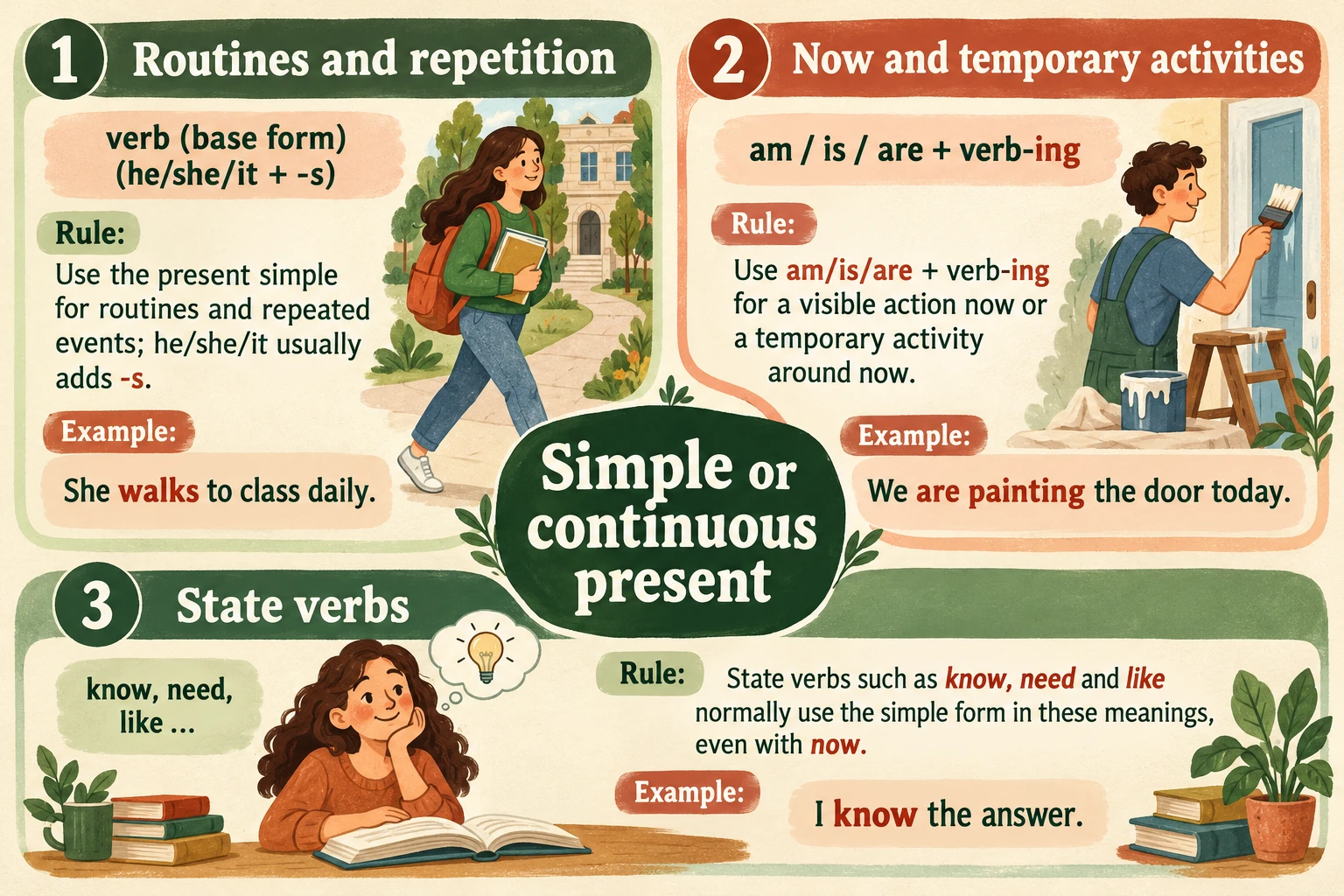
El presente simple expresa rutinas; con he/she/it normalmente se añade -s.
She walks to class daily.
Presente simple o continuo · A1. El presente simple expresa rutinas; con he/she/it normalmente se añade -s.
Practica Presente simple o continuo en situaciones breves. Lee la pista, elige o escribe una forma y revisa la explicación. El nivel es una orientación editorial.
El presente simple expresa rutinas; con he/she/it normalmente se añade -s.
She walks to class daily.Usa am/is/are + verbo-ing para acciones actuales o actividades temporales.
We are painting the door today.Verbos de estado como know, need y like suelen ir en presente simple con estos significados, incluso con now.
I know the answer.
Every Monday, Ben ___ to work. (cycle)
El presente simple expresa rutinas; con he/she/it normalmente se añade -s.
She walks to class daily.Usa am/is/are + verbo-ing para acciones actuales o actividades temporales.
We are painting the door today.Verbos de estado como know, need y like suelen ir en presente simple con estos significados, incluso con now.
I know the answer.Conserva el primer intento, entiende el cambio y compruébalo en otra situación.
Aún no hay repasos. Prueba un calentamiento corto.
El presente simple expresa rutinas; con he/she/it normalmente se añade -s.
She walks to class daily.Usa am/is/are + verbo-ing para acciones actuales o actividades temporales.
We are painting the door today.Verbos de estado como know, need y like suelen ir en presente simple con estos significados, incluso con now.
I know the answer.Abrir una respuesta registra ayuda para esa pregunta.
Every Monday, Ben ___ to work. (cycle)
Mira «Every Monday, Ben ___ to work. (cycle)». El presente simple expresa rutinas; con he/she/it normalmente se añade -s. Oración completa: «Every Monday, Ben cycles to work. (cycle)».
Be quiet! The baby ___ now. (sleep)
Mira «Be quiet! The baby ___ now. (sleep)». Usa am/is/are + verbo-ing para acciones actuales o actividades temporales. Oración completa: «Be quiet! The baby is sleeping now. (sleep)».
I ___ your address now; you told me yesterday. (know)
Mira «I ___ your address now; you told me yesterday. (know)». Verbos de estado como know, need y like suelen ir en presente simple con estos significados, incluso con now. Oración completa: «I know your address now; you told me yesterday. (know)».
My parents ___ coffee every morning. (drink)
Oración de referencia: «My parents drink coffee every morning. (drink)». El presente simple expresa rutinas; con he/she/it normalmente se añade -s.
I usually work at home, but this week I ___ in the office. (work)
Mira «I usually work at home, but this week I ___ in the office. (work)». Usa am/is/are + verbo-ing para acciones actuales o actividades temporales. Oración completa: «I usually work at home, but this week I am working in the office. (work)».
We ___ a larger table; this one is too small. (need)
Mira «We ___ a larger table; this one is too small. (need)». Verbos de estado como know, need y like suelen ir en presente simple con estos significados, incluso con now. Oración completa: «We need a larger table; this one is too small. (need)».
This bus ___ here at six every day. (stop)
Oración de referencia: «This bus stops here at six every day. (stop)». El presente simple expresa rutinas; con he/she/it normalmente se añade -s.
Kai ___ his grandmother every Sunday. (visit)
Mira «Kai ___ his grandmother every Sunday. (visit)». El presente simple expresa rutinas; con he/she/it normalmente se añade -s. Oración completa: «Kai visits his grandmother every Sunday. (visit)».
Look at Mia! She ___ a kite. (fly)
Mira «Look at Mia! She ___ a kite. (fly)». Usa am/is/are + verbo-ing para acciones actuales o actividades temporales. Oración completa: «Look at Mia! She is flying a kite. (fly)».
Sara ___ this song. It is her favourite. (like)
Oración de referencia: «Sara likes this song. It is her favourite. (like)». Verbos de estado como know, need y like suelen ir en presente simple con estos significados, incluso con now.
The shop is closed for repairs, so we ___ online this month. (sell)
Mira «The shop is closed for repairs, so we ___ online this month. (sell)». Usa am/is/are + verbo-ing para acciones actuales o actividades temporales. Oración completa: «The shop is closed for repairs, so we are selling online this month. (sell)».
This soup ___ wonderful. I can smell the garlic. (smell)
Oración de referencia: «This soup smells wonderful. I can smell the garlic. (smell)». Verbos de estado como know, need y like suelen ir en presente simple con estos significados, incluso con now.