01A before consonant sounds
Use a before a consonant sound in a singular countable noun phrase. Sound matters: a university begins with /j/.
A doctor lives here.
A, an and the · A1. Use a before a consonant sound in a singular countable noun phrase. Sound matters: a university begins with /j/.
Practise A, an and the in short situations. Read the clue, choose or write a form, then check the reason. The level is an editorial guide.
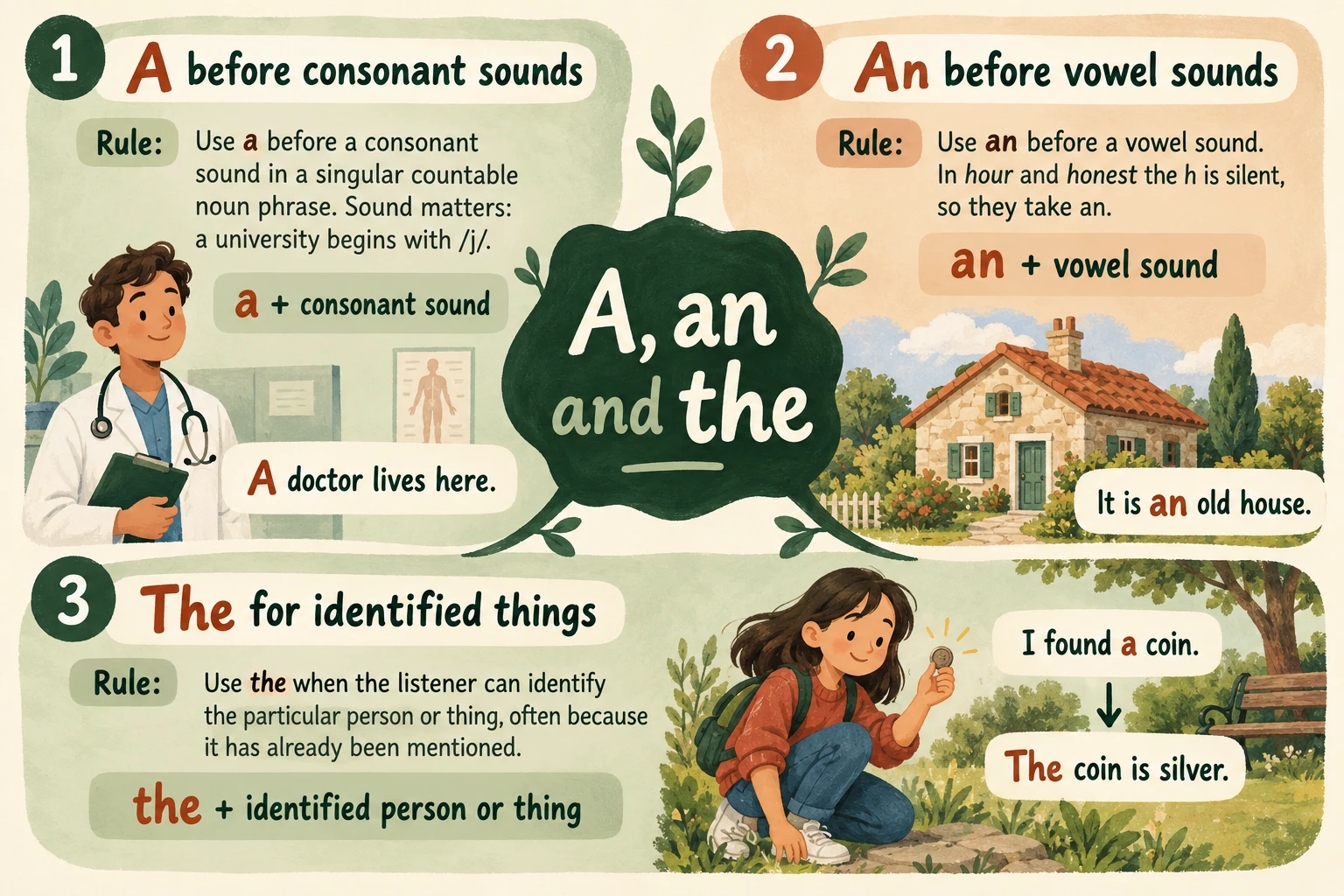
Use a before a consonant sound in a singular countable noun phrase. Sound matters: a university begins with /j/.
A doctor lives here.Use an before a vowel sound. In hour and honest the h is silent, so they take an.
It is an old house.Use the when the listener can identify the particular person or thing, often because it has already been mentioned.
I found a coin. The coin is silver.
Use an indefinite article for a non-specific singular reference: Rina is ___ dentist at a clinic near here.
Use a before a consonant sound in a singular countable noun phrase. Sound matters: a university begins with /j/.
A doctor lives here.Use an before a vowel sound. In hour and honest the h is silent, so they take an.
It is an old house.Use the when the listener can identify the particular person or thing, often because it has already been mentioned.
I found a coin. The coin is silver.Keep the first try. Understand the change. Check it in a fresh situation.
No practice notes yet. Try a short warm-up.
Use a before a consonant sound in a singular countable noun phrase. Sound matters: a university begins with /j/.
A doctor lives here.Use an before a vowel sound. In hour and honest the h is silent, so they take an.
It is an old house.Use the when the listener can identify the particular person or thing, often because it has already been mentioned.
I found a coin. The coin is silver.Opening an answer records help for that question.
Use an indefinite article for a non-specific singular reference: Rina is ___ dentist at a clinic near here.
Look at “Use an indefinite article for a non-specific singular reference: Rina is ___ dentist at a clinic near here.”. Use a before a consonant sound in a singular countable noun phrase. Sound matters: a university begins with /j/. Complete sentence: “Use an indefinite article for a non-specific singular reference: Rina is a dentist at a clinic near here.”.
Use an indefinite article for a non-specific singular reference: We waited for ___ hour outside the cinema.
Look at “Use an indefinite article for a non-specific singular reference: We waited for ___ hour outside the cinema.”. Use an before a vowel sound. In hour and honest the h is silent, so they take an. Complete sentence: “Use an indefinite article for a non-specific singular reference: We waited for an hour outside the cinema.”.
I bought a lamp yesterday. ___ lamp is now on my desk.
Look at “I bought a lamp yesterday. ___ lamp is now on my desk.”. Use the when the listener can identify the particular person or thing, often because it has already been mentioned. Complete sentence: “I bought a lamp yesterday. The lamp is now on my desk.”.
Use an indefinite article for a non-specific singular reference: There is ___ university beside the river.
Reference completion: “Use an indefinite article for a non-specific singular reference: There is a university beside the river.”. Use a before a consonant sound in a singular countable noun phrase. Sound matters: a university begins with /j/.
Use an indefinite article for a first, non-specific mention: Please bring ___ umbrella; any one will do.
Look at “Use an indefinite article for a first, non-specific mention: Please bring ___ umbrella; any one will do.”. Use an before a vowel sound. In hour and honest the h is silent, so they take an. Complete sentence: “Use an indefinite article for a first, non-specific mention: Please bring an umbrella; any one will do.”.
I saw a cat under our car. ___ cat had a red collar.
Look at “I saw a cat under our car. ___ cat had a red collar.”. Use the when the listener can identify the particular person or thing, often because it has already been mentioned. Complete sentence: “I saw a cat under our car. The cat had a red collar.”.
Use an indefinite article for a non-specific singular reference: My cousin wants to be ___ pilot.
Reference completion: “Use an indefinite article for a non-specific singular reference: My cousin wants to be a pilot.”. Use a before a consonant sound in a singular countable noun phrase. Sound matters: a university begins with /j/.
Use an indefinite article for a non-specific singular reference: We need ___ useful map for the walk.
Look at “Use an indefinite article for a non-specific singular reference: We need ___ useful map for the walk.”. Use a before a consonant sound in a singular countable noun phrase. Sound matters: a university begins with /j/. Complete sentence: “Use an indefinite article for a non-specific singular reference: We need a useful map for the walk.”.
Use an indefinite article for a non-specific singular reference: He gave us ___ honest answer.
Look at “Use an indefinite article for a non-specific singular reference: He gave us ___ honest answer.”. Use an before a vowel sound. In hour and honest the h is silent, so they take an. Complete sentence: “Use an indefinite article for a non-specific singular reference: He gave us an honest answer.”.
I put a key in your bag. Please find ___ key.
Reference completion: “I put a key in your bag. Please find the key.”. Use the when the listener can identify the particular person or thing, often because it has already been mentioned.
Use an indefinite article for a non-specific singular reference: There is ___ egg in the small bowl. Any egg will do.
Look at “Use an indefinite article for a non-specific singular reference: There is ___ egg in the small bowl. Any egg will do.”. Use an before a vowel sound. In hour and honest the h is silent, so they take an. Complete sentence: “Use an indefinite article for a non-specific singular reference: There is an egg in the small bowl. Any egg will do.”.
I opened a book on the train. ___ book was about bees.
Reference completion: “I opened a book on the train. The book was about bees.”. Use the when the listener can identify the particular person or thing, often because it has already been mentioned.