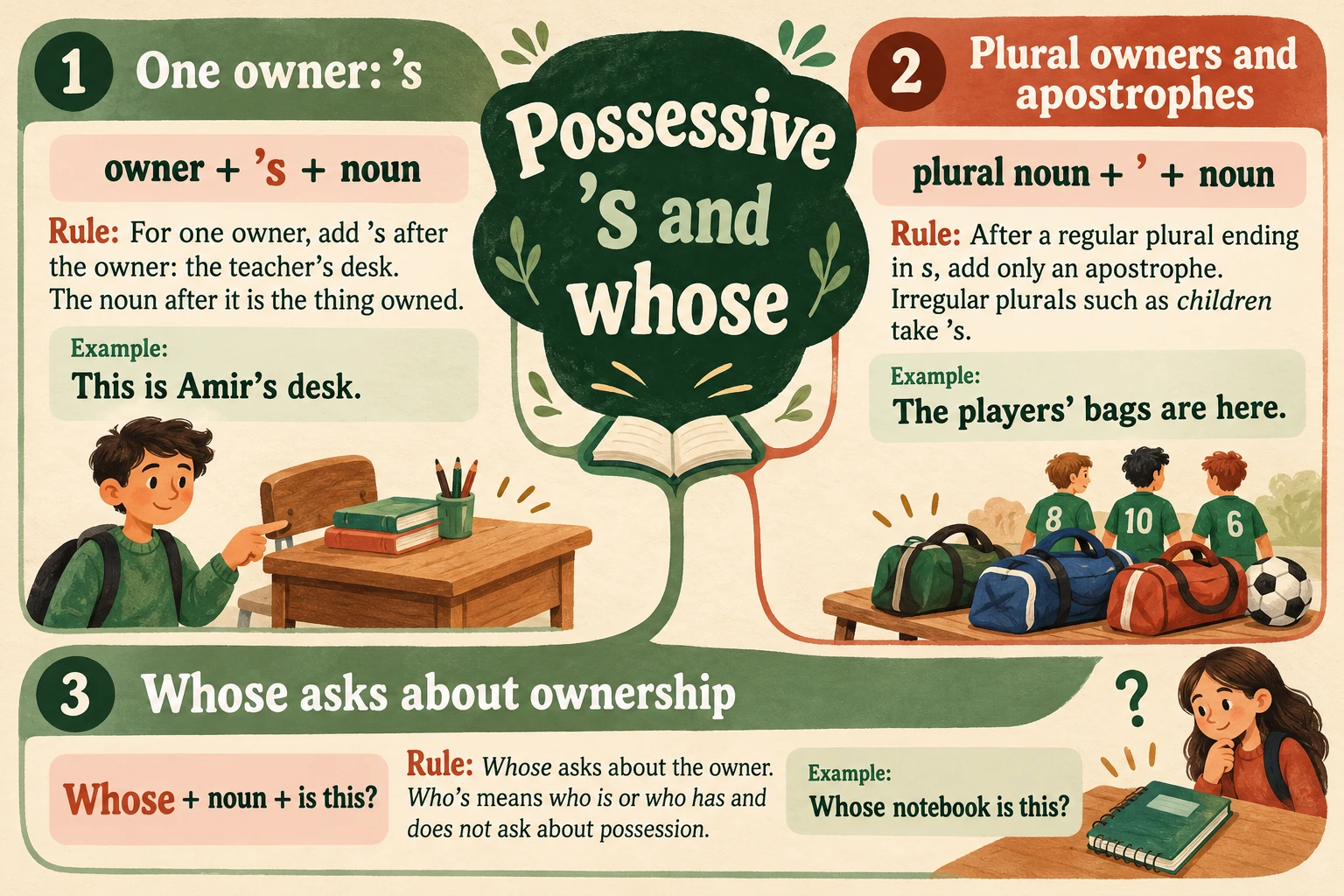
01One owner: ’s
For one owner, add ’s after the owner: the teacher’s desk. The noun after it is the thing owned.
This is Amir’s desk.
Possessive ’s and whose · A1. For one owner, add ’s after the owner: the teacher’s desk. The noun after it is the thing owned.
Practise Possessive ’s and whose in short situations. Read the clue, choose or write a form, then check the reason. The level is an editorial guide.
For one owner, add ’s after the owner: the teacher’s desk. The noun after it is the thing owned.
This is Amir’s desk.After a regular plural ending in s, add only an apostrophe. Irregular plurals such as children take ’s.
The players’ bags are here.Whose asks about the owner. Who’s means who is or who has and does not ask about possession.
Whose notebook is this?
This bag belongs to one girl, Eva. It is ___ bag.
For one owner, add ’s after the owner: the teacher’s desk. The noun after it is the thing owned.
This is Amir’s desk.After a regular plural ending in s, add only an apostrophe. Irregular plurals such as children take ’s.
The players’ bags are here.Whose asks about the owner. Who’s means who is or who has and does not ask about possession.
Whose notebook is this?Keep the first try. Understand the change. Check it in a fresh situation.
No practice notes yet. Try a short warm-up.
For one owner, add ’s after the owner: the teacher’s desk. The noun after it is the thing owned.
This is Amir’s desk.After a regular plural ending in s, add only an apostrophe. Irregular plurals such as children take ’s.
The players’ bags are here.Whose asks about the owner. Who’s means who is or who has and does not ask about possession.
Whose notebook is this?Opening an answer records help for that question.
This bag belongs to one girl, Eva. It is ___ bag.
Look at “This bag belongs to one girl, Eva. It is ___ bag.”. For one owner, add ’s after the owner: the teacher’s desk. The noun after it is the thing owned. Complete sentence: “This bag belongs to one girl, Eva. It is Eva’s bag.”.
Two teachers share an office. It is the ___ office.
Look at “Two teachers share an office. It is the ___ office.”. After a regular plural ending in s, add only an apostrophe. Irregular plurals such as children take ’s. Complete sentence: “Two teachers share an office. It is the teachers’ office.”.
___ coat is this? — It belongs to Ali.
Look at “___ coat is this? — It belongs to Ali.”. Whose asks about the owner. Who’s means who is or who has and does not ask about possession. Complete sentence: “Whose coat is this? — It belongs to Ali.”.
One doctor uses this room. It is the ___ room.
Reference completion: “One doctor uses this room. It is the doctor’s room.”. For one owner, add ’s after the owner: the teacher’s desk. The noun after it is the thing owned.
The toys belong to the children. They are the ___ toys.
Look at “The toys belong to the children. They are the ___ toys.”. After a regular plural ending in s, add only an apostrophe. Irregular plurals such as children take ’s. Complete sentence: “The toys belong to the children. They are the children’s toys.”.
___ keys are on the desk? — Mina’s keys.
Look at “___ keys are on the desk? — Mina’s keys.”. Whose asks about the owner. Who’s means who is or who has and does not ask about possession. Complete sentence: “Whose keys are on the desk? — Mina’s keys.”.
My sister owns this car. It is my ___ car.
Reference completion: “My sister owns this car. It is my sister’s car.”. For one owner, add ’s after the owner: the teacher’s desk. The noun after it is the thing owned.
One neighbour lent me his ladder. It is my ___ ladder.
Look at “One neighbour lent me his ladder. It is my ___ ladder.”. For one owner, add ’s after the owner: the teacher’s desk. The noun after it is the thing owned. Complete sentence: “One neighbour lent me his ladder. It is my neighbour’s ladder.”.
The rooms belong to three students. They are the ___ rooms.
Look at “The rooms belong to three students. They are the ___ rooms.”. After a regular plural ending in s, add only an apostrophe. Irregular plurals such as children take ’s. Complete sentence: “The rooms belong to three students. They are the students’ rooms.”.
___ lunch is in the green box? — Omar’s.
Reference completion: “Whose lunch is in the green box? — Omar’s.”. Whose asks about the owner. Who’s means who is or who has and does not ask about possession.
The coats belong to the women in that room. They are the ___ coats.
Look at “The coats belong to the women in that room. They are the ___ coats.”. After a regular plural ending in s, add only an apostrophe. Irregular plurals such as children take ’s. Complete sentence: “The coats belong to the women in that room. They are the women’s coats.”.
___ phone rang just now? — Carla’s phone.
Reference completion: “Whose phone rang just now? — Carla’s phone.”. Whose asks about the owner. Who’s means who is or who has and does not ask about possession.