01Un poseedor: ’s
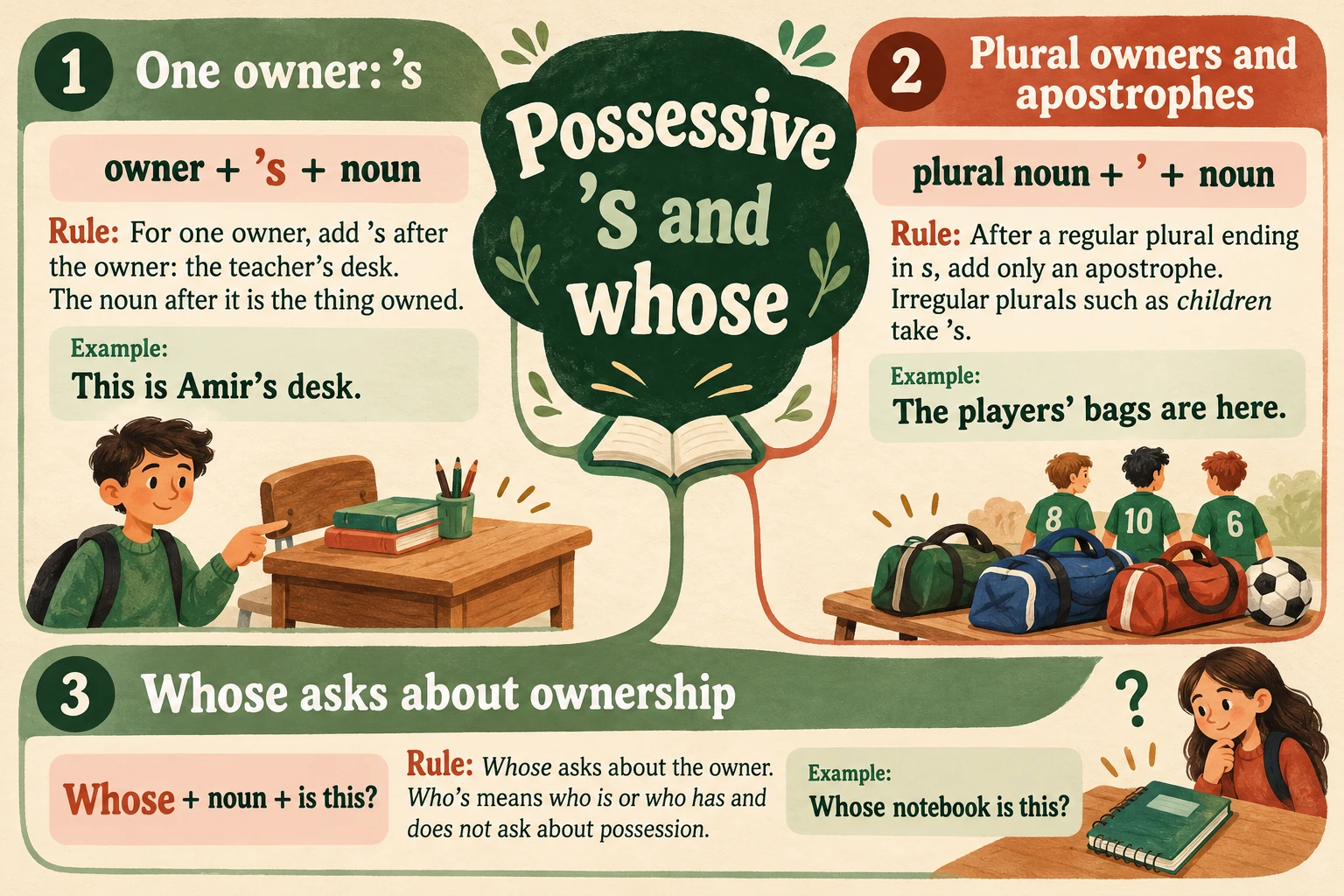
Con un solo poseedor añade ’s: the teacher’s desk. El nombre siguiente indica la cosa poseída.
This is Amir’s desk.
Posesivo ’s y whose · A1. Con un solo poseedor añade ’s: the teacher’s desk. El nombre siguiente indica la cosa poseída.
Practica Posesivo ’s y whose en situaciones breves. Lee la pista, elige o escribe una forma y revisa la explicación. El nivel es una orientación editorial.
Con un solo poseedor añade ’s: the teacher’s desk. El nombre siguiente indica la cosa poseída.
This is Amir’s desk.Tras un plural regular en s añade solo apóstrofo. Los plurales irregulares como children llevan ’s.
The players’ bags are here.Whose pregunta por el poseedor. Who’s significa who is o who has, no expresa posesión.
Whose notebook is this?
This bag belongs to one girl, Eva. It is ___ bag.
Con un solo poseedor añade ’s: the teacher’s desk. El nombre siguiente indica la cosa poseída.
This is Amir’s desk.Tras un plural regular en s añade solo apóstrofo. Los plurales irregulares como children llevan ’s.
The players’ bags are here.Whose pregunta por el poseedor. Who’s significa who is o who has, no expresa posesión.
Whose notebook is this?Conserva el primer intento, entiende el cambio y compruébalo en otra situación.
Aún no hay repasos. Prueba un calentamiento corto.
Con un solo poseedor añade ’s: the teacher’s desk. El nombre siguiente indica la cosa poseída.
This is Amir’s desk.Tras un plural regular en s añade solo apóstrofo. Los plurales irregulares como children llevan ’s.
The players’ bags are here.Whose pregunta por el poseedor. Who’s significa who is o who has, no expresa posesión.
Whose notebook is this?Abrir una respuesta registra ayuda para esa pregunta.
This bag belongs to one girl, Eva. It is ___ bag.
Mira «This bag belongs to one girl, Eva. It is ___ bag.». Con un solo poseedor añade ’s: the teacher’s desk. El nombre siguiente indica la cosa poseída. Oración completa: «This bag belongs to one girl, Eva. It is Eva’s bag.».
Two teachers share an office. It is the ___ office.
Mira «Two teachers share an office. It is the ___ office.». Tras un plural regular en s añade solo apóstrofo. Los plurales irregulares como children llevan ’s. Oración completa: «Two teachers share an office. It is the teachers’ office.».
___ coat is this? — It belongs to Ali.
Mira «___ coat is this? — It belongs to Ali.». Whose pregunta por el poseedor. Who’s significa who is o who has, no expresa posesión. Oración completa: «Whose coat is this? — It belongs to Ali.».
One doctor uses this room. It is the ___ room.
Oración de referencia: «One doctor uses this room. It is the doctor’s room.». Con un solo poseedor añade ’s: the teacher’s desk. El nombre siguiente indica la cosa poseída.
The toys belong to the children. They are the ___ toys.
Mira «The toys belong to the children. They are the ___ toys.». Tras un plural regular en s añade solo apóstrofo. Los plurales irregulares como children llevan ’s. Oración completa: «The toys belong to the children. They are the children’s toys.».
___ keys are on the desk? — Mina’s keys.
Mira «___ keys are on the desk? — Mina’s keys.». Whose pregunta por el poseedor. Who’s significa who is o who has, no expresa posesión. Oración completa: «Whose keys are on the desk? — Mina’s keys.».
My sister owns this car. It is my ___ car.
Oración de referencia: «My sister owns this car. It is my sister’s car.». Con un solo poseedor añade ’s: the teacher’s desk. El nombre siguiente indica la cosa poseída.
One neighbour lent me his ladder. It is my ___ ladder.
Mira «One neighbour lent me his ladder. It is my ___ ladder.». Con un solo poseedor añade ’s: the teacher’s desk. El nombre siguiente indica la cosa poseída. Oración completa: «One neighbour lent me his ladder. It is my neighbour’s ladder.».
The rooms belong to three students. They are the ___ rooms.
Mira «The rooms belong to three students. They are the ___ rooms.». Tras un plural regular en s añade solo apóstrofo. Los plurales irregulares como children llevan ’s. Oración completa: «The rooms belong to three students. They are the students’ rooms.».
___ lunch is in the green box? — Omar’s.
Oración de referencia: «Whose lunch is in the green box? — Omar’s.». Whose pregunta por el poseedor. Who’s significa who is o who has, no expresa posesión.
The coats belong to the women in that room. They are the ___ coats.
Mira «The coats belong to the women in that room. They are the ___ coats.». Tras un plural regular en s añade solo apóstrofo. Los plurales irregulares como children llevan ’s. Oración completa: «The coats belong to the women in that room. They are the women’s coats.».
___ phone rang just now? — Carla’s phone.
Oración de referencia: «Whose phone rang just now? — Carla’s phone.». Whose pregunta por el poseedor. Who’s significa who is o who has, no expresa posesión.