01Ein Besitzer: ’s
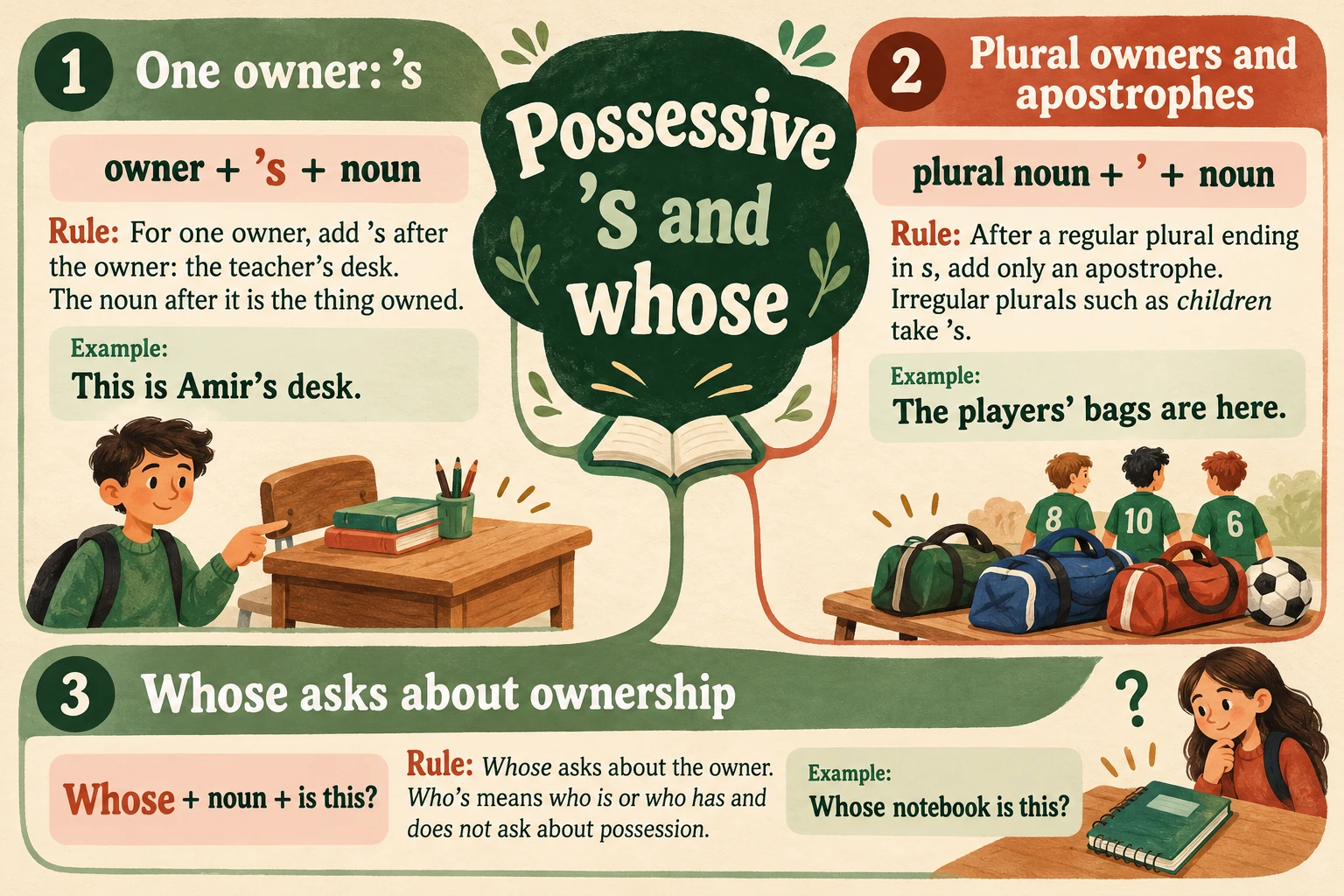
Bei einem Besitzer folgt ’s: the teacher’s desk. Das folgende Nomen bezeichnet den Besitz.
This is Amir’s desk.
Possessiv-s und whose · A1. Bei einem Besitzer folgt ’s: the teacher’s desk. Das folgende Nomen bezeichnet den Besitz.
Übe Possessiv-s und whose in kurzen Situationen. Lies den Hinweis, wähle oder schreibe eine Form und prüfe die Begründung. Die Stufe dient der redaktionellen Orientierung.
Bei einem Besitzer folgt ’s: the teacher’s desk. Das folgende Nomen bezeichnet den Besitz.
This is Amir’s desk.Bei regelmäßigem Plural auf s folgt nur ein Apostroph. Unregelmäßiger Plural wie children erhält ’s.
The players’ bags are here.Whose fragt nach dem Besitzer. Who’s heißt who is oder who has und fragt nicht nach Besitz.
Whose notebook is this?
This bag belongs to one girl, Eva. It is ___ bag.
Bei einem Besitzer folgt ’s: the teacher’s desk. Das folgende Nomen bezeichnet den Besitz.
This is Amir’s desk.Bei regelmäßigem Plural auf s folgt nur ein Apostroph. Unregelmäßiger Plural wie children erhält ’s.
The players’ bags are here.Whose fragt nach dem Besitzer. Who’s heißt who is oder who has und fragt nicht nach Besitz.
Whose notebook is this?Bewahre den ersten Versuch. Verstehe die Änderung. Prüfe sie in einer neuen Situation.
Noch keine Lernnotizen. Starte mit einem kurzen Einstieg.
Bei einem Besitzer folgt ’s: the teacher’s desk. Das folgende Nomen bezeichnet den Besitz.
This is Amir’s desk.Bei regelmäßigem Plural auf s folgt nur ein Apostroph. Unregelmäßiger Plural wie children erhält ’s.
The players’ bags are here.Whose fragt nach dem Besitzer. Who’s heißt who is oder who has und fragt nicht nach Besitz.
Whose notebook is this?Das Öffnen einer Antwort wird für diese Aufgabe als Hilfe erfasst.
This bag belongs to one girl, Eva. It is ___ bag.
Achte auf „This bag belongs to one girl, Eva. It is ___ bag.“. Bei einem Besitzer folgt ’s: the teacher’s desk. Das folgende Nomen bezeichnet den Besitz. Vollständiger Satz: „This bag belongs to one girl, Eva. It is Eva’s bag.“.
Two teachers share an office. It is the ___ office.
Achte auf „Two teachers share an office. It is the ___ office.“. Bei regelmäßigem Plural auf s folgt nur ein Apostroph. Unregelmäßiger Plural wie children erhält ’s. Vollständiger Satz: „Two teachers share an office. It is the teachers’ office.“.
___ coat is this? — It belongs to Ali.
Achte auf „___ coat is this? — It belongs to Ali.“. Whose fragt nach dem Besitzer. Who’s heißt who is oder who has und fragt nicht nach Besitz. Vollständiger Satz: „Whose coat is this? — It belongs to Ali.“.
One doctor uses this room. It is the ___ room.
Vollständiger Beispielsatz: „One doctor uses this room. It is the doctor’s room.“. Bei einem Besitzer folgt ’s: the teacher’s desk. Das folgende Nomen bezeichnet den Besitz.
The toys belong to the children. They are the ___ toys.
Achte auf „The toys belong to the children. They are the ___ toys.“. Bei regelmäßigem Plural auf s folgt nur ein Apostroph. Unregelmäßiger Plural wie children erhält ’s. Vollständiger Satz: „The toys belong to the children. They are the children’s toys.“.
___ keys are on the desk? — Mina’s keys.
Achte auf „___ keys are on the desk? — Mina’s keys.“. Whose fragt nach dem Besitzer. Who’s heißt who is oder who has und fragt nicht nach Besitz. Vollständiger Satz: „Whose keys are on the desk? — Mina’s keys.“.
My sister owns this car. It is my ___ car.
Vollständiger Beispielsatz: „My sister owns this car. It is my sister’s car.“. Bei einem Besitzer folgt ’s: the teacher’s desk. Das folgende Nomen bezeichnet den Besitz.
One neighbour lent me his ladder. It is my ___ ladder.
Achte auf „One neighbour lent me his ladder. It is my ___ ladder.“. Bei einem Besitzer folgt ’s: the teacher’s desk. Das folgende Nomen bezeichnet den Besitz. Vollständiger Satz: „One neighbour lent me his ladder. It is my neighbour’s ladder.“.
The rooms belong to three students. They are the ___ rooms.
Achte auf „The rooms belong to three students. They are the ___ rooms.“. Bei regelmäßigem Plural auf s folgt nur ein Apostroph. Unregelmäßiger Plural wie children erhält ’s. Vollständiger Satz: „The rooms belong to three students. They are the students’ rooms.“.
___ lunch is in the green box? — Omar’s.
Vollständiger Beispielsatz: „Whose lunch is in the green box? — Omar’s.“. Whose fragt nach dem Besitzer. Who’s heißt who is oder who has und fragt nicht nach Besitz.
The coats belong to the women in that room. They are the ___ coats.
Achte auf „The coats belong to the women in that room. They are the ___ coats.“. Bei regelmäßigem Plural auf s folgt nur ein Apostroph. Unregelmäßiger Plural wie children erhält ’s. Vollständiger Satz: „The coats belong to the women in that room. They are the women’s coats.“.
___ phone rang just now? — Carla’s phone.
Vollständiger Beispielsatz: „Whose phone rang just now? — Carla’s phone.“. Whose fragt nach dem Besitzer. Who’s heißt who is oder who has und fragt nicht nach Besitz.