01Um dono: ’s
Para um único dono, acrescente ’s: the teacher’s desk. O substantivo seguinte é o objeto possuído.
This is Amir’s desk.
Possessivo ’s e whose · A1. Para um único dono, acrescente ’s: the teacher’s desk. O substantivo seguinte é o objeto possuído.
Pratique Possessivo ’s e whose em situações curtas. Leia a pista, escolha ou escreva uma forma e confira a explicação. O nível é uma orientação editorial.
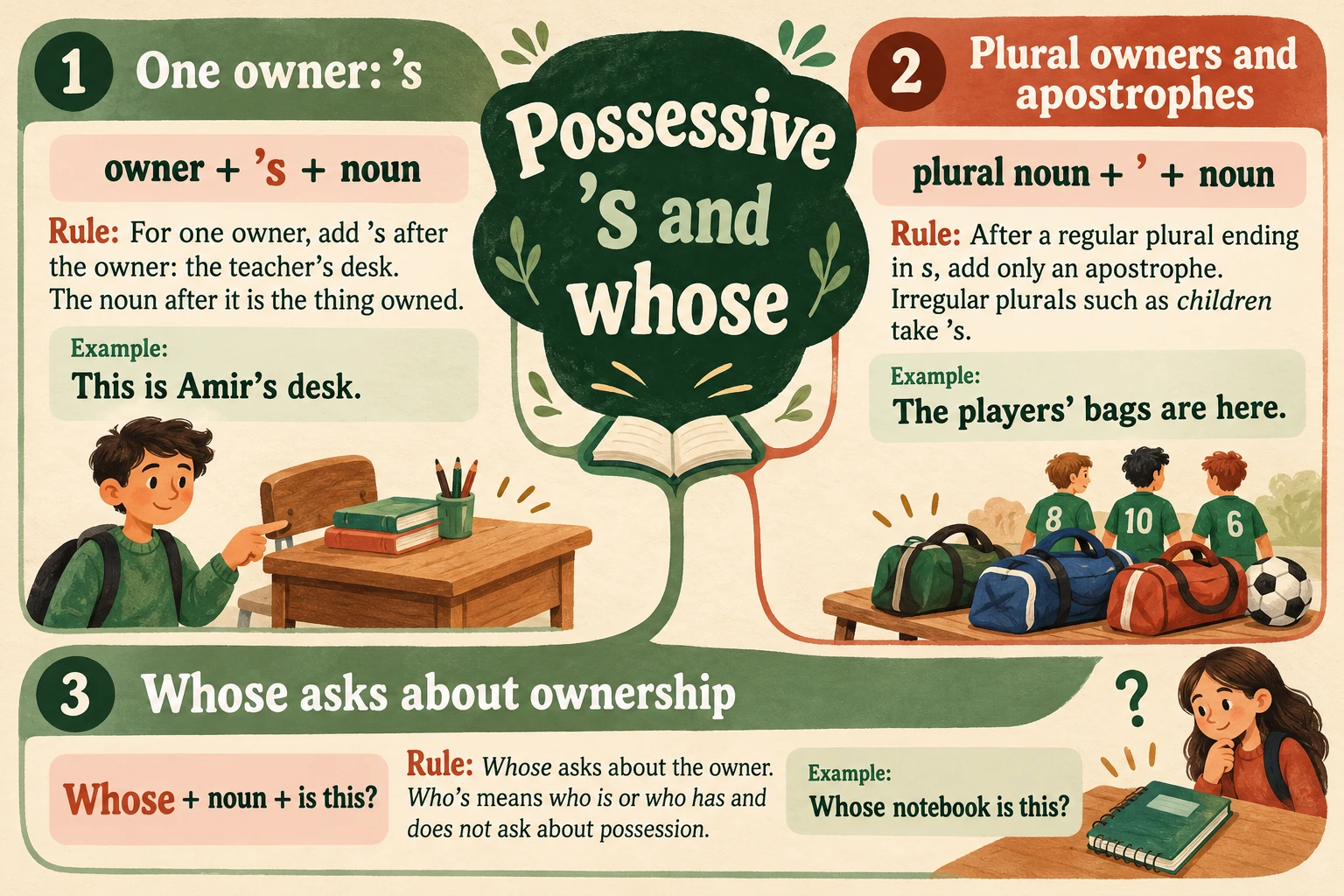
Para um único dono, acrescente ’s: the teacher’s desk. O substantivo seguinte é o objeto possuído.
This is Amir’s desk.Após plural regular em s, acrescente só o apóstrofo. Plurais irregulares como children recebem ’s.
The players’ bags are here.Whose pergunta quem é o dono. Who’s significa who is ou who has, não indica posse.
Whose notebook is this?
This bag belongs to one girl, Eva. It is ___ bag.
Para um único dono, acrescente ’s: the teacher’s desk. O substantivo seguinte é o objeto possuído.
This is Amir’s desk.Após plural regular em s, acrescente só o apóstrofo. Plurais irregulares como children recebem ’s.
The players’ bags are here.Whose pergunta quem é o dono. Who’s significa who is ou who has, não indica posse.
Whose notebook is this?Guarde a primeira tentativa, entenda a mudança e confira em outra situação.
Ainda não há revisões. Faça um aquecimento curto.
Para um único dono, acrescente ’s: the teacher’s desk. O substantivo seguinte é o objeto possuído.
This is Amir’s desk.Após plural regular em s, acrescente só o apóstrofo. Plurais irregulares como children recebem ’s.
The players’ bags are here.Whose pergunta quem é o dono. Who’s significa who is ou who has, não indica posse.
Whose notebook is this?Abrir uma resposta registra ajuda para essa questão.
This bag belongs to one girl, Eva. It is ___ bag.
Observe “This bag belongs to one girl, Eva. It is ___ bag.”. Para um único dono, acrescente ’s: the teacher’s desk. O substantivo seguinte é o objeto possuído. Frase completa: “This bag belongs to one girl, Eva. It is Eva’s bag.”.
Two teachers share an office. It is the ___ office.
Observe “Two teachers share an office. It is the ___ office.”. Após plural regular em s, acrescente só o apóstrofo. Plurais irregulares como children recebem ’s. Frase completa: “Two teachers share an office. It is the teachers’ office.”.
___ coat is this? — It belongs to Ali.
Observe “___ coat is this? — It belongs to Ali.”. Whose pergunta quem é o dono. Who’s significa who is ou who has, não indica posse. Frase completa: “Whose coat is this? — It belongs to Ali.”.
One doctor uses this room. It is the ___ room.
Frase de referência: “One doctor uses this room. It is the doctor’s room.”. Para um único dono, acrescente ’s: the teacher’s desk. O substantivo seguinte é o objeto possuído.
The toys belong to the children. They are the ___ toys.
Observe “The toys belong to the children. They are the ___ toys.”. Após plural regular em s, acrescente só o apóstrofo. Plurais irregulares como children recebem ’s. Frase completa: “The toys belong to the children. They are the children’s toys.”.
___ keys are on the desk? — Mina’s keys.
Observe “___ keys are on the desk? — Mina’s keys.”. Whose pergunta quem é o dono. Who’s significa who is ou who has, não indica posse. Frase completa: “Whose keys are on the desk? — Mina’s keys.”.
My sister owns this car. It is my ___ car.
Frase de referência: “My sister owns this car. It is my sister’s car.”. Para um único dono, acrescente ’s: the teacher’s desk. O substantivo seguinte é o objeto possuído.
One neighbour lent me his ladder. It is my ___ ladder.
Observe “One neighbour lent me his ladder. It is my ___ ladder.”. Para um único dono, acrescente ’s: the teacher’s desk. O substantivo seguinte é o objeto possuído. Frase completa: “One neighbour lent me his ladder. It is my neighbour’s ladder.”.
The rooms belong to three students. They are the ___ rooms.
Observe “The rooms belong to three students. They are the ___ rooms.”. Após plural regular em s, acrescente só o apóstrofo. Plurais irregulares como children recebem ’s. Frase completa: “The rooms belong to three students. They are the students’ rooms.”.
___ lunch is in the green box? — Omar’s.
Frase de referência: “Whose lunch is in the green box? — Omar’s.”. Whose pergunta quem é o dono. Who’s significa who is ou who has, não indica posse.
The coats belong to the women in that room. They are the ___ coats.
Observe “The coats belong to the women in that room. They are the ___ coats.”. Após plural regular em s, acrescente só o apóstrofo. Plurais irregulares como children recebem ’s. Frase completa: “The coats belong to the women in that room. They are the women’s coats.”.
___ phone rang just now? — Carla’s phone.
Frase de referência: “Whose phone rang just now? — Carla’s phone.”. Whose pergunta quem é o dono. Who’s significa who is ou who has, não indica posse.