
B1

Tiempos narrativos: ejercicios

Sobre esta lección

Tiempos narrativos · B1. Usa was/were + -ing para una actividad de fondo en curso en un momento pasado. Otro hecho puede fijar ese momento sin detener necesariamente la actividad.

Completa 12 tareas originales. Deduce el sentido por la situación, practica la forma y aplícala en un contexto nuevo.

12 preguntas
Guárdalo para encontrarlo en Mi colección.
Mapa de conceptos

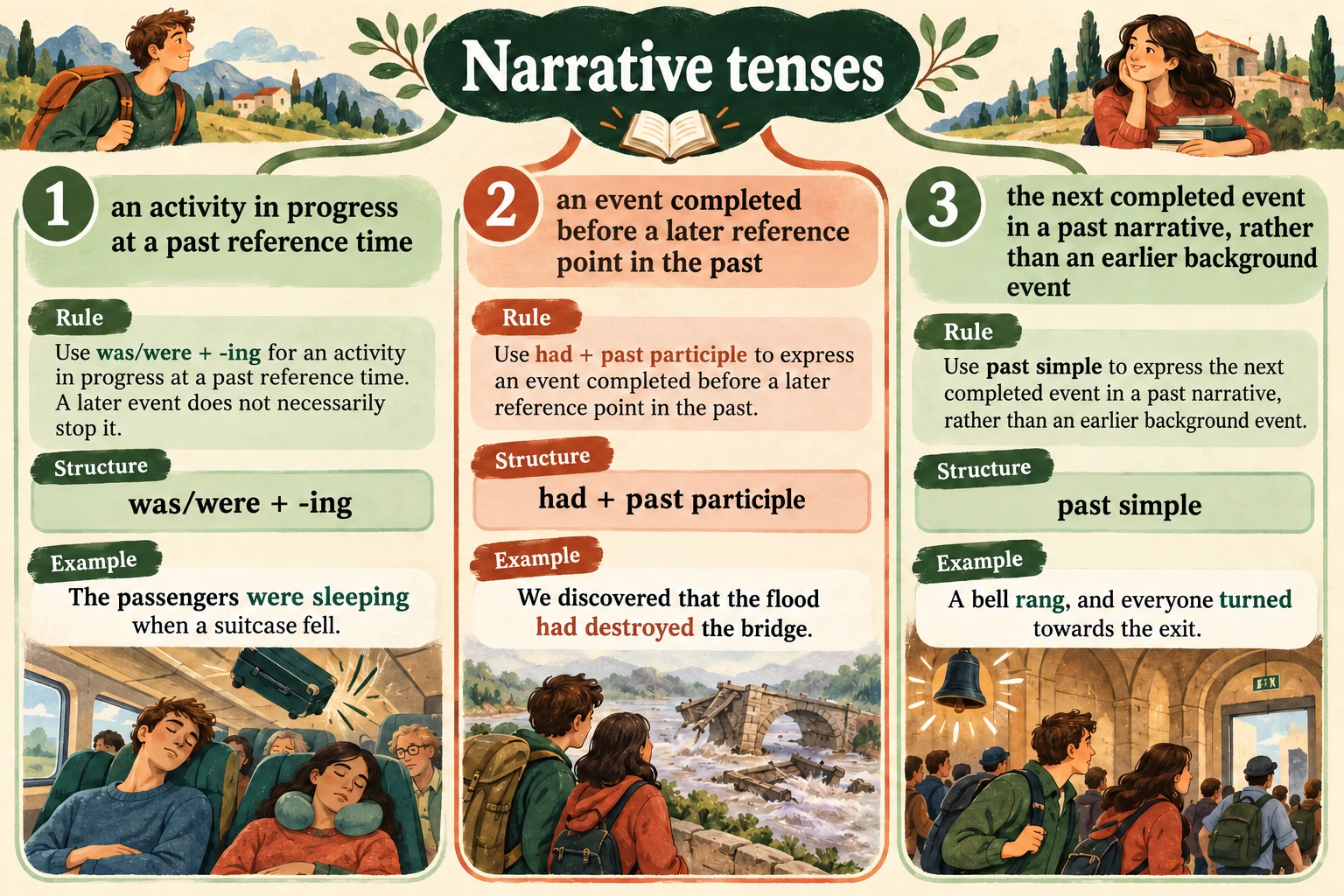
Narrative tenses

Empezar a practicar
Narrative tenses — Mapa de conceptos

01una actividad de fondo en curso en un momento pasado

Usa was/were + -ing para una actividad de fondo en curso en un momento pasado. Otro hecho puede fijar ese momento sin detener necesariamente la actividad.

The passengers were sleeping when a suitcase fell.
02un hecho terminado antes de otro punto pasado

Usa had + past participle para expresar un hecho terminado antes de otro punto pasado.

We discovered that the flood had destroyed the bridge.

03el siguiente hecho completo del relato, no un antecedente anterior

Usa past simple para expresar el siguiente hecho completo del relato, no un antecedente anterior.

A bell rang, and everyone turned towards the exit.

Guía ilustrada

0/12
Preguntas
01 / 12D01Guárdalo para encontrarlo en Mi colección.

The quiet activity was interrupted by the crash.

The passengers ___ when a suitcase fell.

Tu respuesta
1 / 12

Tu ruta de aprendizaje

01
Paso 1 · Calentamiento

Calentamiento

0/3
02
Paso 2 · Practicar la habilidad

una actividad de fondo en curso en un momento pasado

0/2

Usa was/were + -ing para una actividad de fondo en curso en un momento pasado. Otro hecho puede fijar ese momento sin detener necesariamente la actividad.

The passengers were sleeping when a suitcase fell.
03
Paso 3 · Practicar la habilidad

un hecho terminado antes de otro punto pasado

0/1

Usa had + past participle para expresar un hecho terminado antes de otro punto pasado.

We discovered that the flood had destroyed the bridge.
04
Paso 4 · Practicar la habilidad

el siguiente hecho completo del relato, no un antecedente anterior

0/1

Usa past simple para expresar el siguiente hecho completo del relato, no un antecedente anterior.

A bell rang, and everyone turned towards the exit.
05
Paso 5 · Nuevos contextos

Nuevos contextos

0/3
06
Paso 6 · Un nuevo reto

Un nuevo reto

0/2
Repasos de esta unidad

Haz que los errores sirvan.

Conserva el primer intento, entiende el cambio y compruébalo en otra situación.

0

Aún no hay repasos. Prueba un calentamiento corto.

Mapa de la lección

Tiempos narrativos

B1
Narrative tenses

Puntos de la lección

01

una actividad de fondo en curso en un momento pasado

Usa was/were + -ing para una actividad de fondo en curso en un momento pasado. Otro hecho puede fijar ese momento sin detener necesariamente la actividad.

The passengers were sleeping when a suitcase fell.
02

un hecho terminado antes de otro punto pasado

Usa had + past participle para expresar un hecho terminado antes de otro punto pasado.

We discovered that the flood had destroyed the bridge.
03

el siguiente hecho completo del relato, no un antecedente anterior

Usa past simple para expresar el siguiente hecho completo del relato, no un antecedente anterior.

A bell rang, and everyone turned towards the exit.

Preguntas y respuestas

Abrir una respuesta registra ayuda para esa pregunta.

D01 · Calentamiento

The quiet activity was interrupted by the crash.

The passengers ___ when a suitcase fell.

  1. had sleep
  2. were sleeping
  3. are sleep
  4. will sleep
Respuesta y explicación
were sleeping

Mira «The passengers ___ when a suitcase fell.». Usa was/were + -ing para una actividad de fondo en curso en un momento pasado. Otro hecho puede fijar ese momento sin detener necesariamente la actividad. Oración completa: «The passengers were sleeping when a suitcase fell.».

D02 · Calentamiento

The bridge was destroyed a day before our arrival.

We discovered that the flood ___ the bridge.

  1. is destroying
  2. had destroyed
  3. destroys
  4. will destroy
Respuesta y explicación
had destroyed

Mira «We discovered that the flood ___ the bridge.». Usa had + past participle para expresar un hecho terminado antes de otro punto pasado. Oración completa: «We discovered that the flood had destroyed the bridge.».

D03 · Calentamiento

The next event moves the story forward.

A bell rang, and everyone ___ towards the exit.

  1. will turn
  2. has turn
  3. is turning
  4. turned
Respuesta y explicación
turned

Mira «A bell rang, and everyone ___ towards the exit.». Usa past simple para expresar el siguiente hecho completo del relato, no un antecedente anterior. Oración completa: «A bell rang, and everyone turned towards the exit.».

P01 · Practicar la habilidad

A continuous background action at the stated past moment.

As I entered, the chef ___ vegetables.

  1. has chop
  2. is chop
  3. will chop
  4. was chopping
Respuesta y explicación
was chopping

Mira «As I entered, the chef ___ vegetables.». Usa was/were + -ing para una actividad de fondo en curso en un momento pasado. Otro hecho puede fijar ese momento sin detener necesariamente la actividad. Oración completa: «As I entered, the chef was chopping vegetables.».

P02 · Practicar la habilidad

Use the past perfect of leave; departure preceded our reaching the stop.

When we reached the stop, the bus ___.

Respuesta y explicación
had left

Oración completa: «When we reached the stop, the bus had left.» Usa had + past participle para expresar un hecho terminado antes de otro punto pasado. El sujeto, el tiempo y el sentido de la tarea determinan la forma. Solo se cotejan automáticamente las respuestas revisadas; otra redacción no es automáticamente incorrecta.

P03 · Practicar la habilidad

The narrative advances through completed steps.

Mina found the key, unlocked the box and ___ the map.

  1. has remove
  2. removed
  3. will remove
  4. is removing
Respuesta y explicación
removed

Mira «Mina found the key, unlocked the box and ___ the map.». Usa past simple para expresar el siguiente hecho completo del relato, no un antecedente anterior. Oración completa: «Mina found the key, unlocked the box and removed the map.».

P04 · Practicar la habilidad

Use the past continuous of snow for the background at dawn yesterday.

At dawn yesterday, it ___ heavily.

Respuesta y explicación
was snowing

“At dawn yesterday, it was snowing heavily.” Usa was o were + -ing para una actividad en curso en un momento pasado. Otro hecho puede dar ese punto de referencia sin demostrar que la actividad se detuvo.

R01 · Nuevos contextos

The rain was underway when the phone rang.

I ___ home through the rain when my phone rang.

  1. am walk
  2. have walk
  3. was walking
  4. will walk
Respuesta y explicación
was walking

Mira «I ___ home through the rain when my phone rang.». Usa was/were + -ing para una actividad de fondo en curso en un momento pasado. Otro hecho puede fijar ese momento sin detener necesariamente la actividad. Oración completa: «I was walking home through the rain when my phone rang.».

R02 · Nuevos contextos

Use the past perfect of eat; the meal happened before the invitation. The word already is supplied after the gap.

They declined dinner because they ___ already.

Respuesta y explicación
had eaten

Oración completa: «They declined dinner because they had eaten already.» Usa had + past participle para expresar un hecho terminado antes de otro punto pasado. El sujeto, el tiempo y el sentido de la tarea determinan la forma. Solo se cotejan automáticamente las respuestas revisadas; otra redacción no es automáticamente incorrecta.

R03 · Nuevos contextos

A new completed event follows the door opening.

The door opened and a stranger ___ inside.

  1. is stepping
  2. has step
  3. stepped
  4. will step
Respuesta y explicación
stepped

Mira «The door opened and a stranger ___ inside.». Usa past simple para expresar el siguiente hecho completo del relato, no un antecedente anterior. Oración completa: «The door opened and a stranger stepped inside.».

X01 · Un nuevo reto

The later discovery refers back to an earlier mistake.

We realised we ___ the wrong train an hour earlier.

  1. have board
  2. had boarded
  3. are boarding
  4. will board
Respuesta y explicación
had boarded

Mira «We realised we ___ the wrong train an hour earlier.». Usa had + past participle para expresar un hecho terminado antes de otro punto pasado. Oración completa: «We realised we had boarded the wrong train an hour earlier.».

X02 · Un nuevo reto

Use the past simple of ring for the event that interrupted the silence.

Everyone was listening quietly when a phone suddenly ___.

Respuesta y explicación
rang

Oración completa: «Everyone was listening quietly when a phone suddenly rang.» Usa past simple para expresar el siguiente hecho completo del relato, no un antecedente anterior. El sujeto, el tiempo y el sentido de la tarea determinan la forma. Solo se cotejan automáticamente las respuestas revisadas; otra redacción no es automáticamente incorrecta.