
B1

Temps du récit : exercices

À propos de cette leçon

Temps du récit · B1. Utilisez was/were + -ing pour une activité de fond en cours à un repère passé. Un autre événement peut fixer ce repère sans arrêter nécessairement l’activité.

Réalisez 12 exercices originaux. Appuyez-vous sur la situation pour interpréter le sens, pratiquer la forme et la réutiliser dans un nouveau contexte.

12 questions
Retrouvez-le dans Ma collection après enregistrement.
Carte des notions

Narrative tenses

Commencer
Narrative tenses — Carte des notions

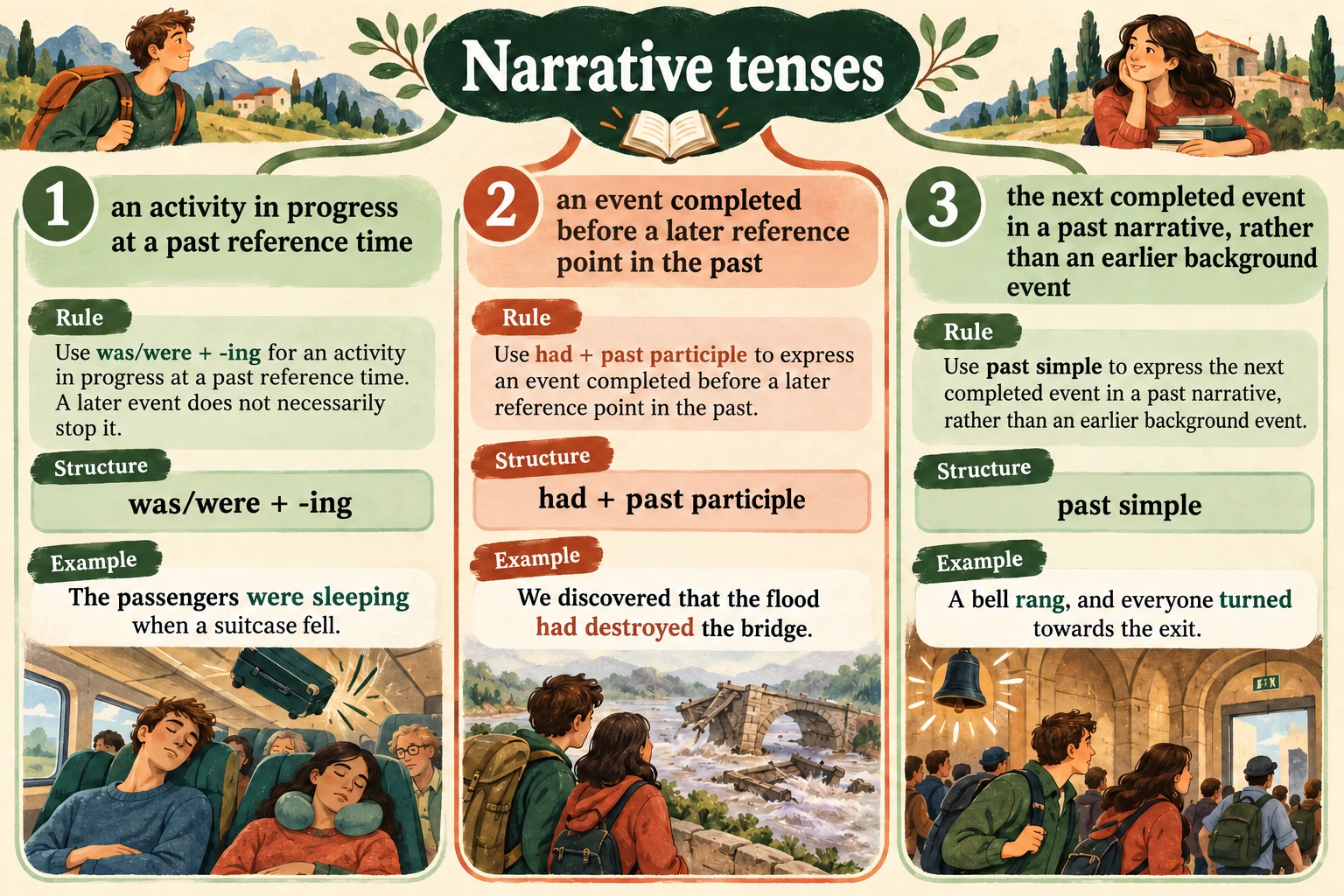
01une activité de fond en cours à un repère passé

Utilisez was/were + -ing pour une activité de fond en cours à un repère passé. Un autre événement peut fixer ce repère sans arrêter nécessairement l’activité.

The passengers were sleeping when a suitcase fell.
02un événement accompli avant un repère passé ultérieur

Utilisez had + past participle pour exprimer un événement accompli avant un repère passé ultérieur.

We discovered that the flood had destroyed the bridge.

03l’événement suivant du récit, plutôt qu’un fait antérieur

Utilisez past simple pour exprimer l’événement suivant du récit, plutôt qu’un fait antérieur.

A bell rang, and everyone turned towards the exit.

Guide illustré

0/12
Questions
01 / 12D01Retrouvez-le dans Ma collection après enregistrement.

The quiet activity was interrupted by the crash.

The passengers ___ when a suitcase fell.

Votre réponse
1 / 12

Votre parcours

01
Étape 1 · Échauffement

Échauffement

0/3
02
Étape 2 · Développer la compétence

une activité de fond en cours à un repère passé

0/2

Utilisez was/were + -ing pour une activité de fond en cours à un repère passé. Un autre événement peut fixer ce repère sans arrêter nécessairement l’activité.

The passengers were sleeping when a suitcase fell.
03
Étape 3 · Développer la compétence

un événement accompli avant un repère passé ultérieur

0/1

Utilisez had + past participle pour exprimer un événement accompli avant un repère passé ultérieur.

We discovered that the flood had destroyed the bridge.
04
Étape 4 · Développer la compétence

l’événement suivant du récit, plutôt qu’un fait antérieur

0/1

Utilisez past simple pour exprimer l’événement suivant du récit, plutôt qu’un fait antérieur.

A bell rang, and everyone turned towards the exit.
05
Étape 5 · Nouveaux contextes

Nouveaux contextes

0/3
06
Étape 6 · Un nouveau défi

Un nouveau défi

0/2
Révisions de cette unité

Apprenez de vos erreurs.

Gardez la première tentative, comprenez le changement et essayez dans une nouvelle situation.

0

Pas encore de notes. Essayez un court échauffement.

Carte de la leçon

Temps du récit

B1
Narrative tenses

Points de la leçon

01

une activité de fond en cours à un repère passé

Utilisez was/were + -ing pour une activité de fond en cours à un repère passé. Un autre événement peut fixer ce repère sans arrêter nécessairement l’activité.

The passengers were sleeping when a suitcase fell.
02

un événement accompli avant un repère passé ultérieur

Utilisez had + past participle pour exprimer un événement accompli avant un repère passé ultérieur.

We discovered that the flood had destroyed the bridge.
03

l’événement suivant du récit, plutôt qu’un fait antérieur

Utilisez past simple pour exprimer l’événement suivant du récit, plutôt qu’un fait antérieur.

A bell rang, and everyone turned towards the exit.

Questions et réponses

Ouvrir une réponse enregistre une aide pour cette question.

D01 · Échauffement

The quiet activity was interrupted by the crash.

The passengers ___ when a suitcase fell.

  1. had sleep
  2. were sleeping
  3. are sleep
  4. will sleep
Réponse et explication
were sleeping

Observe « The passengers ___ when a suitcase fell. ». Utilisez was/were + -ing pour une activité de fond en cours à un repère passé. Un autre événement peut fixer ce repère sans arrêter nécessairement l’activité. Phrase complète : « The passengers were sleeping when a suitcase fell. ».

D02 · Échauffement

The bridge was destroyed a day before our arrival.

We discovered that the flood ___ the bridge.

  1. is destroying
  2. had destroyed
  3. destroys
  4. will destroy
Réponse et explication
had destroyed

Observe « We discovered that the flood ___ the bridge. ». Utilisez had + past participle pour exprimer un événement accompli avant un repère passé ultérieur. Phrase complète : « We discovered that the flood had destroyed the bridge. ».

D03 · Échauffement

The next event moves the story forward.

A bell rang, and everyone ___ towards the exit.

  1. will turn
  2. has turn
  3. is turning
  4. turned
Réponse et explication
turned

Observe « A bell rang, and everyone ___ towards the exit. ». Utilisez past simple pour exprimer l’événement suivant du récit, plutôt qu’un fait antérieur. Phrase complète : « A bell rang, and everyone turned towards the exit. ».

P01 · Développer la compétence

A continuous background action at the stated past moment.

As I entered, the chef ___ vegetables.

  1. has chop
  2. is chop
  3. will chop
  4. was chopping
Réponse et explication
was chopping

Observe « As I entered, the chef ___ vegetables. ». Utilisez was/were + -ing pour une activité de fond en cours à un repère passé. Un autre événement peut fixer ce repère sans arrêter nécessairement l’activité. Phrase complète : « As I entered, the chef was chopping vegetables. ».

P02 · Développer la compétence

Use the past perfect of leave; departure preceded our reaching the stop.

When we reached the stop, the bus ___.

Réponse et explication
had left

Phrase complète : « When we reached the stop, the bus had left. » Utilisez had + past participle pour exprimer un événement accompli avant un repère passé ultérieur. Le sujet, le temps et le sens de la consigne déterminent cette forme. Seules les réponses vérifiées sont comparées automatiquement ; toute autre formulation n’est pas automatiquement fausse.

P03 · Développer la compétence

The narrative advances through completed steps.

Mina found the key, unlocked the box and ___ the map.

  1. has remove
  2. removed
  3. will remove
  4. is removing
Réponse et explication
removed

Observe « Mina found the key, unlocked the box and ___ the map. ». Utilisez past simple pour exprimer l’événement suivant du récit, plutôt qu’un fait antérieur. Phrase complète : « Mina found the key, unlocked the box and removed the map. ».

P04 · Développer la compétence

Use the past continuous of snow for the background at dawn yesterday.

At dawn yesterday, it ___ heavily.

Réponse et explication
was snowing

“At dawn yesterday, it was snowing heavily.” Utilisez was ou were + -ing pour une activité en cours à un repère passé. Un autre événement peut donner ce repère sans prouver que l’activité s’est arrêtée.

R01 · Nouveaux contextes

The rain was underway when the phone rang.

I ___ home through the rain when my phone rang.

  1. am walk
  2. have walk
  3. was walking
  4. will walk
Réponse et explication
was walking

Observe « I ___ home through the rain when my phone rang. ». Utilisez was/were + -ing pour une activité de fond en cours à un repère passé. Un autre événement peut fixer ce repère sans arrêter nécessairement l’activité. Phrase complète : « I was walking home through the rain when my phone rang. ».

R02 · Nouveaux contextes

Use the past perfect of eat; the meal happened before the invitation. The word already is supplied after the gap.

They declined dinner because they ___ already.

Réponse et explication
had eaten

Phrase complète : « They declined dinner because they had eaten already. » Utilisez had + past participle pour exprimer un événement accompli avant un repère passé ultérieur. Le sujet, le temps et le sens de la consigne déterminent cette forme. Seules les réponses vérifiées sont comparées automatiquement ; toute autre formulation n’est pas automatiquement fausse.

R03 · Nouveaux contextes

A new completed event follows the door opening.

The door opened and a stranger ___ inside.

  1. is stepping
  2. has step
  3. stepped
  4. will step
Réponse et explication
stepped

Observe « The door opened and a stranger ___ inside. ». Utilisez past simple pour exprimer l’événement suivant du récit, plutôt qu’un fait antérieur. Phrase complète : « The door opened and a stranger stepped inside. ».

X01 · Un nouveau défi

The later discovery refers back to an earlier mistake.

We realised we ___ the wrong train an hour earlier.

  1. have board
  2. had boarded
  3. are boarding
  4. will board
Réponse et explication
had boarded

Observe « We realised we ___ the wrong train an hour earlier. ». Utilisez had + past participle pour exprimer un événement accompli avant un repère passé ultérieur. Phrase complète : « We realised we had boarded the wrong train an hour earlier. ».

X02 · Un nouveau défi

Use the past simple of ring for the event that interrupted the silence.

Everyone was listening quietly when a phone suddenly ___.

Réponse et explication
rang

Phrase complète : « Everyone was listening quietly when a phone suddenly rang. » Utilisez past simple pour exprimer l’événement suivant du récit, plutôt qu’un fait antérieur. Le sujet, le temps et le sens de la consigne déterminent cette forme. Seules les réponses vérifiées sont comparées automatiquement ; toute autre formulation n’est pas automatiquement fausse.