01a future condition that the speaker presents as a real possibility
Use if + present simple; will + base verb to express a future condition that the speaker presents as a real possibility.
If it snows, the match will be cancelled.
First or second conditional? · B1. Use if + present simple; will + base verb to express a future condition that the speaker presents as a real possibility.
Complete 12 original tasks. Use the situation to choose the intended meaning, practise the form, then apply it in a fresh context.
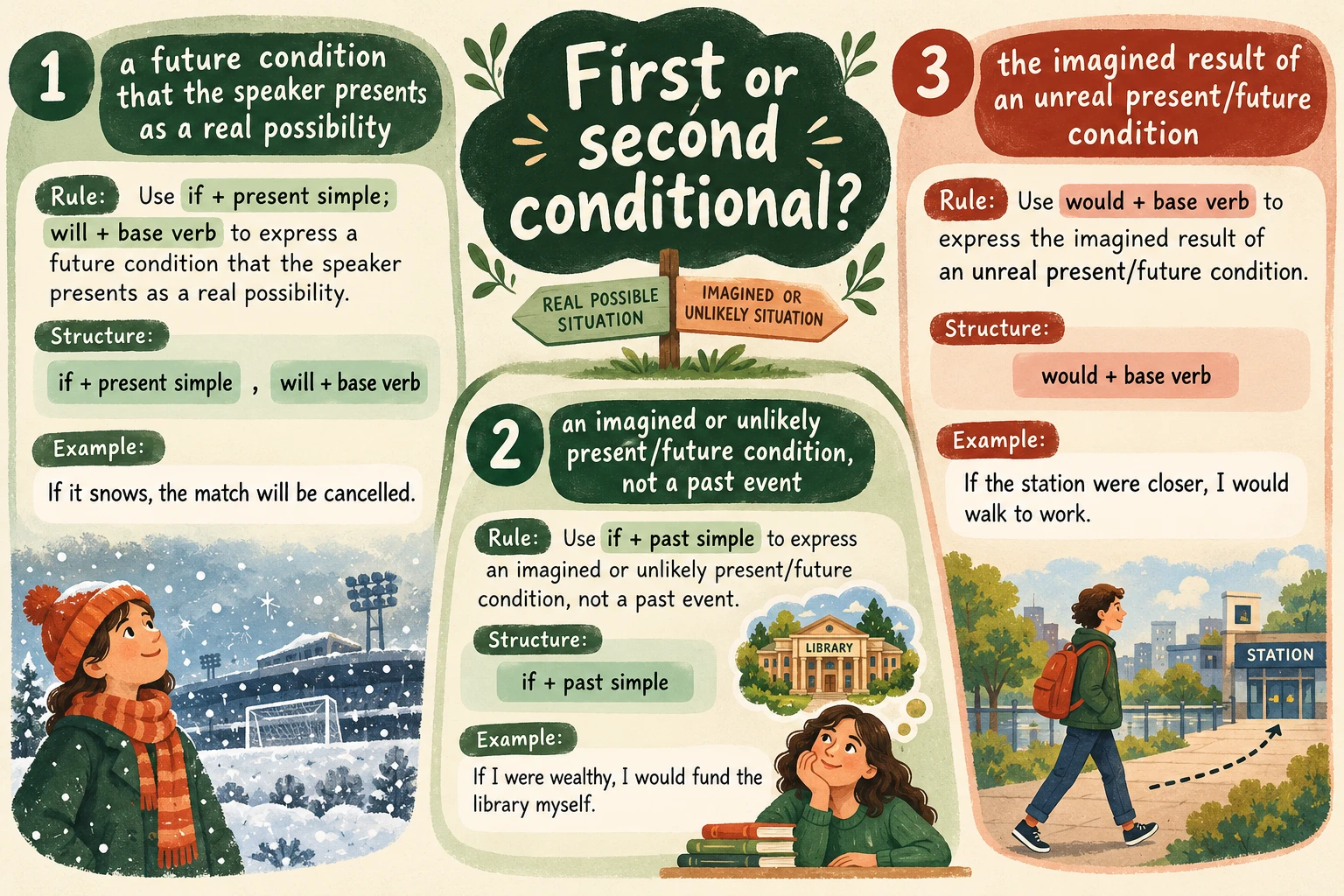
Use if + present simple; will + base verb to express a future condition that the speaker presents as a real possibility.
If it snows, the match will be cancelled.Use if + past simple to express an imagined or unlikely present/future condition, not a past event.
If I were wealthy, I would fund the library myself.Use would + base verb to express the imagined result of an unreal present/future condition.
If the station were closer, I would walk to work.
The forecast gives a realistic chance of snow tomorrow.
Use if + present simple; will + base verb to express a future condition that the speaker presents as a real possibility.
If it snows, the match will be cancelled.Use if + past simple to express an imagined or unlikely present/future condition, not a past event.
If I were wealthy, I would fund the library myself.Use would + base verb to express the imagined result of an unreal present/future condition.
If the station were closer, I would walk to work.Keep the first try. Understand the change. Check it in a fresh situation.
No practice notes yet. Try a short warm-up.
Use if + present simple; will + base verb to express a future condition that the speaker presents as a real possibility.
If it snows, the match will be cancelled.Use if + past simple to express an imagined or unlikely present/future condition, not a past event.
If I were wealthy, I would fund the library myself.Use would + base verb to express the imagined result of an unreal present/future condition.
If the station were closer, I would walk to work.Opening an answer records help for that question.
The forecast gives a realistic chance of snow tomorrow.
Look at “The forecast gives a realistic chance of snow tomorrow.”. Use if + present simple; will + base verb to express a future condition that the speaker presents as a real possibility. Complete sentence: “If it snows, the match will be cancelled.”.
I am not wealthy; imagine a different present. Use the ordinary hypothetical-present/future second-conditional pattern.
Look at “I am not wealthy; imagine a different present. Use the ordinary hypothetical-present/future second-conditional pattern.”. Use if + past simple to express an imagined or unlikely present/future condition, not a past event. Complete sentence: “If I were wealthy, I would fund the library myself.”.
The station cannot move in reality. Use the ordinary hypothetical-present/future second-conditional pattern.
Look at “The station cannot move in reality. Use the ordinary hypothetical-present/future second-conditional pattern.”. Use would + base verb to express the imagined result of an unreal present/future condition. Complete sentence: “If the station were closer, I would walk to work.”.
The supplier may realistically confirm the order today.
Look at “The supplier may realistically confirm the order today.”. Use if + present simple; will + base verb to express a future condition that the speaker presents as a real possibility. Complete sentence: “If they confirm today, we will dispatch tomorrow.”.
Use the past simple of own; the speaker does not own the building.
Complete sentence: “If I owned this building, I would repair the lift.” Use if + past simple to express an imagined or unlikely present/future condition, not a past event. The subject, time and meaning in the task determine this form. Only reviewed responses are matched automatically; other wording is not automatically wrong.
I do not have a spare room at present. Use the ordinary hypothetical-present/future second-conditional pattern.
Look at “I do not have a spare room at present. Use the ordinary hypothetical-present/future second-conditional pattern.”. Use would + base verb to express the imagined result of an unreal present/future condition. Complete sentence: “If I had a spare room, I would invite you to stay.”.
Use the present simple of pass for a realistic future condition.
Complete sentence: “If Nora passes the driving test next week, she will apply for the job.” Use if + present simple; will + base verb to express a future condition that the speaker presents as a real possibility. The subject, time and meaning in the task determine this form. Only reviewed responses are matched automatically; other wording is not automatically wrong.
A genuine possibility: the ticket office may still have seats.
Look at “A genuine possibility: the ticket office may still have seats.”. Use if + present simple; will + base verb to express a future condition that the speaker presents as a real possibility. Complete sentence: “If there are seats left, we will buy two.”.
Use the past simple of live; we actually live on the mainland.
Complete sentence: “If we lived on an island, we would depend on ferries.” Use if + past simple to express an imagined or unlikely present/future condition, not a past event. The subject, time and meaning in the task determine this form. Only reviewed responses are matched automatically; other wording is not automatically wrong.
The speaker is not a pilot. Use the ordinary hypothetical-present/future second-conditional pattern.
Look at “The speaker is not a pilot. Use the ordinary hypothetical-present/future second-conditional pattern.”. Use would + base verb to express the imagined result of an unreal present/future condition. Complete sentence: “If I were a pilot, I would study the weather charts daily.”.
The speaker has no influence over the timetable; this is hypothetical. Use the ordinary hypothetical-present/future second-conditional pattern.
Look at “The speaker has no influence over the timetable; this is hypothetical. Use the ordinary hypothetical-present/future second-conditional pattern.”. Use if + past simple to express an imagined or unlikely present/future condition, not a past event. Complete sentence: “If I controlled the timetable, I would add a later service.”.
Use a would-result with spend for the imagined consequence; I am not on holiday.
Complete sentence: “If I were on holiday now, I would spend the morning by the lake.” Use would + base verb to express the imagined result of an unreal present/future condition. The subject, time and meaning in the task determine this form. Only reviewed responses are matched automatically; other wording is not automatically wrong.