01eine vom Sprecher als real möglich dargestellte zukünftige Bedingung
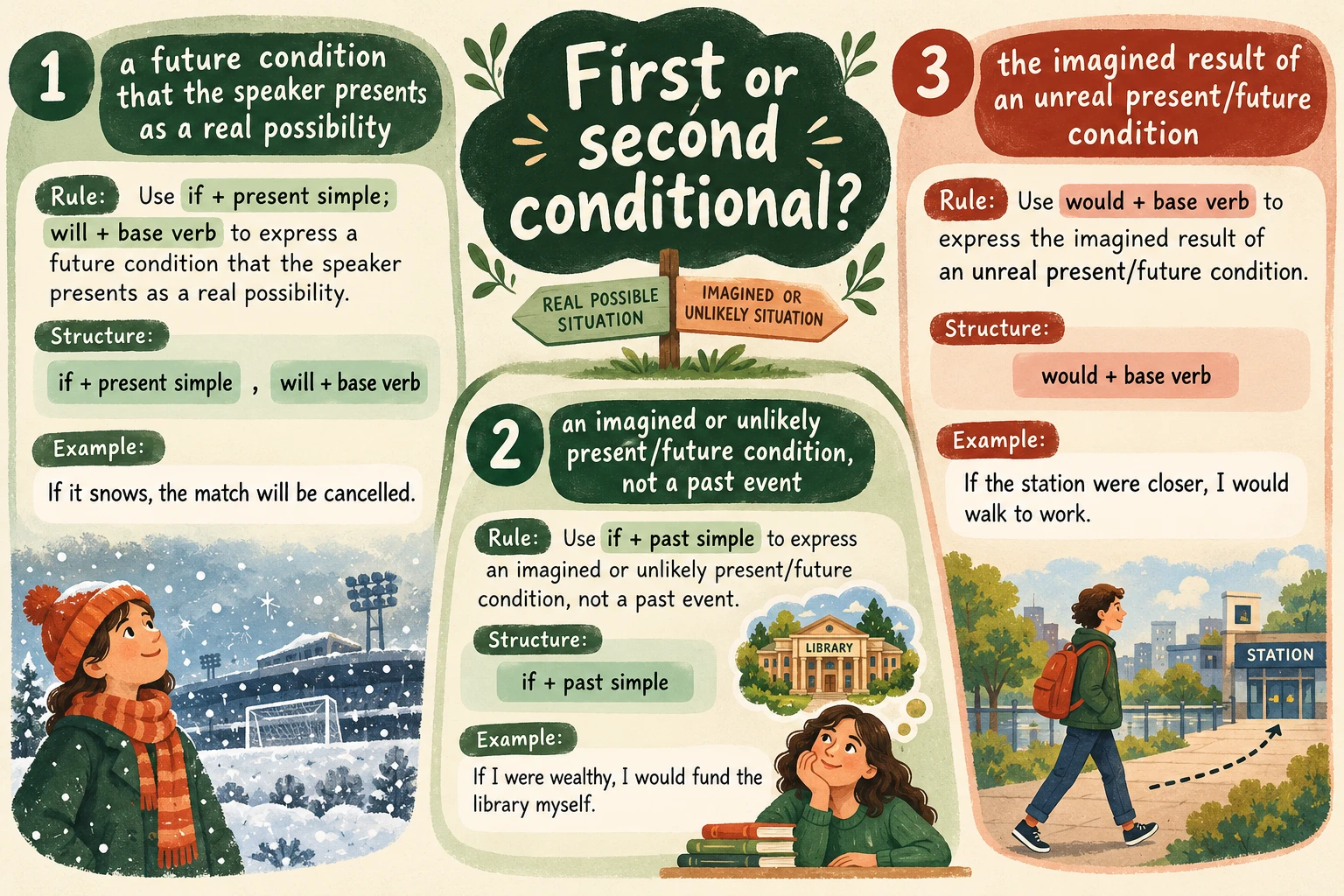
Verwende if + present simple; will + base verb für eine vom Sprecher als real möglich dargestellte zukünftige Bedingung.
If it snows, the match will be cancelled.
Erster oder zweiter Konditional? · B1. Verwende if + present simple; will + base verb für eine vom Sprecher als real möglich dargestellte zukünftige Bedingung.
Bearbeite 12 neue Aufgaben. Erschließe die beabsichtigte Bedeutung aus der Situation, übe die Form und wende sie in einem neuen Kontext an.
Verwende if + present simple; will + base verb für eine vom Sprecher als real möglich dargestellte zukünftige Bedingung.
If it snows, the match will be cancelled.Verwende if + past simple für eine gedachte oder unwahrscheinliche Bedingung der Gegenwart/Zukunft, kein vergangenes Ereignis.
If I were wealthy, I would fund the library myself.Verwende would + base verb für das gedachte Ergebnis einer irrealen Gegenwarts-/Zukunftsbedingung.
If the station were closer, I would walk to work.
The forecast gives a realistic chance of snow tomorrow.
Verwende if + present simple; will + base verb für eine vom Sprecher als real möglich dargestellte zukünftige Bedingung.
If it snows, the match will be cancelled.Verwende if + past simple für eine gedachte oder unwahrscheinliche Bedingung der Gegenwart/Zukunft, kein vergangenes Ereignis.
If I were wealthy, I would fund the library myself.Verwende would + base verb für das gedachte Ergebnis einer irrealen Gegenwarts-/Zukunftsbedingung.
If the station were closer, I would walk to work.Bewahre den ersten Versuch. Verstehe die Änderung. Prüfe sie in einer neuen Situation.
Noch keine Lernnotizen. Starte mit einem kurzen Einstieg.
Verwende if + present simple; will + base verb für eine vom Sprecher als real möglich dargestellte zukünftige Bedingung.
If it snows, the match will be cancelled.Verwende if + past simple für eine gedachte oder unwahrscheinliche Bedingung der Gegenwart/Zukunft, kein vergangenes Ereignis.
If I were wealthy, I would fund the library myself.Verwende would + base verb für das gedachte Ergebnis einer irrealen Gegenwarts-/Zukunftsbedingung.
If the station were closer, I would walk to work.Das Öffnen einer Antwort wird für diese Aufgabe als Hilfe erfasst.
The forecast gives a realistic chance of snow tomorrow.
Achte auf „The forecast gives a realistic chance of snow tomorrow.“. Verwende if + present simple; will + base verb für eine vom Sprecher als real möglich dargestellte zukünftige Bedingung. Vollständiger Satz: „If it snows, the match will be cancelled.“.
I am not wealthy; imagine a different present. Use the ordinary hypothetical-present/future second-conditional pattern.
Achte auf „I am not wealthy; imagine a different present. Use the ordinary hypothetical-present/future second-conditional pattern.“. Verwende if + past simple für eine gedachte oder unwahrscheinliche Bedingung der Gegenwart/Zukunft, kein vergangenes Ereignis. Vollständiger Satz: „If I were wealthy, I would fund the library myself.“.
The station cannot move in reality. Use the ordinary hypothetical-present/future second-conditional pattern.
Achte auf „The station cannot move in reality. Use the ordinary hypothetical-present/future second-conditional pattern.“. Verwende would + base verb für das gedachte Ergebnis einer irrealen Gegenwarts-/Zukunftsbedingung. Vollständiger Satz: „If the station were closer, I would walk to work.“.
The supplier may realistically confirm the order today.
Achte auf „The supplier may realistically confirm the order today.“. Verwende if + present simple; will + base verb für eine vom Sprecher als real möglich dargestellte zukünftige Bedingung. Vollständiger Satz: „If they confirm today, we will dispatch tomorrow.“.
Use the past simple of own; the speaker does not own the building.
Vollständiger Satz: „If I owned this building, I would repair the lift.“ Verwende if + past simple für eine gedachte oder unwahrscheinliche Bedingung der Gegenwart/Zukunft, kein vergangenes Ereignis. Subjekt, Zeit und Bedeutung der Aufgabe bestimmen diese Form. Nur geprüfte Antworten werden automatisch abgeglichen; andere Formulierungen sind nicht automatisch falsch.
I do not have a spare room at present. Use the ordinary hypothetical-present/future second-conditional pattern.
Achte auf „I do not have a spare room at present. Use the ordinary hypothetical-present/future second-conditional pattern.“. Verwende would + base verb für das gedachte Ergebnis einer irrealen Gegenwarts-/Zukunftsbedingung. Vollständiger Satz: „If I had a spare room, I would invite you to stay.“.
Use the present simple of pass for a realistic future condition.
Vollständiger Satz: „If Nora passes the driving test next week, she will apply for the job.“ Verwende if + present simple; will + base verb für eine vom Sprecher als real möglich dargestellte zukünftige Bedingung. Subjekt, Zeit und Bedeutung der Aufgabe bestimmen diese Form. Nur geprüfte Antworten werden automatisch abgeglichen; andere Formulierungen sind nicht automatisch falsch.
A genuine possibility: the ticket office may still have seats.
Achte auf „A genuine possibility: the ticket office may still have seats.“. Verwende if + present simple; will + base verb für eine vom Sprecher als real möglich dargestellte zukünftige Bedingung. Vollständiger Satz: „If there are seats left, we will buy two.“.
Use the past simple of live; we actually live on the mainland.
Vollständiger Satz: „If we lived on an island, we would depend on ferries.“ Verwende if + past simple für eine gedachte oder unwahrscheinliche Bedingung der Gegenwart/Zukunft, kein vergangenes Ereignis. Subjekt, Zeit und Bedeutung der Aufgabe bestimmen diese Form. Nur geprüfte Antworten werden automatisch abgeglichen; andere Formulierungen sind nicht automatisch falsch.
The speaker is not a pilot. Use the ordinary hypothetical-present/future second-conditional pattern.
Achte auf „The speaker is not a pilot. Use the ordinary hypothetical-present/future second-conditional pattern.“. Verwende would + base verb für das gedachte Ergebnis einer irrealen Gegenwarts-/Zukunftsbedingung. Vollständiger Satz: „If I were a pilot, I would study the weather charts daily.“.
The speaker has no influence over the timetable; this is hypothetical. Use the ordinary hypothetical-present/future second-conditional pattern.
Achte auf „The speaker has no influence over the timetable; this is hypothetical. Use the ordinary hypothetical-present/future second-conditional pattern.“. Verwende if + past simple für eine gedachte oder unwahrscheinliche Bedingung der Gegenwart/Zukunft, kein vergangenes Ereignis. Vollständiger Satz: „If I controlled the timetable, I would add a later service.“.
Use a would-result with spend for the imagined consequence; I am not on holiday.
Vollständiger Satz: „If I were on holiday now, I would spend the morning by the lake.“ Verwende would + base verb für das gedachte Ergebnis einer irrealen Gegenwarts-/Zukunftsbedingung. Subjekt, Zeit und Bedeutung der Aufgabe bestimmen diese Form. Nur geprüfte Antworten werden automatisch abgeglichen; andere Formulierungen sind nicht automatisch falsch.