01uma condição futura apresentada como uma possibilidade real
Use if + present simple; will + base verb para expressar uma condição futura apresentada como uma possibilidade real.
If it snows, the match will be cancelled.
Primeira ou segunda condicional? · B1. Use if + present simple; will + base verb para expressar uma condição futura apresentada como uma possibilidade real.
Resolva 12 tarefas originais. Use a situação para interpretar o sentido, praticar a estrutura e aplicá-la em um novo contexto.
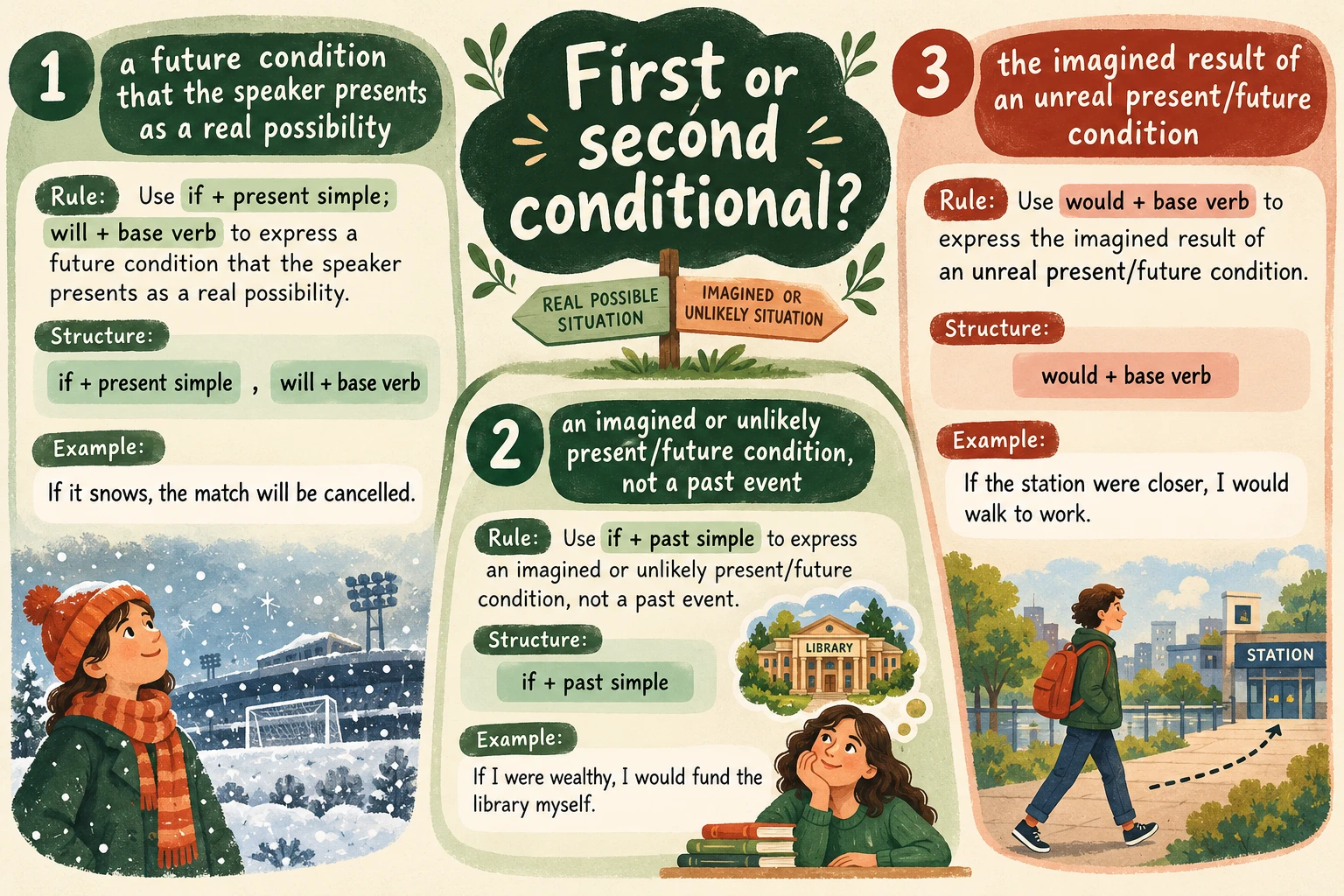
Use if + present simple; will + base verb para expressar uma condição futura apresentada como uma possibilidade real.
If it snows, the match will be cancelled.Use if + past simple para expressar uma condição presente ou futura imaginária ou improvável, não um fato passado.
If I were wealthy, I would fund the library myself.Use would + base verb para expressar o resultado imaginário de uma condição irreal no presente ou futuro.
If the station were closer, I would walk to work.
The forecast gives a realistic chance of snow tomorrow.
Use if + present simple; will + base verb para expressar uma condição futura apresentada como uma possibilidade real.
If it snows, the match will be cancelled.Use if + past simple para expressar uma condição presente ou futura imaginária ou improvável, não um fato passado.
If I were wealthy, I would fund the library myself.Use would + base verb para expressar o resultado imaginário de uma condição irreal no presente ou futuro.
If the station were closer, I would walk to work.Guarde a primeira tentativa, entenda a mudança e confira em outra situação.
Ainda não há revisões. Faça um aquecimento curto.
Use if + present simple; will + base verb para expressar uma condição futura apresentada como uma possibilidade real.
If it snows, the match will be cancelled.Use if + past simple para expressar uma condição presente ou futura imaginária ou improvável, não um fato passado.
If I were wealthy, I would fund the library myself.Use would + base verb para expressar o resultado imaginário de uma condição irreal no presente ou futuro.
If the station were closer, I would walk to work.Abrir uma resposta registra ajuda para essa questão.
The forecast gives a realistic chance of snow tomorrow.
Observe “The forecast gives a realistic chance of snow tomorrow.”. Use if + present simple; will + base verb para expressar uma condição futura apresentada como uma possibilidade real. Frase completa: “If it snows, the match will be cancelled.”.
I am not wealthy; imagine a different present. Use the ordinary hypothetical-present/future second-conditional pattern.
Observe “I am not wealthy; imagine a different present. Use the ordinary hypothetical-present/future second-conditional pattern.”. Use if + past simple para expressar uma condição presente ou futura imaginária ou improvável, não um fato passado. Frase completa: “If I were wealthy, I would fund the library myself.”.
The station cannot move in reality. Use the ordinary hypothetical-present/future second-conditional pattern.
Observe “The station cannot move in reality. Use the ordinary hypothetical-present/future second-conditional pattern.”. Use would + base verb para expressar o resultado imaginário de uma condição irreal no presente ou futuro. Frase completa: “If the station were closer, I would walk to work.”.
The supplier may realistically confirm the order today.
Observe “The supplier may realistically confirm the order today.”. Use if + present simple; will + base verb para expressar uma condição futura apresentada como uma possibilidade real. Frase completa: “If they confirm today, we will dispatch tomorrow.”.
Use the past simple of own; the speaker does not own the building.
Frase completa: “If I owned this building, I would repair the lift.” Use if + past simple para expressar uma condição presente ou futura imaginária ou improvável, não um fato passado. O sujeito, o tempo e o sentido da tarefa determinam esta forma. Só as respostas revisadas são comparadas automaticamente; outras formulações não estão automaticamente erradas.
I do not have a spare room at present. Use the ordinary hypothetical-present/future second-conditional pattern.
Observe “I do not have a spare room at present. Use the ordinary hypothetical-present/future second-conditional pattern.”. Use would + base verb para expressar o resultado imaginário de uma condição irreal no presente ou futuro. Frase completa: “If I had a spare room, I would invite you to stay.”.
Use the present simple of pass for a realistic future condition.
Frase completa: “If Nora passes the driving test next week, she will apply for the job.” Use if + present simple; will + base verb para expressar uma condição futura apresentada como uma possibilidade real. O sujeito, o tempo e o sentido da tarefa determinam esta forma. Só as respostas revisadas são comparadas automaticamente; outras formulações não estão automaticamente erradas.
A genuine possibility: the ticket office may still have seats.
Observe “A genuine possibility: the ticket office may still have seats.”. Use if + present simple; will + base verb para expressar uma condição futura apresentada como uma possibilidade real. Frase completa: “If there are seats left, we will buy two.”.
Use the past simple of live; we actually live on the mainland.
Frase completa: “If we lived on an island, we would depend on ferries.” Use if + past simple para expressar uma condição presente ou futura imaginária ou improvável, não um fato passado. O sujeito, o tempo e o sentido da tarefa determinam esta forma. Só as respostas revisadas são comparadas automaticamente; outras formulações não estão automaticamente erradas.
The speaker is not a pilot. Use the ordinary hypothetical-present/future second-conditional pattern.
Observe “The speaker is not a pilot. Use the ordinary hypothetical-present/future second-conditional pattern.”. Use would + base verb para expressar o resultado imaginário de uma condição irreal no presente ou futuro. Frase completa: “If I were a pilot, I would study the weather charts daily.”.
The speaker has no influence over the timetable; this is hypothetical. Use the ordinary hypothetical-present/future second-conditional pattern.
Observe “The speaker has no influence over the timetable; this is hypothetical. Use the ordinary hypothetical-present/future second-conditional pattern.”. Use if + past simple para expressar uma condição presente ou futura imaginária ou improvável, não um fato passado. Frase completa: “If I controlled the timetable, I would add a later service.”.
Use a would-result with spend for the imagined consequence; I am not on holiday.
Frase completa: “If I were on holiday now, I would spend the morning by the lake.” Use would + base verb para expressar o resultado imaginário de uma condição irreal no presente ou futuro. O sujeito, o tempo e o sentido da tarefa determinam esta forma. Só as respostas revisadas são comparadas automaticamente; outras formulações não estão automaticamente erradas.