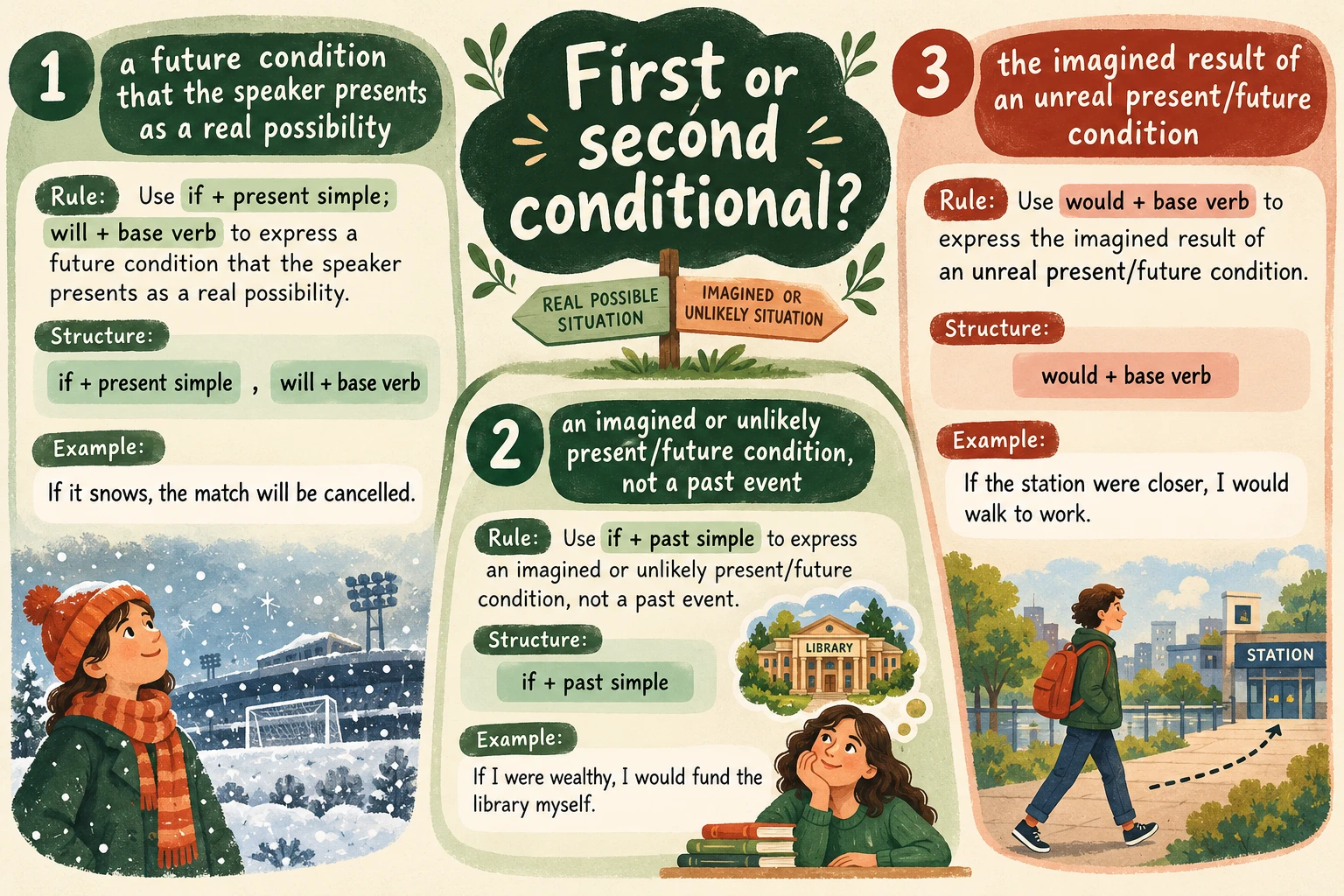
01une condition future présentée comme une possibilité réelle
Utilisez if + present simple; will + base verb pour exprimer une condition future présentée comme une possibilité réelle.
If it snows, the match will be cancelled.
Premier ou deuxième conditionnel ? · B1. Utilisez if + present simple; will + base verb pour exprimer une condition future présentée comme une possibilité réelle.
Réalisez 12 exercices originaux. Appuyez-vous sur la situation pour interpréter le sens, pratiquer la forme et la réutiliser dans un nouveau contexte.
Utilisez if + present simple; will + base verb pour exprimer une condition future présentée comme une possibilité réelle.
If it snows, the match will be cancelled.Utilisez if + past simple pour exprimer une condition présente ou future imaginaire ou improbable, pas un événement passé.
If I were wealthy, I would fund the library myself.Utilisez would + base verb pour exprimer le résultat imaginaire d’une condition présente ou future irréelle.
If the station were closer, I would walk to work.
The forecast gives a realistic chance of snow tomorrow.
Utilisez if + present simple; will + base verb pour exprimer une condition future présentée comme une possibilité réelle.
If it snows, the match will be cancelled.Utilisez if + past simple pour exprimer une condition présente ou future imaginaire ou improbable, pas un événement passé.
If I were wealthy, I would fund the library myself.Utilisez would + base verb pour exprimer le résultat imaginaire d’une condition présente ou future irréelle.
If the station were closer, I would walk to work.Gardez la première tentative, comprenez le changement et essayez dans une nouvelle situation.
Pas encore de notes. Essayez un court échauffement.
Utilisez if + present simple; will + base verb pour exprimer une condition future présentée comme une possibilité réelle.
If it snows, the match will be cancelled.Utilisez if + past simple pour exprimer une condition présente ou future imaginaire ou improbable, pas un événement passé.
If I were wealthy, I would fund the library myself.Utilisez would + base verb pour exprimer le résultat imaginaire d’une condition présente ou future irréelle.
If the station were closer, I would walk to work.Ouvrir une réponse enregistre une aide pour cette question.
The forecast gives a realistic chance of snow tomorrow.
Observe « The forecast gives a realistic chance of snow tomorrow. ». Utilisez if + present simple; will + base verb pour exprimer une condition future présentée comme une possibilité réelle. Phrase complète : « If it snows, the match will be cancelled. ».
I am not wealthy; imagine a different present. Use the ordinary hypothetical-present/future second-conditional pattern.
Observe « I am not wealthy; imagine a different present. Use the ordinary hypothetical-present/future second-conditional pattern. ». Utilisez if + past simple pour exprimer une condition présente ou future imaginaire ou improbable, pas un événement passé. Phrase complète : « If I were wealthy, I would fund the library myself. ».
The station cannot move in reality. Use the ordinary hypothetical-present/future second-conditional pattern.
Observe « The station cannot move in reality. Use the ordinary hypothetical-present/future second-conditional pattern. ». Utilisez would + base verb pour exprimer le résultat imaginaire d’une condition présente ou future irréelle. Phrase complète : « If the station were closer, I would walk to work. ».
The supplier may realistically confirm the order today.
Observe « The supplier may realistically confirm the order today. ». Utilisez if + present simple; will + base verb pour exprimer une condition future présentée comme une possibilité réelle. Phrase complète : « If they confirm today, we will dispatch tomorrow. ».
Use the past simple of own; the speaker does not own the building.
Phrase complète : « If I owned this building, I would repair the lift. » Utilisez if + past simple pour exprimer une condition présente ou future imaginaire ou improbable, pas un événement passé. Le sujet, le temps et le sens de la consigne déterminent cette forme. Seules les réponses vérifiées sont comparées automatiquement ; toute autre formulation n’est pas automatiquement fausse.
I do not have a spare room at present. Use the ordinary hypothetical-present/future second-conditional pattern.
Observe « I do not have a spare room at present. Use the ordinary hypothetical-present/future second-conditional pattern. ». Utilisez would + base verb pour exprimer le résultat imaginaire d’une condition présente ou future irréelle. Phrase complète : « If I had a spare room, I would invite you to stay. ».
Use the present simple of pass for a realistic future condition.
Phrase complète : « If Nora passes the driving test next week, she will apply for the job. » Utilisez if + present simple; will + base verb pour exprimer une condition future présentée comme une possibilité réelle. Le sujet, le temps et le sens de la consigne déterminent cette forme. Seules les réponses vérifiées sont comparées automatiquement ; toute autre formulation n’est pas automatiquement fausse.
A genuine possibility: the ticket office may still have seats.
Observe « A genuine possibility: the ticket office may still have seats. ». Utilisez if + present simple; will + base verb pour exprimer une condition future présentée comme une possibilité réelle. Phrase complète : « If there are seats left, we will buy two. ».
Use the past simple of live; we actually live on the mainland.
Phrase complète : « If we lived on an island, we would depend on ferries. » Utilisez if + past simple pour exprimer une condition présente ou future imaginaire ou improbable, pas un événement passé. Le sujet, le temps et le sens de la consigne déterminent cette forme. Seules les réponses vérifiées sont comparées automatiquement ; toute autre formulation n’est pas automatiquement fausse.
The speaker is not a pilot. Use the ordinary hypothetical-present/future second-conditional pattern.
Observe « The speaker is not a pilot. Use the ordinary hypothetical-present/future second-conditional pattern. ». Utilisez would + base verb pour exprimer le résultat imaginaire d’une condition présente ou future irréelle. Phrase complète : « If I were a pilot, I would study the weather charts daily. ».
The speaker has no influence over the timetable; this is hypothetical. Use the ordinary hypothetical-present/future second-conditional pattern.
Observe « The speaker has no influence over the timetable; this is hypothetical. Use the ordinary hypothetical-present/future second-conditional pattern. ». Utilisez if + past simple pour exprimer une condition présente ou future imaginaire ou improbable, pas un événement passé. Phrase complète : « If I controlled the timetable, I would add a later service. ».
Use a would-result with spend for the imagined consequence; I am not on holiday.
Phrase complète : « If I were on holiday now, I would spend the morning by the lake. » Utilisez would + base verb pour exprimer le résultat imaginaire d’une condition présente ou future irréelle. Le sujet, le temps et le sens de la consigne déterminent cette forme. Seules les réponses vérifiées sont comparées automatiquement ; toute autre formulation n’est pas automatiquement fausse.