
B2

Cleft sentences and emphasis Exercises

About this lesson

Cleft sentences and emphasis · B2. Use it + be + focus + that/who + clause to express contrastive focus on a person, thing or time, while preserving the underlying fact.

Complete 12 original tasks. Use the situation to choose the intended meaning, practise the form, then apply it in a fresh context.

12 items
Save it to find it in My collection.
Knowledge map

Cleft sentences and emphasis

Start practising
Cleft sentences and emphasis — Knowledge map

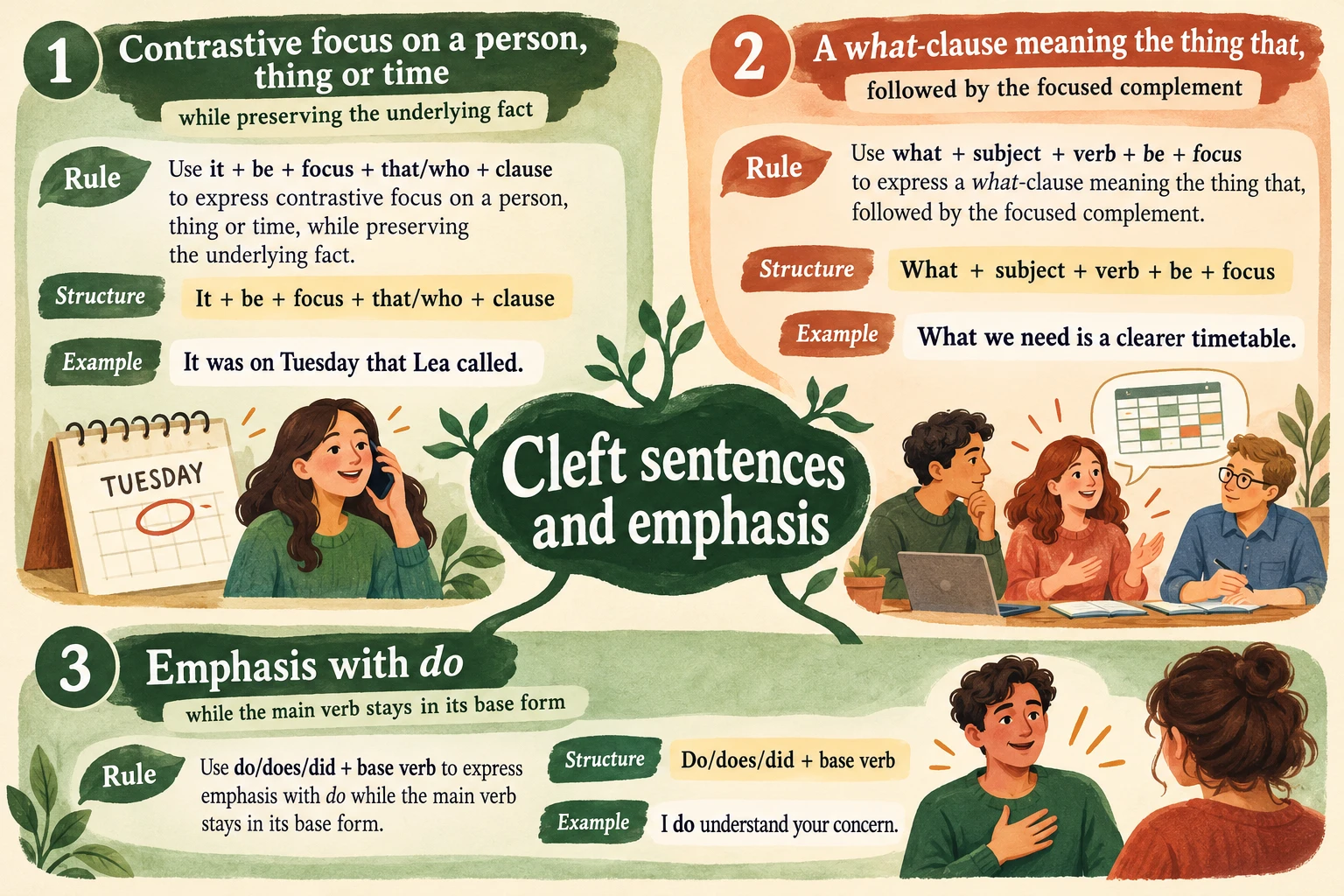
01contrastive focus on a person, thing or time, while preserving the underlying fact

Use it + be + focus + that/who + clause to express contrastive focus on a person, thing or time, while preserving the underlying fact.

It was on Tuesday that Lea called.
02a what-clause meaning the thing that, followed by the focused complement

Use what + subject + verb + be + focus to express a what-clause meaning the thing that, followed by the focused complement.

What we need is a clearer timetable.

03emphasis with do while the main verb stays in its base form

Use do/does/did + base verb to express emphasis with do while the main verb stays in its base form.

I do understand your concern.

Illustrated guide

0/12
Questions
01 / 12D01Save it to find it in My collection.

Contrast Tuesday with Monday without changing who called.

It was on Tuesday ___ Lea called.

Your answer
1 / 12

Your learning route

01
Step 1 · Warm-up

Warm-up

0/3
02
Step 2 · Build the skill

contrastive focus on a person, thing or time, while preserving the underlying fact

0/2

Use it + be + focus + that/who + clause to express contrastive focus on a person, thing or time, while preserving the underlying fact.

It was on Tuesday that Lea called.
03
Step 3 · Build the skill

a what-clause meaning the thing that, followed by the focused complement

0/1

Use what + subject + verb + be + focus to express a what-clause meaning the thing that, followed by the focused complement.

What we need is a clearer timetable.
04
Step 4 · Build the skill

emphasis with do while the main verb stays in its base form

0/1

Use do/does/did + base verb to express emphasis with do while the main verb stays in its base form.

I do understand your concern.
05
Step 5 · New contexts

New contexts

0/3
06
Step 6 · A fresh challenge

A fresh challenge

0/2
Practice notes in this unit

Make mistakes useful.

Keep the first try. Understand the change. Check it in a fresh situation.

0

No practice notes yet. Try a short warm-up.

Lesson map

Cleft sentences and emphasis

B2
Cleft sentences and emphasis

Lesson points

01

contrastive focus on a person, thing or time, while preserving the underlying fact

Use it + be + focus + that/who + clause to express contrastive focus on a person, thing or time, while preserving the underlying fact.

It was on Tuesday that Lea called.
02

a what-clause meaning the thing that, followed by the focused complement

Use what + subject + verb + be + focus to express a what-clause meaning the thing that, followed by the focused complement.

What we need is a clearer timetable.
03

emphasis with do while the main verb stays in its base form

Use do/does/did + base verb to express emphasis with do while the main verb stays in its base form.

I do understand your concern.

Questions & answers

Opening an answer records help for that question.

D01 · Warm-up

Contrast Tuesday with Monday without changing who called.

It was on Tuesday ___ Lea called.

  1. when that
  2. which
  3. what
  4. that
Answer & explanation
that

The deciding clue is “Contrast Tuesday with Monday without changing who called.”. Use it + be + focus + that/who + clause to express contrastive focus on a person, thing or time, while preserving the underlying fact. In this task, the completed sentence is “It was on Tuesday that Lea called.”.

D02 · Warm-up

The clause means the thing we need.

___ we need is a clearer timetable.

  1. That
  2. Which
  3. It
  4. What
Answer & explanation
What

The deciding clue is “The clause means the thing we need.”. Use what + subject + verb + be + focus to express a what-clause meaning the thing that, followed by the focused complement. In this task, the completed sentence is “What we need is a clearer timetable.”.

D03 · Warm-up

Use an emphatic auxiliary but keep understand in the base form.

I ___ understand your concern.

  1. do
  2. am
  3. have
  4. did to
Answer & explanation
do

The deciding clue is “Use an emphatic auxiliary but keep understand in the base form.”. Use do/does/did + base verb to express emphasis with do while the main verb stays in its base form. In this task, the completed sentence is “I do understand your concern.”.

P01 · Build the skill

Contrast Ravi with the other people who might have solved it.

It was Ravi ___ solved the puzzle.

  1. what
  2. whose
  3. whom did
  4. who
Answer & explanation
who

The deciding clue is “Contrast Ravi with the other people who might have solved it.”. Use it + be + focus + that/who + clause to express contrastive focus on a person, thing or time, while preserving the underlying fact. In this task, the completed sentence is “It was Ravi who solved the puzzle.”.

P02 · Build the skill

Introduce a nominal clause meaning the thing that she wanted.

___ she wanted was a chance to explain.

Answer & explanation
What

Complete sentence: “What she wanted was a chance to explain.” Use what + subject + verb + be + focus to express a what-clause meaning the thing that, followed by the focused complement. The subject, time and meaning in the task determine this form. Only reviewed responses are matched automatically; other wording is not automatically wrong.

P03 · Build the skill

The verb following emphatic did stays in the base form.

He did ___ us about the delay.

  1. warn
  2. warning
  3. to warn
  4. warned
Answer & explanation
warn

The deciding clue is “The verb following emphatic did stays in the base form.”. Use do/does/did + base verb to express emphasis with do while the main verb stays in its base form. In this task, the completed sentence is “He did warn us about the delay.”.

P04 · Build the skill

Supply the normal linker for an it-cleft focusing on the missing folder.

It was the blue folder ___ they had misplaced.

Answer & explanation
that

Complete sentence: “It was the blue folder that they had misplaced.” Use it + be + focus + that/who + clause to express contrastive focus on a person, thing or time, while preserving the underlying fact. The subject, time and meaning in the task determine this form. Only reviewed responses are matched automatically; other wording is not automatically wrong.

R01 · New contexts

Focus the timing, preserving the underlying fact that the lights failed at midnight.

It was at midnight ___ the lights failed.

  1. that
  2. what
  3. which
  4. when that
Answer & explanation
that

The deciding clue is “Focus the timing, preserving the underlying fact that the lights failed at midnight.”. Use it + be + focus + that/who + clause to express contrastive focus on a person, thing or time, while preserving the underlying fact. In this task, the completed sentence is “It was at midnight that the lights failed.”.

R02 · New contexts

Introduce a nominal clause meaning the thing that the committee rejected.

___ the committee rejected was the proposed deadline.

Answer & explanation
What

Complete sentence: “What the committee rejected was the proposed deadline.” Use what + subject + verb + be + focus to express a what-clause meaning the thing that, followed by the focused complement. The subject, time and meaning in the task determine this form. Only reviewed responses are matched automatically; other wording is not automatically wrong.

R03 · New contexts

The emphatic positive statement is present simple, third-person singular.

She ___ care about the outcome.

  1. did to
  2. does
  3. is
  4. has
Answer & explanation
does

The deciding clue is “The emphatic positive statement is present simple, third-person singular.”. Use do/does/did + base verb to express emphasis with do while the main verb stays in its base form. In this task, the completed sentence is “She does care about the outcome.”.

X01 · A fresh challenge

A what-clause functions as the subject meaning the thing I regret.

___ I regret most is the lack of consultation.

  1. It
  2. Which
  3. What
  4. That
Answer & explanation
What

The deciding clue is “A what-clause functions as the subject meaning the thing I regret.”. Use what + subject + verb + be + focus to express a what-clause meaning the thing that, followed by the focused complement. In this task, the completed sentence is “What I regret most is the lack of consultation.”.

X02 · A fresh challenge

Use an emphatic past auxiliary with explain to contradict a claim that no explanation occurred.

I ___ the change yesterday; you were absent.

Answer & explanation
did explain

Complete sentence: “I did explain the change yesterday; you were absent.” Use do/does/did + base verb to express emphasis with do while the main verb stays in its base form. The subject, time and meaning in the task determine this form. Only reviewed responses are matched automatically; other wording is not automatically wrong.