
B2

Mixed conditionals Exercises

About this lesson

Mixed conditionals · B2. Use if + past perfect; would + base verb to express a past unreal cause with a present unreal consequence; check both time references.

Complete 12 original tasks. Use the situation to choose the intended meaning, practise the form, then apply it in a fresh context.

12 items
Save it to find it in My collection.
Knowledge map

Mixed conditionals

Start practising
Mixed conditionals — Knowledge map

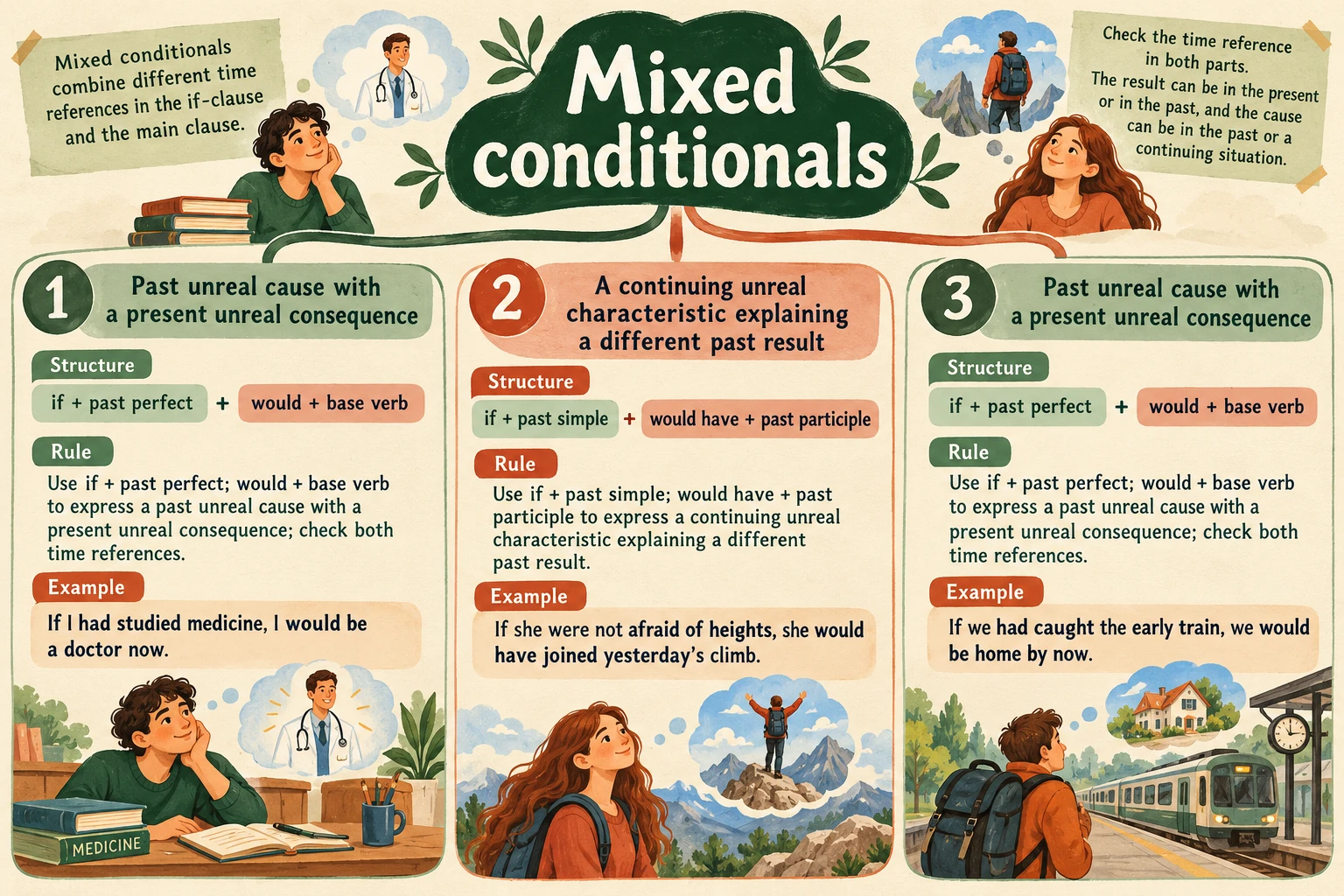
01a past unreal cause with a present unreal consequence; check both time references

Use if + past perfect; would + base verb to express a past unreal cause with a present unreal consequence; check both time references.

If I had studied medicine, I would be a doctor now.

02a continuing unreal characteristic explaining a different past result

Use if + past simple; would have + past participle to express a continuing unreal characteristic explaining a different past result.

If she were not afraid of heights, she would have joined yesterday’s climb.

03a past unreal cause with a present unreal consequence; check both time references

Use if + past perfect; would + base verb to express a past unreal cause with a present unreal consequence; check both time references.

If we had caught the early train, we would be home by now.

Illustrated guide

0/12
Questions
01 / 12D01Save it to find it in My collection.

I did not study medicine years ago; I am not a doctor now.

If I had studied medicine, I ___ a doctor now.

Your answer
1 / 12

Your learning route

01
Step 1 · Warm-up

Warm-up

0/3
02
Step 2 · Build the skill

a past unreal cause with a present unreal consequence; check both time references

0/2

Use if + past perfect; would + base verb to express a past unreal cause with a present unreal consequence; check both time references.

If I had studied medicine, I would be a doctor now.
03
Step 3 · Build the skill

a continuing unreal characteristic explaining a different past result

0/1

Use if + past simple; would have + past participle to express a continuing unreal characteristic explaining a different past result.

If she were not afraid of heights, she would have joined yesterday’s climb.
04
Step 4 · Build the skill

a past unreal cause with a present unreal consequence; check both time references

0/1

Use if + past perfect; would + base verb to express a past unreal cause with a present unreal consequence; check both time references.

If we had caught the early train, we would be home by now.
05
Step 5 · New contexts

New contexts

0/3
06
Step 6 · A fresh challenge

A fresh challenge

0/2
Practice notes in this unit

Make mistakes useful.

Keep the first try. Understand the change. Check it in a fresh situation.

0

No practice notes yet. Try a short warm-up.

Lesson map

Mixed conditionals

B2
Mixed conditionals

Lesson points

01

a past unreal cause with a present unreal consequence; check both time references

Use if + past perfect; would + base verb to express a past unreal cause with a present unreal consequence; check both time references.

If I had studied medicine, I would be a doctor now.
02

a continuing unreal characteristic explaining a different past result

Use if + past simple; would have + past participle to express a continuing unreal characteristic explaining a different past result.

If she were not afraid of heights, she would have joined yesterday’s climb.
03

a past unreal cause with a present unreal consequence; check both time references

Use if + past perfect; would + base verb to express a past unreal cause with a present unreal consequence; check both time references.

If we had caught the early train, we would be home by now.

Questions & answers

Opening an answer records help for that question.

D01 · Warm-up

I did not study medicine years ago; I am not a doctor now.

If I had studied medicine, I ___ a doctor now.

  1. will be
  2. was
  3. would be
  4. am
Answer & explanation
would be

The deciding clue is “I did not study medicine years ago; I am not a doctor now.”. Use if + past perfect; would + base verb to express a past unreal cause with a present unreal consequence; check both time references. In this task, the completed sentence is “If I had studied medicine, I would be a doctor now.”.

D02 · Warm-up

She is generally afraid of heights; that is why she refused yesterday’s climb.

If she were not afraid of heights, she ___ yesterday’s climb.

  1. would have joined
  2. had joined
  3. would join tomorrow
  4. will join
Answer & explanation
would have joined

The deciding clue is “She is generally afraid of heights; that is why she refused yesterday’s climb.”. Use if + past simple; would have + past participle to express a continuing unreal characteristic explaining a different past result. In this task, the completed sentence is “If she were not afraid of heights, she would have joined yesterday’s climb.”.

D03 · Warm-up

We missed the early train; as a consequence we are still travelling now.

If we had caught the early train, we ___ home by now.

  1. are
  2. would be
  3. were
  4. will be
Answer & explanation
would be

The deciding clue is “We missed the early train; as a consequence we are still travelling now.”. Use if + past perfect; would + base verb to express a past unreal cause with a present unreal consequence; check both time references. In this task, the completed sentence is “If we had caught the early train, we would be home by now.”.

P01 · Build the skill

He ignored the map earlier and is lost now.

If he had followed the map, he ___ where he was now.

  1. will know
  2. knows
  3. had known
  4. would know
Answer & explanation
would know

The deciding clue is “He ignored the map earlier and is lost now.”. Use if + past perfect; would + base verb to express a past unreal cause with a present unreal consequence; check both time references. In this task, the completed sentence is “If he had followed the map, he would know where he was now.”.

P02 · Build the skill

Use a would-result with notice for a past consequence of a stable personal characteristic.

If I were more observant, I ___ the error yesterday.

Answer & explanation
would have noticed

Complete sentence: “If I were more observant, I would have noticed the error yesterday.” Use if + past simple; would have + past participle to express a continuing unreal characteristic explaining a different past result. The subject, time and meaning in the task determine this form. Only reviewed responses are matched automatically; other wording is not automatically wrong.

P03 · Build the skill

The university rejected my application last year; I am not living abroad now.

If it had accepted me, I ___ abroad now.

  1. would be living
  2. had been living
  3. am living
  4. will be living
Answer & explanation
would be living

The deciding clue is “The university rejected my application last year; I am not living abroad now.”. Use if + past perfect; would + base verb to express a past unreal cause with a present unreal consequence; check both time references. In this task, the completed sentence is “If it had accepted me, I would be living abroad now.”.

P04 · Build the skill

Use a would-result with have for a present consequence of last year’s decision.

If we had installed solar panels last year, we ___ lower bills now.

Answer & explanation
would have

Complete sentence: “If we had installed solar panels last year, we would have lower bills now.” Use if + past perfect; would + base verb to express a past unreal cause with a present unreal consequence; check both time references. The subject, time and meaning in the task determine this form. Only reviewed responses are matched automatically; other wording is not automatically wrong.

R01 · New contexts

She did not bring the key earlier; we cannot enter now.

If she had brought the key, we ___ get in now.

  1. can
  2. could
  3. had
  4. will
Answer & explanation
could

The deciding clue is “She did not bring the key earlier; we cannot enter now.”. If + past perfect presents the unreal past condition: she did not bring the key. Could + base verb marks the resulting unreal ability now: we would be able to get in. Could is an ability/possibility modal here; the answer is not a would-form. In this task, the completed sentence is “If she had brought the key, we could get in now.”.

R02 · New contexts

Use a would-result with apply for last month’s unreal past outcome; I am generally risk-averse.

If I were less cautious, I ___ for that post last month.

Answer & explanation
would have applied

Complete sentence: “If I were less cautious, I would have applied for that post last month.” Use if + past simple; would have + past participle to express a continuing unreal characteristic explaining a different past result. The subject, time and meaning in the task determine this form. Only reviewed responses are matched automatically; other wording is not automatically wrong.

R03 · New contexts

A past injury explains a current limitation.

If I had not injured my knee, I ___ with you today.

  1. am hiking
  2. had hiked
  3. will hike
  4. would be hiking
Answer & explanation
would be hiking

The deciding clue is “A past injury explains a current limitation.”. Use if + past perfect; would + base verb to express a past unreal cause with a present unreal consequence; check both time references. In this task, the completed sentence is “If I had not injured my knee, I would be hiking with you today.”.

X01 · A fresh challenge

A stable present skill would have changed an earlier event.

If he spoke Arabic, he ___ that conversation yesterday.

  1. would have understood
  2. had understood
  3. will understand
  4. would understand tomorrow
Answer & explanation
would have understood

The deciding clue is “A stable present skill would have changed an earlier event.”. Use if + past simple; would have + past participle to express a continuing unreal characteristic explaining a different past result. In this task, the completed sentence is “If he spoke Arabic, he would have understood that conversation yesterday.”.

X02 · A fresh challenge

Use a would-result with feel for a present consequence of yesterday’s choice.

If I had gone to bed earlier, I ___ less tired now.

Answer & explanation
would feel

Complete sentence: “If I had gone to bed earlier, I would feel less tired now.” Use if + past perfect; would + base verb to express a past unreal cause with a present unreal consequence; check both time references. The subject, time and meaning in the task determine this form. Only reviewed responses are matched automatically; other wording is not automatically wrong.