01accumulated duration up to a future point, often with for or since
Use will have been + -ing to express accumulated duration up to a future point, often with for or since.
By next June, we will have been studying this species for ten years.
Future perfect continuous · B2. Use will have been + -ing to express accumulated duration up to a future point, often with for or since.
Complete 12 original tasks. Use the situation to choose the intended meaning, practise the form, then apply it in a fresh context.
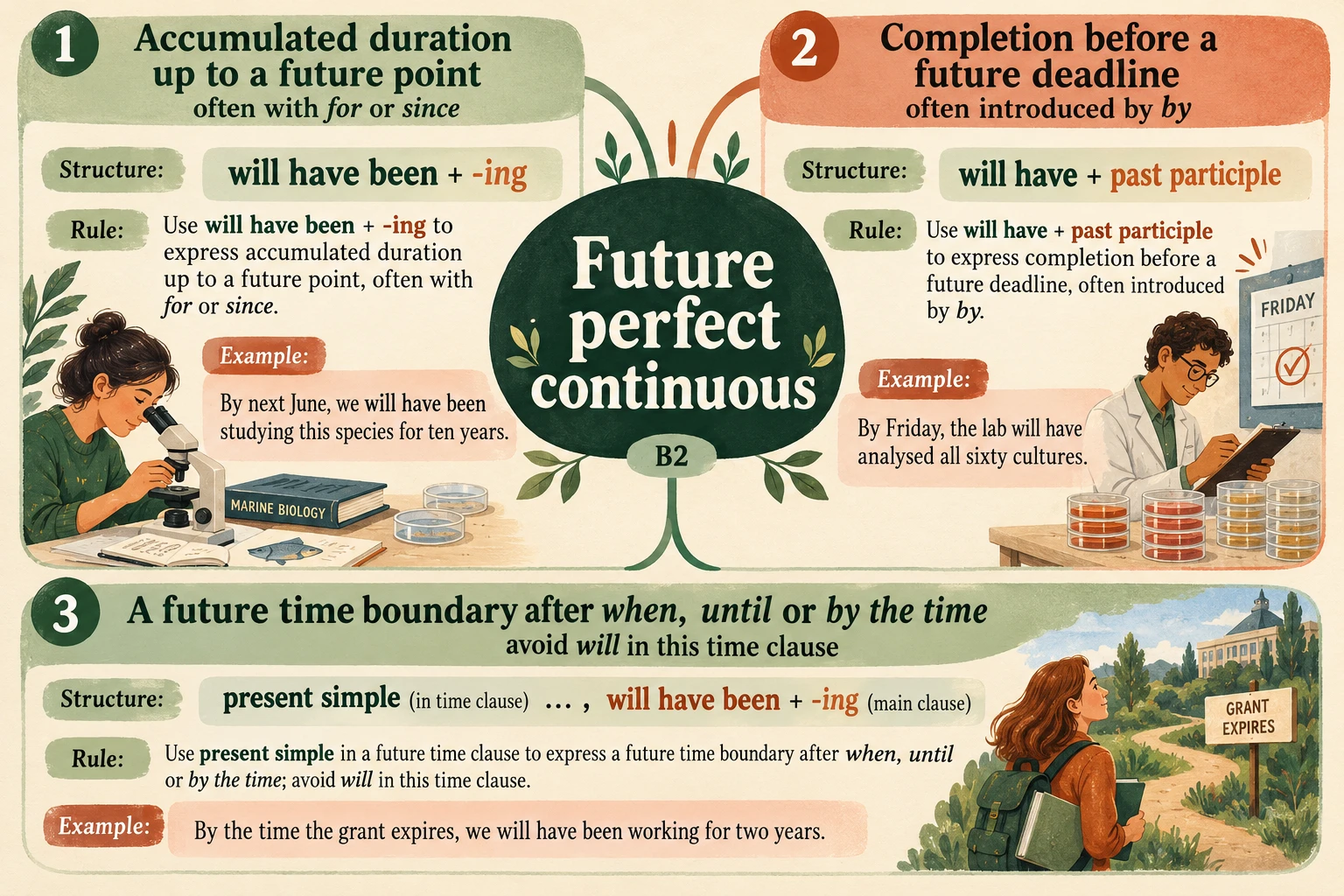
Use will have been + -ing to express accumulated duration up to a future point, often with for or since.
By next June, we will have been studying this species for ten years.Use will have + past participle to express completion before a future deadline, often introduced by by.
By Friday, the lab will have analysed all sixty cultures.Use present simple in a future time clause to express a future time boundary after when, until or by the time; avoid will in this time clause.
By the time the grant expires, we will have been working for two years.
The research will continue; stress accumulated duration at next June.
Use will have been + -ing to express accumulated duration up to a future point, often with for or since.
By next June, we will have been studying this species for ten years.Use will have + past participle to express completion before a future deadline, often introduced by by.
By Friday, the lab will have analysed all sixty cultures.Use present simple in a future time clause to express a future time boundary after when, until or by the time; avoid will in this time clause.
By the time the grant expires, we will have been working for two years.Keep the first try. Understand the change. Check it in a fresh situation.
No practice notes yet. Try a short warm-up.
Use will have been + -ing to express accumulated duration up to a future point, often with for or since.
By next June, we will have been studying this species for ten years.Use will have + past participle to express completion before a future deadline, often introduced by by.
By Friday, the lab will have analysed all sixty cultures.Use present simple in a future time clause to express a future time boundary after when, until or by the time; avoid will in this time clause.
By the time the grant expires, we will have been working for two years.Opening an answer records help for that question.
The research will continue; stress accumulated duration at next June.
The deciding clue is “The research will continue; stress accumulated duration at next June.”. Use will have been + -ing to express accumulated duration up to a future point, often with for or since. In this task, the completed sentence is “By next June, we will have been studying this species for ten years.”.
Focus on an exact completed total before the future deadline.
The deciding clue is “Focus on an exact completed total before the future deadline.”. Use will have + past participle to express completion before a future deadline, often introduced by by. In this task, the completed sentence is “By Friday, the lab will have analysed all sixty cultures.”.
Future time boundary follows by the time.
The deciding clue is “Future time boundary follows by the time.”. Use present simple in a future time clause to express a future time boundary after when, until or by the time; avoid will in this time clause. In this task, the completed sentence is “By the time the grant expires, we will have been working for two years.”.
The occupation will still be continuing; emphasise duration at a future anniversary.
The deciding clue is “The occupation will still be continuing; emphasise duration at a future anniversary.”. Use will have been + -ing to express accumulated duration up to a future point, often with for or since. In this task, the completed sentence is “In August, she will have been working at the station for twenty years.”.
Use the future perfect simple of publish for the completed total.
Complete sentence: “By the end of next year, the team will have published three volumes.” Use will have + past participle to express completion before a future deadline, often introduced by by. The subject, time and meaning in the task determine this form. Only reviewed responses are matched automatically; other wording is not automatically wrong.
The main clause is future; this subordinate clause sets its time boundary.
The deciding clue is “The main clause is future; this subordinate clause sets its time boundary.”. Use present simple in a future time clause to express a future time boundary after when, until or by the time; avoid will in this time clause. In this task, the completed sentence is “When you arrive next week, I will have been teaching here for a month.”.
Use the future perfect continuous of travel to stress duration up to next Monday.
Complete sentence: “By next Monday, they will have been travelling for six consecutive weeks.” Use will have been + -ing to express accumulated duration up to a future point, often with for or since. The subject, time and meaning in the task determine this form. Only reviewed responses are matched automatically; other wording is not automatically wrong.
The strike will be ongoing; count its duration at next Friday.
The deciding clue is “The strike will be ongoing; count its duration at next Friday.”. Use will have been + -ing to express accumulated duration up to a future point, often with for or since. In this task, the completed sentence is “By next Friday, the workers will have been striking for a fortnight.”.
Use the future perfect simple of complete for all ten trials finished before the meeting.
Complete sentence: “By the review meeting, we will have completed all ten trials.” Use will have + past participle to express completion before a future deadline, often introduced by by. The subject, time and meaning in the task determine this form. Only reviewed responses are matched automatically; other wording is not automatically wrong.
In a future time clause, use the present simple for the event boundary.
The deciding clue is “In a future time clause, use the present simple for the event boundary.”. Use present simple in a future time clause to express a future time boundary after when, until or by the time; avoid will in this time clause. In this task, the completed sentence is “We will have been walking for five hours when we reach the refuge.”.
Count completed deliveries, rather than the duration of delivery activity.
The deciding clue is “Count completed deliveries, rather than the duration of delivery activity.”. Use will have + past participle to express completion before a future deadline, often introduced by by. In this task, the completed sentence is “By this evening, the courier will have delivered eighty parcels.”.
Use the present simple of finish in the time clause.
Complete sentence: “By the time the course finishes, she will have been studying for nine months.” Use present simple in a future time clause to express a future time boundary after when, until or by the time; avoid will in this time clause. The subject, time and meaning in the task determine this form. Only reviewed responses are matched automatically; other wording is not automatically wrong.