01기본 사실을 유지하며 사람·사물·시간을 대조 강조
it + be + focus + that/who + clause 구조를 사용합니다. 의미: 기본 사실을 유지하며 사람·사물·시간을 대조 강조.
It was on Tuesday that Lea called.
분열문과 강조 · B2. it + be + focus + that/who + clause 구조를 사용합니다. 의미: 기본 사실을 유지하며 사람·사물·시간을 대조 강조.
새로 만든 12문제입니다. 상황에서 의도를 파악하고 형태를 연습한 뒤 새로운 맥락에 적용하세요.
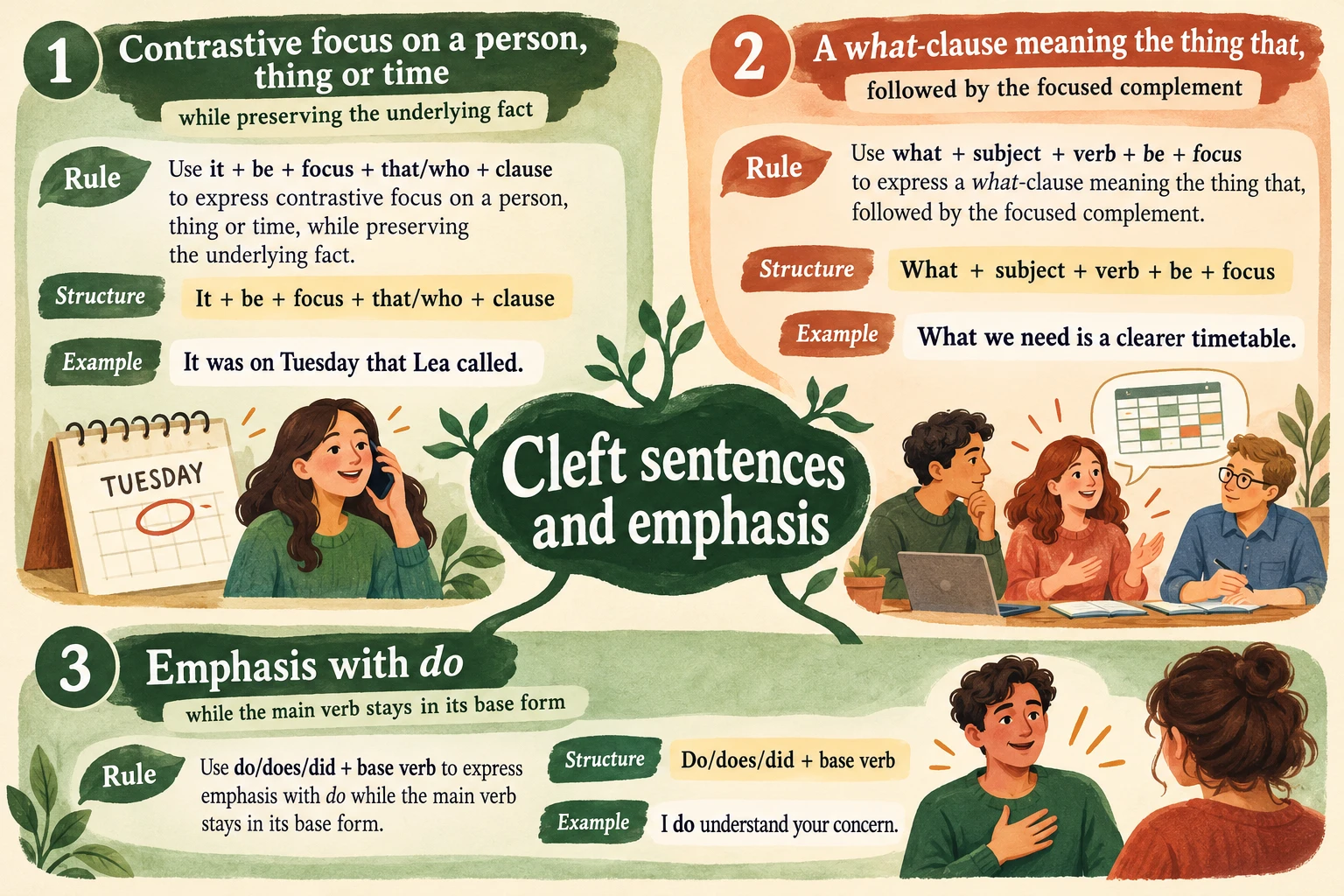
it + be + focus + that/who + clause 구조를 사용합니다. 의미: 기본 사실을 유지하며 사람·사물·시간을 대조 강조.
It was on Tuesday that Lea called.what + subject + verb + be + focus 구조를 사용합니다. 의미: ‘~하는 것’을 뜻하는 what절 뒤의 강조 보어.
What we need is a clearer timetable.do/does/did + base verb 구조를 사용합니다. 의미: 본동사를 원형으로 두는 do 강조.
I do understand your concern.
Contrast Tuesday with Monday without changing who called.
it + be + focus + that/who + clause 구조를 사용합니다. 의미: 기본 사실을 유지하며 사람·사물·시간을 대조 강조.
It was on Tuesday that Lea called.what + subject + verb + be + focus 구조를 사용합니다. 의미: ‘~하는 것’을 뜻하는 what절 뒤의 강조 보어.
What we need is a clearer timetable.do/does/did + base verb 구조를 사용합니다. 의미: 본동사를 원형으로 두는 do 강조.
I do understand your concern.첫 시도를 남기고 변화의 이유를 이해한 뒤 새로운 상황에서 확인해 보세요.
아직 복습 노트가 없어요. 짧은 워밍업부터 해보세요.
it + be + focus + that/who + clause 구조를 사용합니다. 의미: 기본 사실을 유지하며 사람·사물·시간을 대조 강조.
It was on Tuesday that Lea called.what + subject + verb + be + focus 구조를 사용합니다. 의미: ‘~하는 것’을 뜻하는 what절 뒤의 강조 보어.
What we need is a clearer timetable.do/does/did + base verb 구조를 사용합니다. 의미: 본동사를 원형으로 두는 do 강조.
I do understand your concern.정답을 열면 해당 문제에 도움 사용이 기록돼요.
Contrast Tuesday with Monday without changing who called.
판단 단서는 “Contrast Tuesday with Monday without changing who called.”입니다. it + be + focus + that/who + clause 구조를 사용합니다. 의미: 기본 사실을 유지하며 사람·사물·시간을 대조 강조. 이 과제의 완성 문장은 “It was on Tuesday that Lea called.”입니다.
The clause means the thing we need.
판단 단서는 “The clause means the thing we need.”입니다. what + subject + verb + be + focus 구조를 사용합니다. 의미: ‘~하는 것’을 뜻하는 what절 뒤의 강조 보어. 이 과제의 완성 문장은 “What we need is a clearer timetable.”입니다.
Use an emphatic auxiliary but keep understand in the base form.
판단 단서는 “Use an emphatic auxiliary but keep understand in the base form.”입니다. do/does/did + base verb 구조를 사용합니다. 의미: 본동사를 원형으로 두는 do 강조. 이 과제의 완성 문장은 “I do understand your concern.”입니다.
Contrast Ravi with the other people who might have solved it.
판단 단서는 “Contrast Ravi with the other people who might have solved it.”입니다. it + be + focus + that/who + clause 구조를 사용합니다. 의미: 기본 사실을 유지하며 사람·사물·시간을 대조 강조. 이 과제의 완성 문장은 “It was Ravi who solved the puzzle.”입니다.
Introduce a nominal clause meaning the thing that she wanted.
완성 문장: “What she wanted was a chance to explain.” what + subject + verb + be + focus 구조를 사용합니다. 의미: ‘~하는 것’을 뜻하는 what절 뒤의 강조 보어. 과제의 주어·시간·의미에 맞춘 형태입니다. 검토한 답만 자동으로 확인하며, 다른 표현을 자동으로 틀렸다고 하지 않습니다.
The verb following emphatic did stays in the base form.
판단 단서는 “The verb following emphatic did stays in the base form.”입니다. do/does/did + base verb 구조를 사용합니다. 의미: 본동사를 원형으로 두는 do 강조. 이 과제의 완성 문장은 “He did warn us about the delay.”입니다.
Supply the normal linker for an it-cleft focusing on the missing folder.
완성 문장: “It was the blue folder that they had misplaced.” it + be + focus + that/who + clause 구조를 사용합니다. 의미: 기본 사실을 유지하며 사람·사물·시간을 대조 강조. 과제의 주어·시간·의미에 맞춘 형태입니다. 검토한 답만 자동으로 확인하며, 다른 표현을 자동으로 틀렸다고 하지 않습니다.
Focus the timing, preserving the underlying fact that the lights failed at midnight.
판단 단서는 “Focus the timing, preserving the underlying fact that the lights failed at midnight.”입니다. it + be + focus + that/who + clause 구조를 사용합니다. 의미: 기본 사실을 유지하며 사람·사물·시간을 대조 강조. 이 과제의 완성 문장은 “It was at midnight that the lights failed.”입니다.
Introduce a nominal clause meaning the thing that the committee rejected.
완성 문장: “What the committee rejected was the proposed deadline.” what + subject + verb + be + focus 구조를 사용합니다. 의미: ‘~하는 것’을 뜻하는 what절 뒤의 강조 보어. 과제의 주어·시간·의미에 맞춘 형태입니다. 검토한 답만 자동으로 확인하며, 다른 표현을 자동으로 틀렸다고 하지 않습니다.
The emphatic positive statement is present simple, third-person singular.
판단 단서는 “The emphatic positive statement is present simple, third-person singular.”입니다. do/does/did + base verb 구조를 사용합니다. 의미: 본동사를 원형으로 두는 do 강조. 이 과제의 완성 문장은 “She does care about the outcome.”입니다.
A what-clause functions as the subject meaning the thing I regret.
판단 단서는 “A what-clause functions as the subject meaning the thing I regret.”입니다. what + subject + verb + be + focus 구조를 사용합니다. 의미: ‘~하는 것’을 뜻하는 what절 뒤의 강조 보어. 이 과제의 완성 문장은 “What I regret most is the lack of consultation.”입니다.
Use an emphatic past auxiliary with explain to contradict a claim that no explanation occurred.
완성 문장: “I did explain the change yesterday; you were absent.” do/does/did + base verb 구조를 사용합니다. 의미: 본동사를 원형으로 두는 do 강조. 과제의 주어·시간·의미에 맞춘 형태입니다. 검토한 답만 자동으로 확인하며, 다른 표현을 자동으로 틀렸다고 하지 않습니다.