01una actividad en curso en un momento futuro concreto
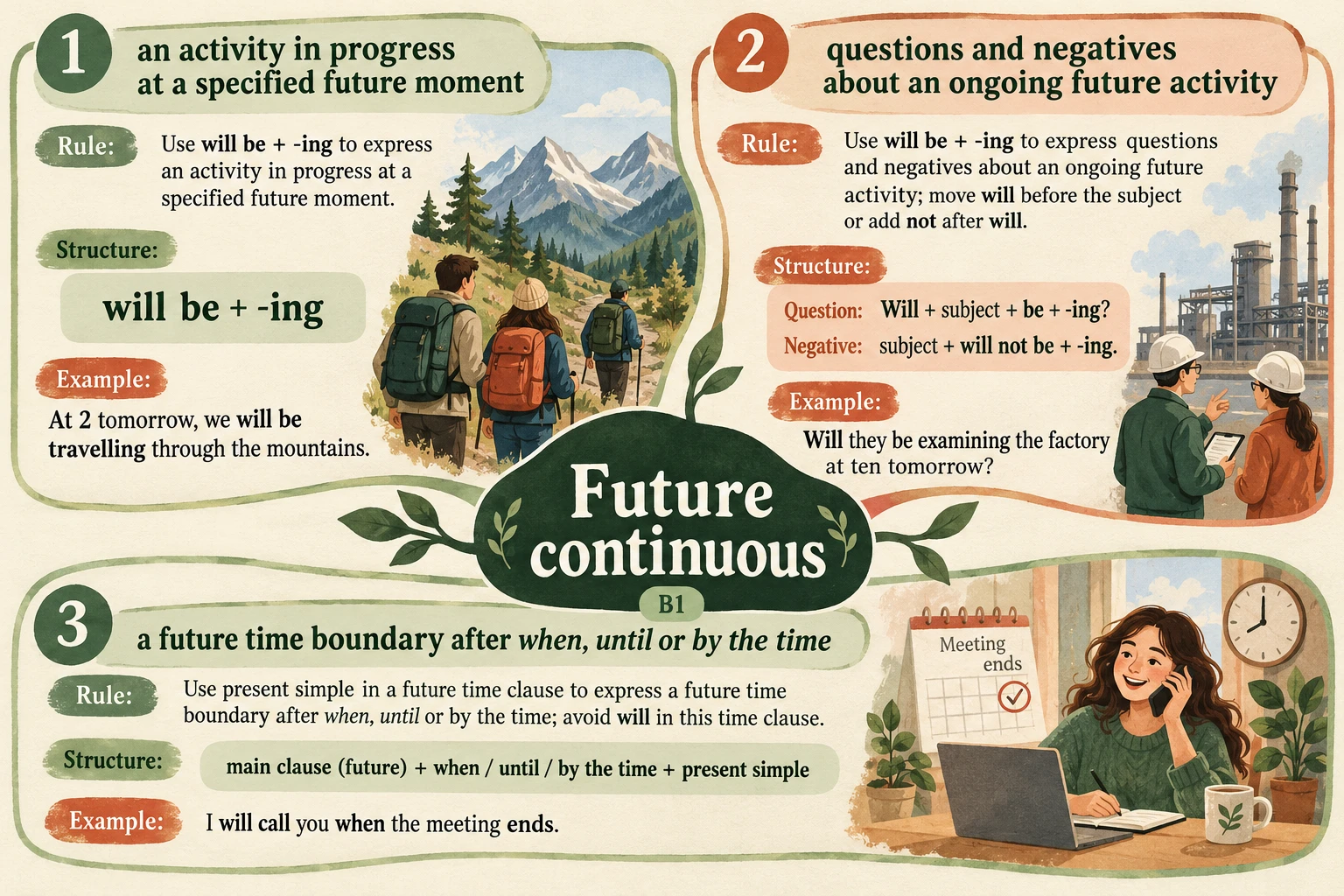
Usa will be + -ing para expresar una actividad en curso en un momento futuro concreto.
At 2 tomorrow, we will be travelling through the mountains.
Futuro continuo · B1. Usa will be + -ing para expresar una actividad en curso en un momento futuro concreto.
Completa 12 tareas originales. Deduce el sentido por la situación, practica la forma y aplícala en un contexto nuevo.
Usa will be + -ing para expresar una actividad en curso en un momento futuro concreto.
At 2 tomorrow, we will be travelling through the mountains.Usa will be + -ing para expresar preguntas y negativas sobre una actividad futura en curso; antepón will al sujeto o añade not tras will.
Will they be examining the factory at ten tomorrow?Usa present simple in a future time clause para expresar un límite futuro tras when, until o by the time; no se usa will en esa subordinada.
I will call you when the meeting ends.
The train journey runs from 1 to 4 tomorrow.
Usa will be + -ing para expresar una actividad en curso en un momento futuro concreto.
At 2 tomorrow, we will be travelling through the mountains.Usa will be + -ing para expresar preguntas y negativas sobre una actividad futura en curso; antepón will al sujeto o añade not tras will.
Will they be examining the factory at ten tomorrow?Usa present simple in a future time clause para expresar un límite futuro tras when, until o by the time; no se usa will en esa subordinada.
I will call you when the meeting ends.Conserva el primer intento, entiende el cambio y compruébalo en otra situación.
Aún no hay repasos. Prueba un calentamiento corto.
Usa will be + -ing para expresar una actividad en curso en un momento futuro concreto.
At 2 tomorrow, we will be travelling through the mountains.Usa will be + -ing para expresar preguntas y negativas sobre una actividad futura en curso; antepón will al sujeto o añade not tras will.
Will they be examining the factory at ten tomorrow?Usa present simple in a future time clause para expresar un límite futuro tras when, until o by the time; no se usa will en esa subordinada.
I will call you when the meeting ends.Abrir una respuesta registra ayuda para esa pregunta.
The train journey runs from 1 to 4 tomorrow.
Mira «At 2 tomorrow, we ___ through the mountains.». Usa will be + -ing para expresar una actividad en curso en un momento futuro concreto. Oración completa: «At 2 tomorrow, we will be travelling through the mountains.».
Ask about an activity in progress at ten tomorrow; keep future continuous question order.
Mira «___ the factory at ten tomorrow?». Usa will be + -ing para expresar preguntas y negativas sobre una actividad futura en curso; antepón will al sujeto o añade not tras will. Oración completa: «Will they be examining the factory at ten tomorrow?».
This is a future time clause, not an indirect question.
Mira «I will call you when the meeting ___.». Usa present simple in a future time clause para expresar un límite futuro tras when, until o by the time; no se usa will en esa subordinada. Oración completa: «I will call you when the meeting ends.».
Her night shift tomorrow covers midnight.
Mira «At midnight tomorrow, Lea ___ at the hospital.». Usa will be + -ing para expresar una actividad en curso en un momento futuro concreto. Oración completa: «At midnight tomorrow, Lea will be working at the hospital.».
Use the negative future continuous of rehearse for an activity that will not be in progress at six.
Oración completa: «At six tomorrow, the dancers will not be rehearsing.» Usa will be + -ing para expresar preguntas y negativas sobre una actividad futura en curso; antepón will al sujeto o añade not tras will. El sujeto, el tiempo y el sentido de la tarea determinan la forma. Solo se cotejan automáticamente las respuestas revisadas; otra redacción no es automáticamente incorrecta.
The main clause is future; the until-clause gives its boundary.
Mira «We will keep the room open until everyone ___.». Usa present simple in a future time clause para expresar un límite futuro tras when, until o by the time; no se usa will en esa subordinada. Oración completa: «We will keep the room open until everyone arrives.».
Use the future continuous of cross for an action underway at noon tomorrow.
Oración completa: «At noon tomorrow, the expedition will be crossing the plateau.» Usa will be + -ing para expresar una actividad en curso en un momento futuro concreto. El sujeto, el tiempo y el sentido de la tarea determinan la forma. Solo se cotejan automáticamente las respuestas revisadas; otra redacción no es automáticamente incorrecta.
The workshop runs from 9 to 5 next Monday.
Mira «At three next Monday, I ___ a workshop.». Usa will be + -ing para expresar una actividad en curso en un momento futuro concreto. Oración completa: «At three next Monday, I will be attending a workshop.».
Write a future-continuous question using the subject the panel and the verb interview.
Oración completa: «Will the panel be interviewing candidates at eleven tomorrow?» Usa will be + -ing para expresar preguntas y negativas sobre una actividad futura en curso; antepón will al sujeto o añade not tras will. El sujeto, el tiempo y el sentido de la tarea determinan la forma. Solo se cotejan automáticamente las respuestas revisadas; otra redacción no es automáticamente incorrecta.
Future time boundary after by the time.
Mira «By the time you ___, I will be waiting outside.». Usa present simple in a future time clause para expresar un límite futuro tras when, until o by the time; no se usa will en esa subordinada. Oración completa: «By the time you finish, I will be waiting outside.».
At this time next week the ship will be in port, so the sailing activity will not be in progress.
Mira «This time next week, the crew ___ across the Atlantic.». Usa will be + -ing para expresar preguntas y negativas sobre una actividad futura en curso; antepón will al sujeto o añade not tras will. Oración completa: «This time next week, the crew will not be sailing across the Atlantic.».
Use the present simple of reach in this future time clause.
Oración completa: «I will be reading when the train reaches the border.» Usa present simple in a future time clause para expresar un límite futuro tras when, until o by the time; no se usa will en esa subordinada. El sujeto, el tiempo y el sentido de la tarea determinan la forma. Solo se cotejan automáticamente las respuestas revisadas; otra redacción no es automáticamente incorrecta.