01eine Tätigkeit, die zu einem bestimmten zukünftigen Zeitpunkt gerade läuft
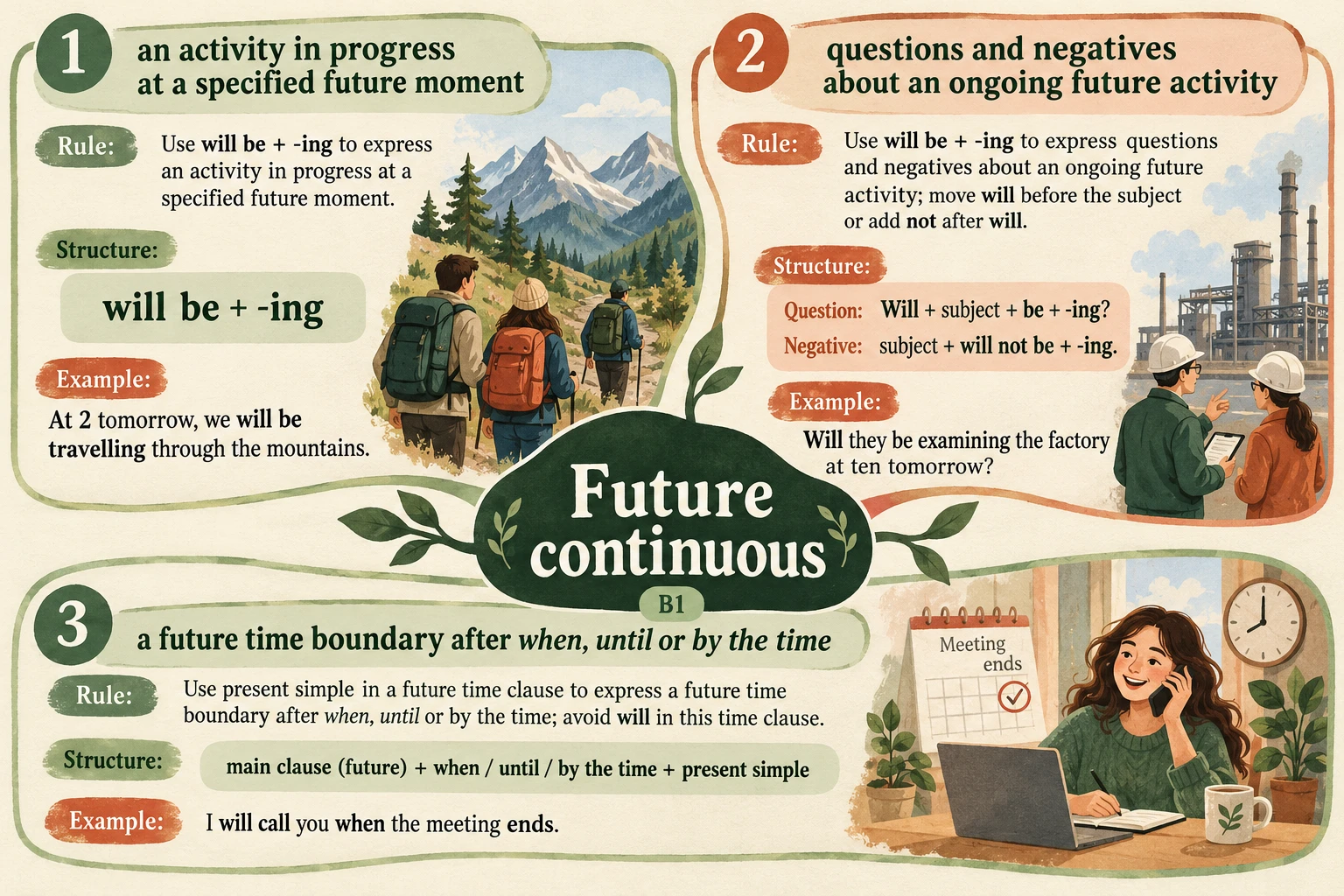
Verwende will be + -ing für eine Tätigkeit, die zu einem bestimmten zukünftigen Zeitpunkt gerade läuft.
At 2 tomorrow, we will be travelling through the mountains.
Future Continuous · B1. Verwende will be + -ing für eine Tätigkeit, die zu einem bestimmten zukünftigen Zeitpunkt gerade läuft.
Bearbeite 12 neue Aufgaben. Erschließe die beabsichtigte Bedeutung aus der Situation, übe die Form und wende sie in einem neuen Kontext an.
Verwende will be + -ing für eine Tätigkeit, die zu einem bestimmten zukünftigen Zeitpunkt gerade läuft.
At 2 tomorrow, we will be travelling through the mountains.Verwende will be + -ing für Fragen und Verneinungen zu einer zukünftigen laufenden Handlung; will vor das Subjekt stellen oder not danach ergänzen.
Will they be examining the factory at ten tomorrow?Verwende present simple in a future time clause für eine zukünftige Zeitgrenze nach when, until oder by the time; dort kein will.
I will call you when the meeting ends.
The train journey runs from 1 to 4 tomorrow.
Verwende will be + -ing für eine Tätigkeit, die zu einem bestimmten zukünftigen Zeitpunkt gerade läuft.
At 2 tomorrow, we will be travelling through the mountains.Verwende will be + -ing für Fragen und Verneinungen zu einer zukünftigen laufenden Handlung; will vor das Subjekt stellen oder not danach ergänzen.
Will they be examining the factory at ten tomorrow?Verwende present simple in a future time clause für eine zukünftige Zeitgrenze nach when, until oder by the time; dort kein will.
I will call you when the meeting ends.Bewahre den ersten Versuch. Verstehe die Änderung. Prüfe sie in einer neuen Situation.
Noch keine Lernnotizen. Starte mit einem kurzen Einstieg.
Verwende will be + -ing für eine Tätigkeit, die zu einem bestimmten zukünftigen Zeitpunkt gerade läuft.
At 2 tomorrow, we will be travelling through the mountains.Verwende will be + -ing für Fragen und Verneinungen zu einer zukünftigen laufenden Handlung; will vor das Subjekt stellen oder not danach ergänzen.
Will they be examining the factory at ten tomorrow?Verwende present simple in a future time clause für eine zukünftige Zeitgrenze nach when, until oder by the time; dort kein will.
I will call you when the meeting ends.Das Öffnen einer Antwort wird für diese Aufgabe als Hilfe erfasst.
The train journey runs from 1 to 4 tomorrow.
Achte auf „At 2 tomorrow, we ___ through the mountains.“. Verwende will be + -ing für eine Tätigkeit, die zu einem bestimmten zukünftigen Zeitpunkt gerade läuft. Vollständiger Satz: „At 2 tomorrow, we will be travelling through the mountains.“.
Ask about an activity in progress at ten tomorrow; keep future continuous question order.
Achte auf „___ the factory at ten tomorrow?“. Verwende will be + -ing für Fragen und Verneinungen zu einer zukünftigen laufenden Handlung; will vor das Subjekt stellen oder not danach ergänzen. Vollständiger Satz: „Will they be examining the factory at ten tomorrow?“.
This is a future time clause, not an indirect question.
Achte auf „I will call you when the meeting ___.“. Verwende present simple in a future time clause für eine zukünftige Zeitgrenze nach when, until oder by the time; dort kein will. Vollständiger Satz: „I will call you when the meeting ends.“.
Her night shift tomorrow covers midnight.
Achte auf „At midnight tomorrow, Lea ___ at the hospital.“. Verwende will be + -ing für eine Tätigkeit, die zu einem bestimmten zukünftigen Zeitpunkt gerade läuft. Vollständiger Satz: „At midnight tomorrow, Lea will be working at the hospital.“.
Use the negative future continuous of rehearse for an activity that will not be in progress at six.
Vollständiger Satz: „At six tomorrow, the dancers will not be rehearsing.“ Verwende will be + -ing für Fragen und Verneinungen zu einer zukünftigen laufenden Handlung; will vor das Subjekt stellen oder not danach ergänzen. Subjekt, Zeit und Bedeutung der Aufgabe bestimmen diese Form. Nur geprüfte Antworten werden automatisch abgeglichen; andere Formulierungen sind nicht automatisch falsch.
The main clause is future; the until-clause gives its boundary.
Achte auf „We will keep the room open until everyone ___.“. Verwende present simple in a future time clause für eine zukünftige Zeitgrenze nach when, until oder by the time; dort kein will. Vollständiger Satz: „We will keep the room open until everyone arrives.“.
Use the future continuous of cross for an action underway at noon tomorrow.
Vollständiger Satz: „At noon tomorrow, the expedition will be crossing the plateau.“ Verwende will be + -ing für eine Tätigkeit, die zu einem bestimmten zukünftigen Zeitpunkt gerade läuft. Subjekt, Zeit und Bedeutung der Aufgabe bestimmen diese Form. Nur geprüfte Antworten werden automatisch abgeglichen; andere Formulierungen sind nicht automatisch falsch.
The workshop runs from 9 to 5 next Monday.
Achte auf „At three next Monday, I ___ a workshop.“. Verwende will be + -ing für eine Tätigkeit, die zu einem bestimmten zukünftigen Zeitpunkt gerade läuft. Vollständiger Satz: „At three next Monday, I will be attending a workshop.“.
Write a future-continuous question using the subject the panel and the verb interview.
Vollständiger Satz: „Will the panel be interviewing candidates at eleven tomorrow?“ Verwende will be + -ing für Fragen und Verneinungen zu einer zukünftigen laufenden Handlung; will vor das Subjekt stellen oder not danach ergänzen. Subjekt, Zeit und Bedeutung der Aufgabe bestimmen diese Form. Nur geprüfte Antworten werden automatisch abgeglichen; andere Formulierungen sind nicht automatisch falsch.
Future time boundary after by the time.
Achte auf „By the time you ___, I will be waiting outside.“. Verwende present simple in a future time clause für eine zukünftige Zeitgrenze nach when, until oder by the time; dort kein will. Vollständiger Satz: „By the time you finish, I will be waiting outside.“.
At this time next week the ship will be in port, so the sailing activity will not be in progress.
Achte auf „This time next week, the crew ___ across the Atlantic.“. Verwende will be + -ing für Fragen und Verneinungen zu einer zukünftigen laufenden Handlung; will vor das Subjekt stellen oder not danach ergänzen. Vollständiger Satz: „This time next week, the crew will not be sailing across the Atlantic.“.
Use the present simple of reach in this future time clause.
Vollständiger Satz: „I will be reading when the train reaches the border.“ Verwende present simple in a future time clause für eine zukünftige Zeitgrenze nach when, until oder by the time; dort kein will. Subjekt, Zeit und Bedeutung der Aufgabe bestimmen diese Form. Nur geprüfte Antworten werden automatisch abgeglichen; andere Formulierungen sind nicht automatisch falsch.