01uma atividade em andamento em um momento futuro específico
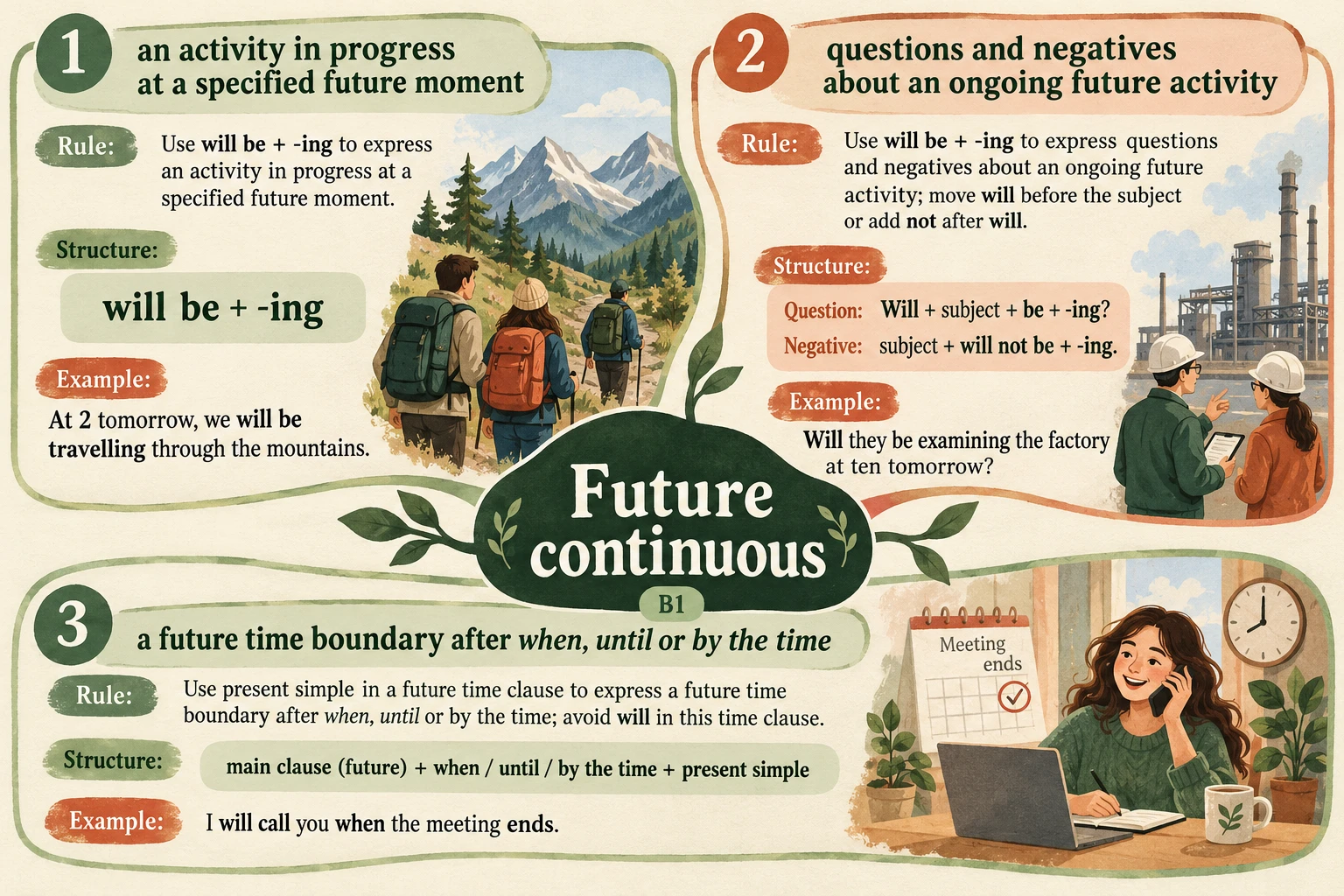
Use will be + -ing para expressar uma atividade em andamento em um momento futuro específico.
At 2 tomorrow, we will be travelling through the mountains.
Futuro contínuo · B1. Use will be + -ing para expressar uma atividade em andamento em um momento futuro específico.
Resolva 12 tarefas originais. Use a situação para interpretar o sentido, praticar a estrutura e aplicá-la em um novo contexto.
Use will be + -ing para expressar uma atividade em andamento em um momento futuro específico.
At 2 tomorrow, we will be travelling through the mountains.Use will be + -ing para expressar perguntas e negativas de atividade futura em andamento; will precede o sujeito ou recebe not depois.
Will they be examining the factory at ten tomorrow?Use present simple in a future time clause para expressar um limite futuro após when, until ou by the time, sem will nessa oração.
I will call you when the meeting ends.
The train journey runs from 1 to 4 tomorrow.
Use will be + -ing para expressar uma atividade em andamento em um momento futuro específico.
At 2 tomorrow, we will be travelling through the mountains.Use will be + -ing para expressar perguntas e negativas de atividade futura em andamento; will precede o sujeito ou recebe not depois.
Will they be examining the factory at ten tomorrow?Use present simple in a future time clause para expressar um limite futuro após when, until ou by the time, sem will nessa oração.
I will call you when the meeting ends.Guarde a primeira tentativa, entenda a mudança e confira em outra situação.
Ainda não há revisões. Faça um aquecimento curto.
Use will be + -ing para expressar uma atividade em andamento em um momento futuro específico.
At 2 tomorrow, we will be travelling through the mountains.Use will be + -ing para expressar perguntas e negativas de atividade futura em andamento; will precede o sujeito ou recebe not depois.
Will they be examining the factory at ten tomorrow?Use present simple in a future time clause para expressar um limite futuro após when, until ou by the time, sem will nessa oração.
I will call you when the meeting ends.Abrir uma resposta registra ajuda para essa questão.
The train journey runs from 1 to 4 tomorrow.
Observe “At 2 tomorrow, we ___ through the mountains.”. Use will be + -ing para expressar uma atividade em andamento em um momento futuro específico. Frase completa: “At 2 tomorrow, we will be travelling through the mountains.”.
Ask about an activity in progress at ten tomorrow; keep future continuous question order.
Observe “___ the factory at ten tomorrow?”. Use will be + -ing para expressar perguntas e negativas de atividade futura em andamento; will precede o sujeito ou recebe not depois. Frase completa: “Will they be examining the factory at ten tomorrow?”.
This is a future time clause, not an indirect question.
Observe “I will call you when the meeting ___.”. Use present simple in a future time clause para expressar um limite futuro após when, until ou by the time, sem will nessa oração. Frase completa: “I will call you when the meeting ends.”.
Her night shift tomorrow covers midnight.
Observe “At midnight tomorrow, Lea ___ at the hospital.”. Use will be + -ing para expressar uma atividade em andamento em um momento futuro específico. Frase completa: “At midnight tomorrow, Lea will be working at the hospital.”.
Use the negative future continuous of rehearse for an activity that will not be in progress at six.
Frase completa: “At six tomorrow, the dancers will not be rehearsing.” Use will be + -ing para expressar perguntas e negativas de atividade futura em andamento; will precede o sujeito ou recebe not depois. O sujeito, o tempo e o sentido da tarefa determinam esta forma. Só as respostas revisadas são comparadas automaticamente; outras formulações não estão automaticamente erradas.
The main clause is future; the until-clause gives its boundary.
Observe “We will keep the room open until everyone ___.”. Use present simple in a future time clause para expressar um limite futuro após when, until ou by the time, sem will nessa oração. Frase completa: “We will keep the room open until everyone arrives.”.
Use the future continuous of cross for an action underway at noon tomorrow.
Frase completa: “At noon tomorrow, the expedition will be crossing the plateau.” Use will be + -ing para expressar uma atividade em andamento em um momento futuro específico. O sujeito, o tempo e o sentido da tarefa determinam esta forma. Só as respostas revisadas são comparadas automaticamente; outras formulações não estão automaticamente erradas.
The workshop runs from 9 to 5 next Monday.
Observe “At three next Monday, I ___ a workshop.”. Use will be + -ing para expressar uma atividade em andamento em um momento futuro específico. Frase completa: “At three next Monday, I will be attending a workshop.”.
Write a future-continuous question using the subject the panel and the verb interview.
Frase completa: “Will the panel be interviewing candidates at eleven tomorrow?” Use will be + -ing para expressar perguntas e negativas de atividade futura em andamento; will precede o sujeito ou recebe not depois. O sujeito, o tempo e o sentido da tarefa determinam esta forma. Só as respostas revisadas são comparadas automaticamente; outras formulações não estão automaticamente erradas.
Future time boundary after by the time.
Observe “By the time you ___, I will be waiting outside.”. Use present simple in a future time clause para expressar um limite futuro após when, until ou by the time, sem will nessa oração. Frase completa: “By the time you finish, I will be waiting outside.”.
At this time next week the ship will be in port, so the sailing activity will not be in progress.
Observe “This time next week, the crew ___ across the Atlantic.”. Use will be + -ing para expressar perguntas e negativas de atividade futura em andamento; will precede o sujeito ou recebe not depois. Frase completa: “This time next week, the crew will not be sailing across the Atlantic.”.
Use the present simple of reach in this future time clause.
Frase completa: “I will be reading when the train reaches the border.” Use present simple in a future time clause para expressar um limite futuro após when, until ou by the time, sem will nessa oração. O sujeito, o tempo e o sentido da tarefa determinam esta forma. Só as respostas revisadas são comparadas automaticamente; outras formulações não estão automaticamente erradas.