01a conclusão antes de um prazo futuro, muitas vezes com by
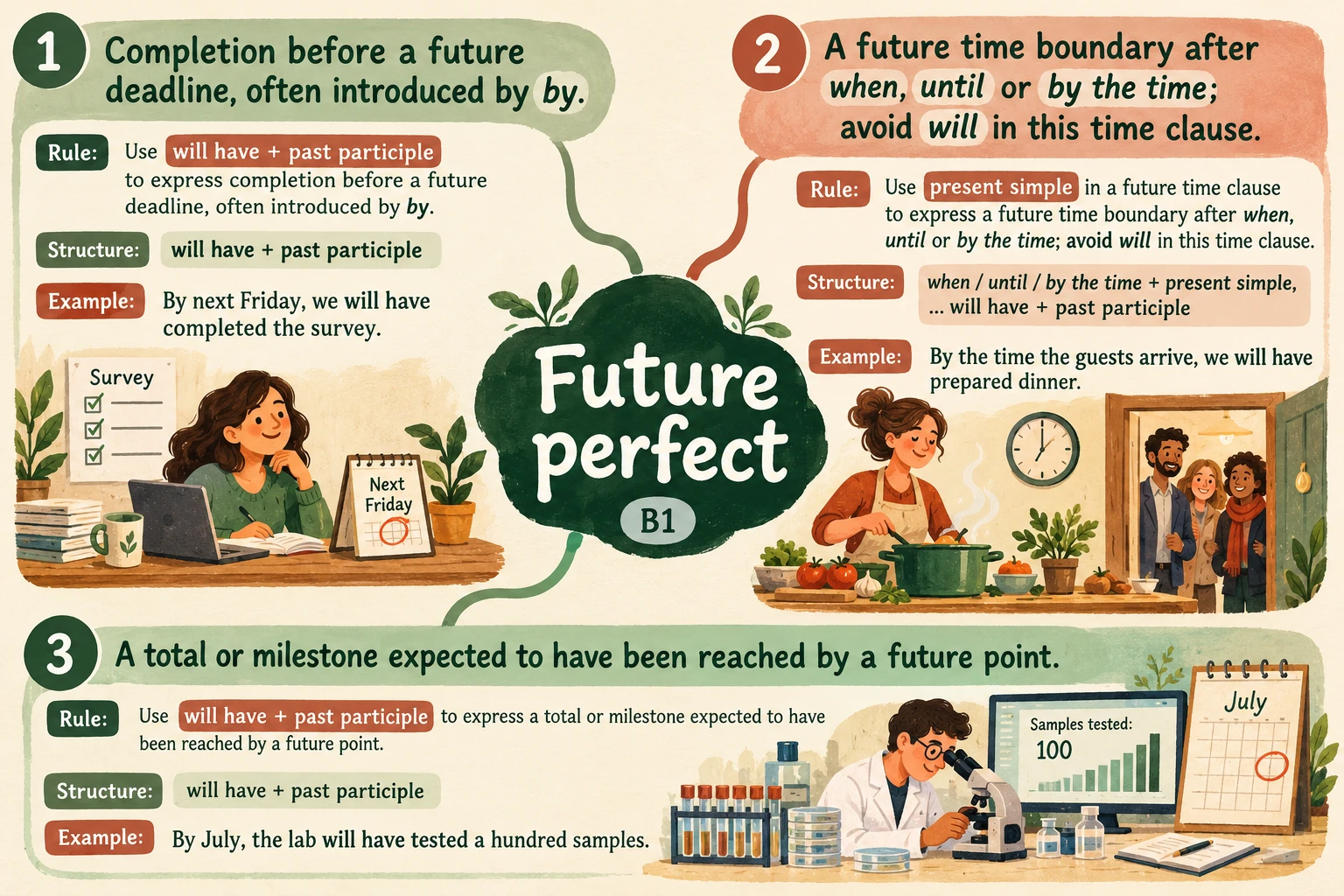
Use will have + past participle para expressar a conclusão antes de um prazo futuro, muitas vezes com by.
By next Friday, we will have completed the survey.
Futuro perfeito · B1. Use will have + past participle para expressar a conclusão antes de um prazo futuro, muitas vezes com by.
Resolva 12 tarefas originais. Use a situação para interpretar o sentido, praticar a estrutura e aplicá-la em um novo contexto.
Use will have + past participle para expressar a conclusão antes de um prazo futuro, muitas vezes com by.
By next Friday, we will have completed the survey.Use present simple in a future time clause para expressar um limite futuro após when, until ou by the time, sem will nessa oração.
By the time the guests arrive, we will have prepared dinner.Use will have + past participle para expressar um total ou marco esperado até um ponto futuro.
By July, the lab will have tested a hundred samples.
The deadline is next Friday; the work will be complete earlier.
Use will have + past participle para expressar a conclusão antes de um prazo futuro, muitas vezes com by.
By next Friday, we will have completed the survey.Use present simple in a future time clause para expressar um limite futuro após when, until ou by the time, sem will nessa oração.
By the time the guests arrive, we will have prepared dinner.Use will have + past participle para expressar um total ou marco esperado até um ponto futuro.
By July, the lab will have tested a hundred samples.Guarde a primeira tentativa, entenda a mudança e confira em outra situação.
Ainda não há revisões. Faça um aquecimento curto.
Use will have + past participle para expressar a conclusão antes de um prazo futuro, muitas vezes com by.
By next Friday, we will have completed the survey.Use present simple in a future time clause para expressar um limite futuro após when, until ou by the time, sem will nessa oração.
By the time the guests arrive, we will have prepared dinner.Use will have + past participle para expressar um total ou marco esperado até um ponto futuro.
By July, the lab will have tested a hundred samples.Abrir uma resposta registra ajuda para essa questão.
The deadline is next Friday; the work will be complete earlier.
Observe “By next Friday, we ___ the survey.”. Use will have + past participle para expressar a conclusão antes de um prazo futuro, muitas vezes com by. Frase completa: “By next Friday, we will have completed the survey.”.
A future time clause starts with by the time.
Observe “By the time the guests ___, we will have prepared dinner.”. Use present simple in a future time clause para expressar um limite futuro após when, until ou by the time, sem will nessa oração. Frase completa: “By the time the guests arrive, we will have prepared dinner.”.
The total is expected to be achieved before July begins.
Observe “By July, the lab ___ a hundred samples.”. Use will have + past participle para expressar um total ou marco esperado até um ponto futuro. Frase completa: “By July, the lab will have tested a hundred samples.”.
The report will be finished before tomorrow noon.
Observe “By noon tomorrow, I ___ the report.”. Use will have + past participle para expressar a conclusão antes de um prazo futuro, muitas vezes com by. Frase completa: “By noon tomorrow, I will have written the report.”.
Use the present simple of end in the future time clause.
Frase completa: “We will have packed everything by the time the lease ends.” Use present simple in a future time clause para expressar um limite futuro após when, until ou by the time, sem will nessa oração. O sujeito, o tempo e o sentido da tarefa determinam esta forma. Só as respostas revisadas são comparadas automaticamente; outras formulações não estão automaticamente erradas.
Their ten-year anniversary occurs before the future reference point.
Observe “By December, they ___ ten years in this town.”. Use will have + past participle para expressar um total ou marco esperado até um ponto futuro. Frase completa: “By December, they will have spent ten years in this town.”.
Use the future perfect of leave; departure will be complete before your arrival tomorrow.
Frase completa: “By the time you get here tomorrow, I will have left.” Use will have + past participle para expressar a conclusão antes de um prazo futuro, muitas vezes com by. O sujeito, o tempo e o sentido da tarefa determinam esta forma. Só as respostas revisadas são comparadas automaticamente; outras formulações não estão automaticamente erradas.
The last payment occurs before the future deadline.
Observe “By the end of May, she ___ the loan.”. Use will have + past participle para expressar a conclusão antes de um prazo futuro, muitas vezes com by. Frase completa: “By the end of May, she will have repaid the loan.”.
Use the present simple of close in the future time clause.
Frase completa: “We will have served everyone before the kitchen closes.” Use present simple in a future time clause para expressar um limite futuro após when, until ou by the time, sem will nessa oração. O sujeito, o tempo e o sentido da tarefa determinam esta forma. Só as respostas revisadas são comparadas automaticamente; outras formulações não estão automaticamente erradas.
The future reference point is after the completion of all interviews.
Observe “By five tomorrow, the panel ___ all eight applicants.”. Use will have + past participle para expressar um total ou marco esperado até um ponto futuro. Frase completa: “By five tomorrow, the panel will have interviewed all eight applicants.”.
Future time boundary after before.
Observe “I will have checked the figures before the director ___.”. Use present simple in a future time clause para expressar um limite futuro após when, until ou by the time, sem will nessa oração. Frase completa: “I will have checked the figures before the director returns.”.
Use the future perfect of save for a target reached before next summer.
Frase completa: “By next summer, we will have saved enough for the deposit.” Use will have + past participle para expressar um total ou marco esperado até um ponto futuro. O sujeito, o tempo e o sentido da tarefa determinam esta forma. Só as respostas revisadas são comparadas automaticamente; outras formulações não estão automaticamente erradas.