01Plurais regulares: -s e -es
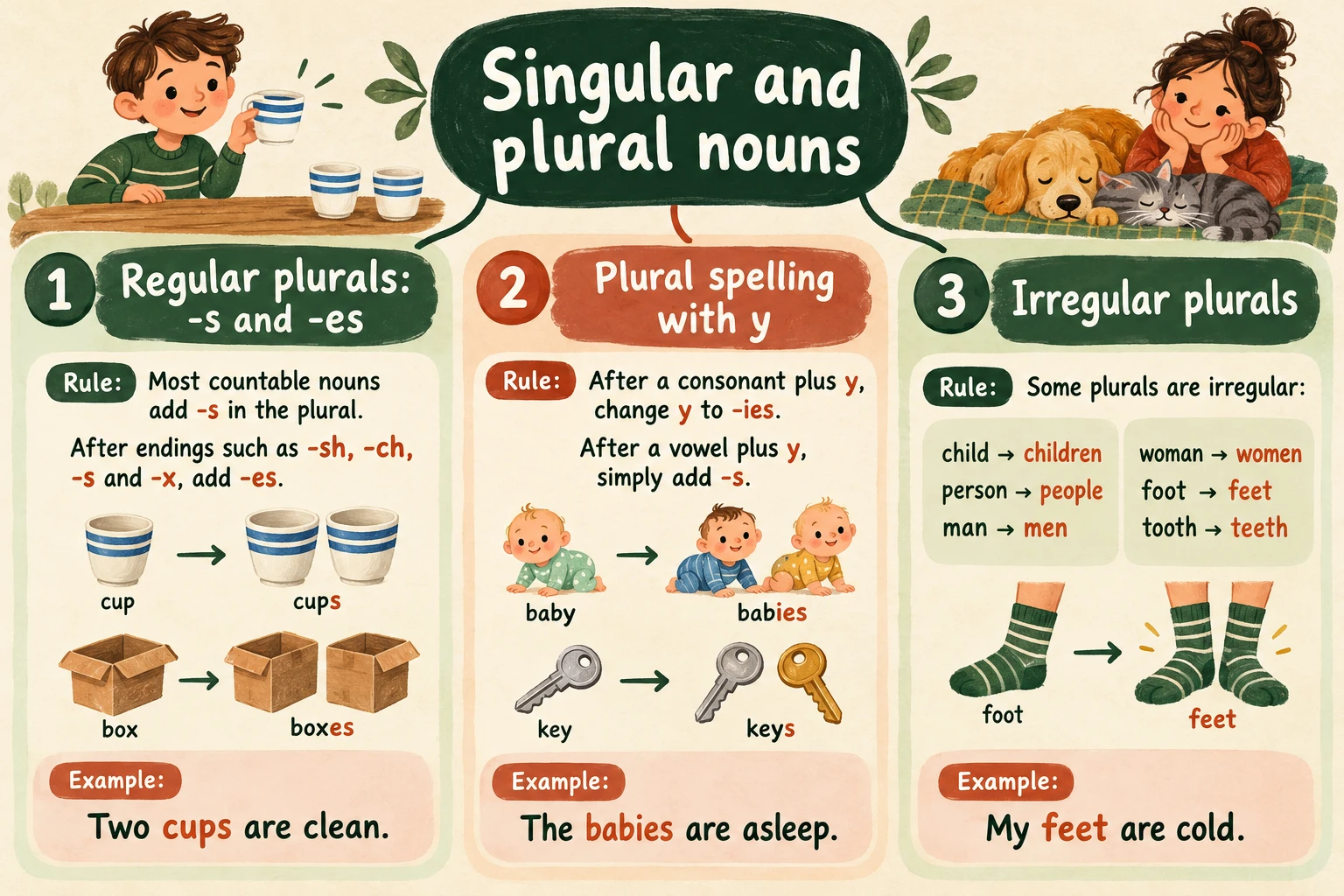
A maioria dos substantivos contáveis recebe -s; depois de -sh, -ch, -s e -x, use -es.
Two cups are clean.
Substantivos no singular e no plural · A1. A maioria dos substantivos contáveis recebe -s; depois de -sh, -ch, -s e -x, use -es.
Pratique Substantivos no singular e no plural em situações curtas. Leia a pista, escolha ou escreva uma forma e confira a explicação. O nível é uma orientação editorial.
A maioria dos substantivos contáveis recebe -s; depois de -sh, -ch, -s e -x, use -es.
Two cups are clean.Depois de consoante + y, troque y por -ies. Depois de vogal + y, acrescente apenas -s.
The babies are asleep.Alguns plurais são irregulares: child→children, person→people, man→men, woman→women, foot→feet, tooth→teeth.
My feet are cold.
The removal team carried three large ___ upstairs. (box)
A maioria dos substantivos contáveis recebe -s; depois de -sh, -ch, -s e -x, use -es.
Two cups are clean.Depois de consoante + y, troque y por -ies. Depois de vogal + y, acrescente apenas -s.
The babies are asleep.Alguns plurais são irregulares: child→children, person→people, man→men, woman→women, foot→feet, tooth→teeth.
My feet are cold.Guarde a primeira tentativa, entenda a mudança e confira em outra situação.
Ainda não há revisões. Faça um aquecimento curto.
A maioria dos substantivos contáveis recebe -s; depois de -sh, -ch, -s e -x, use -es.
Two cups are clean.Depois de consoante + y, troque y por -ies. Depois de vogal + y, acrescente apenas -s.
The babies are asleep.Alguns plurais são irregulares: child→children, person→people, man→men, woman→women, foot→feet, tooth→teeth.
My feet are cold.Abrir uma resposta registra ajuda para essa questão.
The removal team carried three large ___ upstairs. (box)
Observe “The removal team carried three large ___ upstairs. (box)”. A maioria dos substantivos contáveis recebe -s; depois de -sh, -ch, -s e -x, use -es. Frase completa: “The removal team carried three large boxes upstairs. (box)”.
Our street has two new ___. (family)
Observe “Our street has two new ___. (family)”. Depois de consoante + y, troque y por -ies. Depois de vogal + y, acrescente apenas -s. Frase completa: “Our street has two new families. (family)”.
The school has sixty ___. (child)
Observe “The school has sixty ___. (child)”. Alguns plurais são irregulares: child→children, person→people, man→men, woman→women, foot→feet, tooth→teeth. Frase completa: “The school has sixty children. (child)”.
There are four ___ on this route. (bus)
Frase de referência: “There are four buses on this route. (bus)”. A maioria dos substantivos contáveis recebe -s; depois de -sh, -ch, -s e -x, use -es. Buses é a forma normalmente ensinada; busses também é um plural padrão de bus e é aceito aqui.
The twins share their ___. (toy)
Observe “The twins share their ___. (toy)”. Pede-se plural. Toy termina em vogal + y: mantenha y e acrescente -s, toys. Frase completa: “The twins share their toys. (toy)”.
Five ___ work in the laboratory. (woman)
Observe “Five ___ work in the laboratory. (woman)”. Alguns plurais são irregulares: child→children, person→people, man→men, woman→women, foot→feet, tooth→teeth. Frase completa: “Five women work in the laboratory. (woman)”.
I washed six ___ after lunch. (dish)
Frase de referência: “I washed six dishes after lunch. (dish)”. A maioria dos substantivos contáveis recebe -s; depois de -sh, -ch, -s e -x, use -es.
We packed eight ___ for the art class. (brush)
Observe “We packed eight ___ for the art class. (brush)”. A maioria dos substantivos contáveis recebe -s; depois de -sh, -ch, -s e -x, use -es. Frase completa: “We packed eight brushes for the art class. (brush)”.
The library serves three nearby ___. (city)
Observe “The library serves three nearby ___. (city)”. Depois de consoante + y, troque y por -ies. Depois de vogal + y, acrescente apenas -s. Frase completa: “The library serves three nearby cities. (city)”.
The baby has two new ___. (tooth)
Frase de referência: “The baby has two new teeth. (tooth)”. Alguns plurais são irregulares: child→children, person→people, man→men, woman→women, foot→feet, tooth→teeth.
The shop sells small ___ for doors. (key)
Observe “The shop sells small ___ for doors. (key)”. Depois de consoante + y, troque y por -ies. Depois de vogal + y, acrescente apenas -s. Frase completa: “The shop sells small keys for doors. (key)”.
Two ___ are waiting at reception. (person)
Two pede plural. People é o plural cotidiano de person; persons também é padrão, mais formal, e é aceito aqui. Também são aceitas estas variantes revisadas: persons. A lista não cobre todas as expressões possíveis.