01Plurales regulares: -s y -es
La mayoría de nombres contables añaden -s; tras -sh, -ch, -s y -x se añade -es.
Two cups are clean.
Sustantivos singulares y plurales · A1. La mayoría de nombres contables añaden -s; tras -sh, -ch, -s y -x se añade -es.
Practica Sustantivos singulares y plurales en situaciones breves. Lee la pista, elige o escribe una forma y revisa la explicación. El nivel es una orientación editorial.
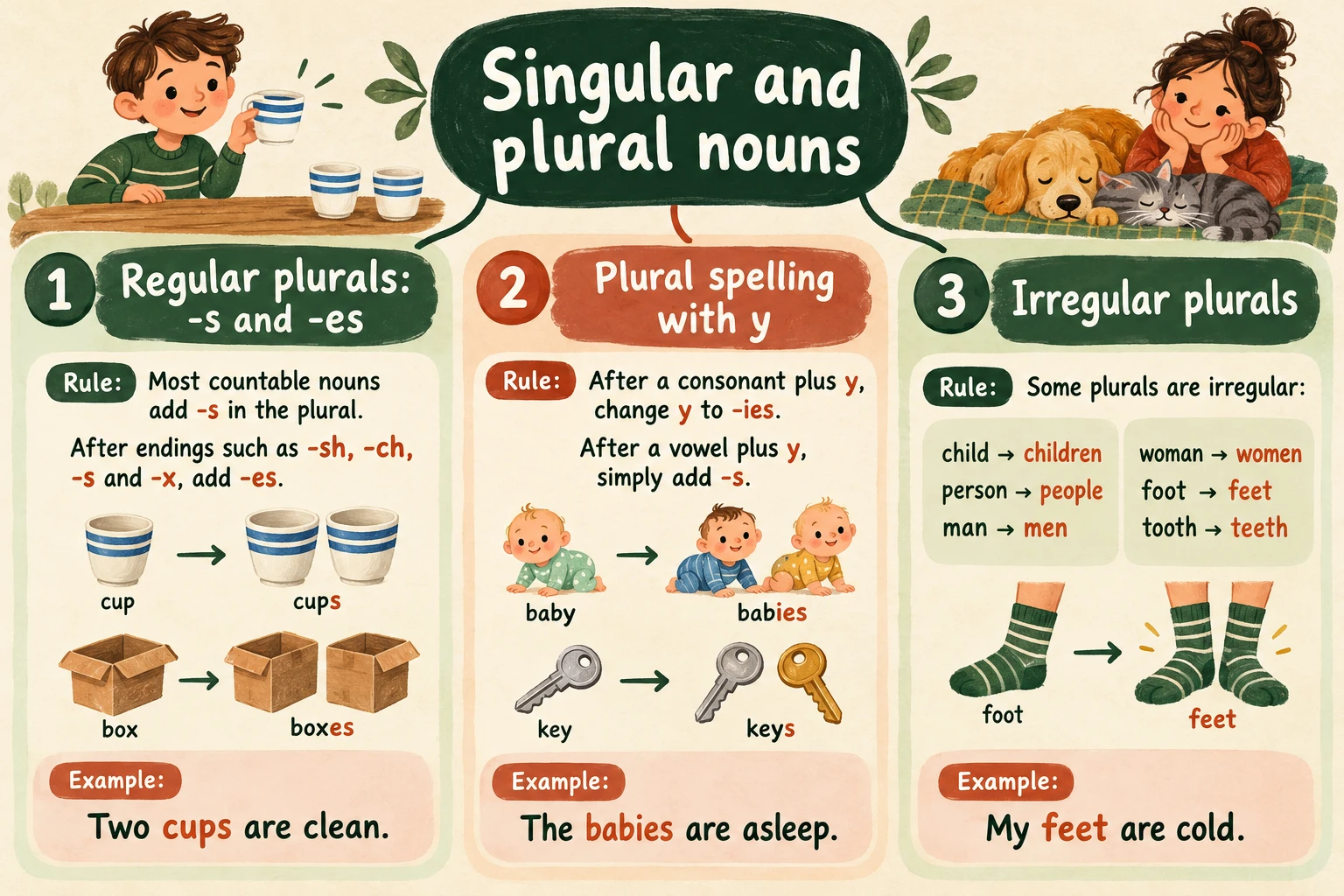
La mayoría de nombres contables añaden -s; tras -sh, -ch, -s y -x se añade -es.
Two cups are clean.Tras consonante + y, cambia y por -ies. Tras vocal + y, añade solo -s.
The babies are asleep.Algunos plurales son irregulares: child→children, person→people, man→men, woman→women, foot→feet, tooth→teeth.
My feet are cold.
The removal team carried three large ___ upstairs. (box)
La mayoría de nombres contables añaden -s; tras -sh, -ch, -s y -x se añade -es.
Two cups are clean.Tras consonante + y, cambia y por -ies. Tras vocal + y, añade solo -s.
The babies are asleep.Algunos plurales son irregulares: child→children, person→people, man→men, woman→women, foot→feet, tooth→teeth.
My feet are cold.Conserva el primer intento, entiende el cambio y compruébalo en otra situación.
Aún no hay repasos. Prueba un calentamiento corto.
La mayoría de nombres contables añaden -s; tras -sh, -ch, -s y -x se añade -es.
Two cups are clean.Tras consonante + y, cambia y por -ies. Tras vocal + y, añade solo -s.
The babies are asleep.Algunos plurales son irregulares: child→children, person→people, man→men, woman→women, foot→feet, tooth→teeth.
My feet are cold.Abrir una respuesta registra ayuda para esa pregunta.
The removal team carried three large ___ upstairs. (box)
Mira «The removal team carried three large ___ upstairs. (box)». La mayoría de nombres contables añaden -s; tras -sh, -ch, -s y -x se añade -es. Oración completa: «The removal team carried three large boxes upstairs. (box)».
Our street has two new ___. (family)
Mira «Our street has two new ___. (family)». Tras consonante + y, cambia y por -ies. Tras vocal + y, añade solo -s. Oración completa: «Our street has two new families. (family)».
The school has sixty ___. (child)
Mira «The school has sixty ___. (child)». Algunos plurales son irregulares: child→children, person→people, man→men, woman→women, foot→feet, tooth→teeth. Oración completa: «The school has sixty children. (child)».
There are four ___ on this route. (bus)
Oración de referencia: «There are four buses on this route. (bus)». La mayoría de nombres contables añaden -s; tras -sh, -ch, -s y -x se añade -es. Buses es la forma habitual de enseñanza; busses también es un plural estándar de bus y se acepta aquí.
The twins share their ___. (toy)
Mira «The twins share their ___. (toy)». Se pide plural. Toy termina en vocal + y, así que se conserva y y se añade -s: toys. Oración completa: «The twins share their toys. (toy)».
Five ___ work in the laboratory. (woman)
Mira «Five ___ work in the laboratory. (woman)». Algunos plurales son irregulares: child→children, person→people, man→men, woman→women, foot→feet, tooth→teeth. Oración completa: «Five women work in the laboratory. (woman)».
I washed six ___ after lunch. (dish)
Oración de referencia: «I washed six dishes after lunch. (dish)». La mayoría de nombres contables añaden -s; tras -sh, -ch, -s y -x se añade -es.
We packed eight ___ for the art class. (brush)
Mira «We packed eight ___ for the art class. (brush)». La mayoría de nombres contables añaden -s; tras -sh, -ch, -s y -x se añade -es. Oración completa: «We packed eight brushes for the art class. (brush)».
The library serves three nearby ___. (city)
Mira «The library serves three nearby ___. (city)». Tras consonante + y, cambia y por -ies. Tras vocal + y, añade solo -s. Oración completa: «The library serves three nearby cities. (city)».
The baby has two new ___. (tooth)
Oración de referencia: «The baby has two new teeth. (tooth)». Algunos plurales son irregulares: child→children, person→people, man→men, woman→women, foot→feet, tooth→teeth.
The shop sells small ___ for doors. (key)
Mira «The shop sells small ___ for doors. (key)». Tras consonante + y, cambia y por -ies. Tras vocal + y, añade solo -s. Oración completa: «The shop sells small keys for doors. (key)».
Two ___ are waiting at reception. (person)
Two exige plural. People es el plural habitual de person; persons también es estándar y más formal, por lo que se acepta aquí. También se admiten estas variantes revisadas: persons. No es una lista de todas las expresiones posibles.