01a neutral confirmation tag with opposite polarity and the same auxiliary
Use positive statement + negative tag to express a neutral confirmation tag with opposite polarity and the same auxiliary.
You have received the invoice, haven’t you?
Question tags · B1. Use positive statement + negative tag to express a neutral confirmation tag with opposite polarity and the same auxiliary.
Complete 12 original tasks. Use the situation to choose the intended meaning, practise the form, then apply it in a fresh context.
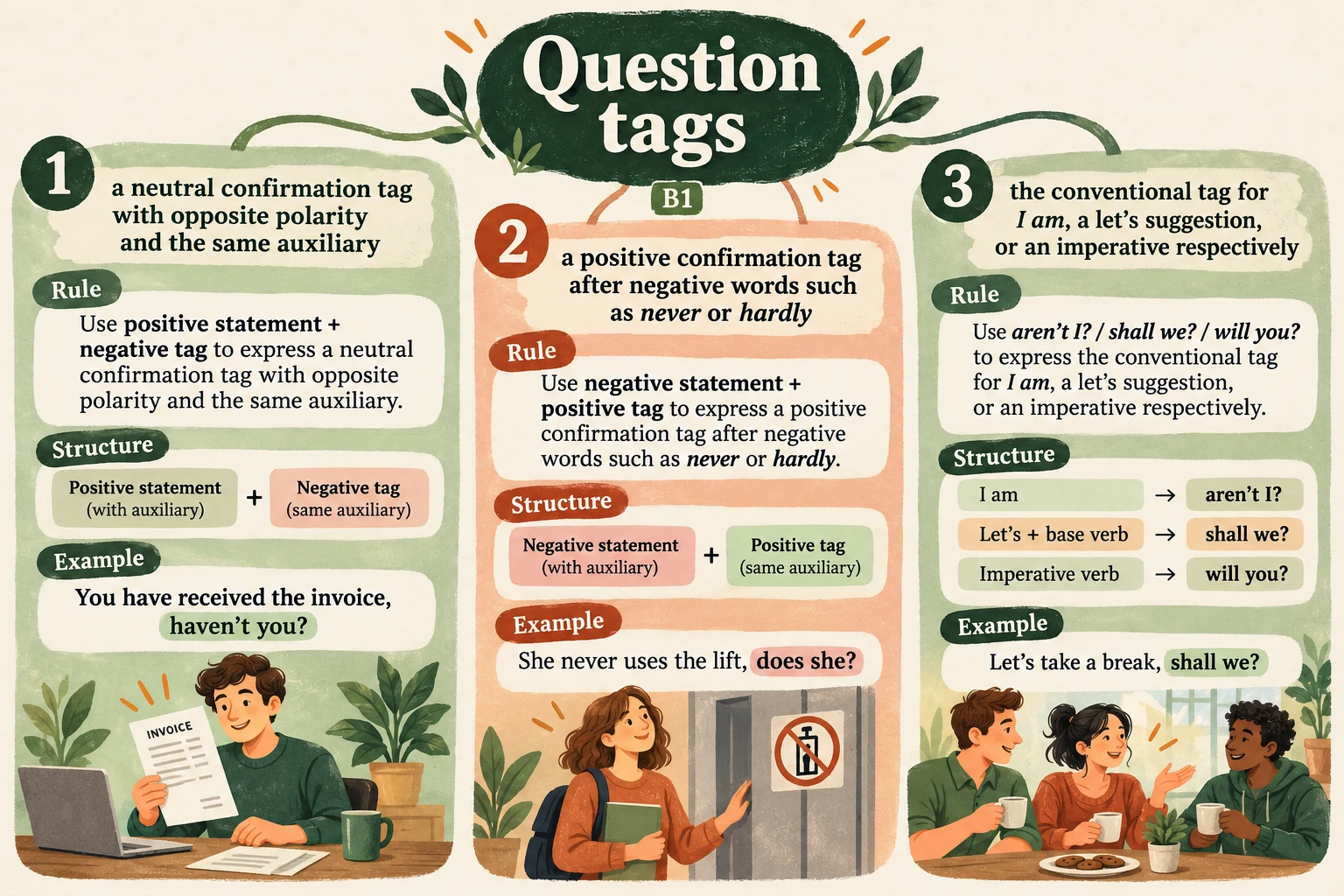
Use positive statement + negative tag to express a neutral confirmation tag with opposite polarity and the same auxiliary.
You have received the invoice, haven’t you?Use negative statement + positive tag to express a positive confirmation tag after negative words such as never or hardly.
She never uses the lift, does she?Use aren't I? / shall we? / will you? to express the conventional tag for I am, a let’s suggestion, or an imperative respectively.
Let’s take a break, shall we?
Use a neutral confirmation tag after the positive statement.
Use positive statement + negative tag to express a neutral confirmation tag with opposite polarity and the same auxiliary.
You have received the invoice, haven’t you?Use negative statement + positive tag to express a positive confirmation tag after negative words such as never or hardly.
She never uses the lift, does she?Use aren't I? / shall we? / will you? to express the conventional tag for I am, a let’s suggestion, or an imperative respectively.
Let’s take a break, shall we?Keep the first try. Understand the change. Check it in a fresh situation.
No practice notes yet. Try a short warm-up.
Use positive statement + negative tag to express a neutral confirmation tag with opposite polarity and the same auxiliary.
You have received the invoice, haven’t you?Use negative statement + positive tag to express a positive confirmation tag after negative words such as never or hardly.
She never uses the lift, does she?Use aren't I? / shall we? / will you? to express the conventional tag for I am, a let’s suggestion, or an imperative respectively.
Let’s take a break, shall we?Opening an answer records help for that question.
Use a neutral confirmation tag after the positive statement.
Look at “You have received the invoice, ___?”. Use positive statement + negative tag to express a neutral confirmation tag with opposite polarity and the same auxiliary. Complete sentence: “You have received the invoice, haven’t you?”.
Never makes the statement negative in meaning.
Look at “She never uses the lift, ___?”. Use negative statement + positive tag to express a positive confirmation tag after negative words such as never or hardly. Complete sentence: “She never uses the lift, does she?”.
Use the conventional tag for a suggestion with let’s.
Look at “Let’s take a break, ___?”. Use aren't I? / shall we? / will you? to express the conventional tag for I am, a let’s suggestion, or an imperative respectively. Complete sentence: “Let’s take a break, shall we?”.
The main clause is a positive past simple statement. Use a neutral opposite-polarity confirmation tag, not a same-polarity echo.
Look at “The main clause is a positive past simple statement. Use a neutral opposite-polarity confirmation tag, not a same-polarity echo.”. Use positive statement + negative tag to express a neutral confirmation tag with opposite polarity and the same auxiliary. Complete sentence: “They signed the contract, didn’t they?”.
Write the positive tag after a negative past statement.
Complete sentence: “You did not see the notice, did you?” Use negative statement + positive tag to express a positive confirmation tag after negative words such as never or hardly. The subject, time and meaning in the task determine this form. Only reviewed responses are matched automatically; other wording is not automatically wrong.
Use the conventional informal confirmation tag for I am.
Look at “I am next, ___?”. Use aren't I? / shall we? / will you? to express the conventional tag for I am, a let’s suggestion, or an imperative respectively. Complete sentence: “I am next, aren’t I?”.
Write the negative tag corresponding to will.
Complete sentence: “They will call tonight, won’t they?” Use positive statement + negative tag to express a neutral confirmation tag with opposite polarity and the same auxiliary. The subject, time and meaning in the task determine this form. Only reviewed responses are matched automatically; other wording is not automatically wrong.
The positive statement contains can. Use a neutral opposite-polarity confirmation tag, not a same-polarity echo.
Look at “The positive statement contains can. Use a neutral opposite-polarity confirmation tag, not a same-polarity echo.”. Use positive statement + negative tag to express a neutral confirmation tag with opposite polarity and the same auxiliary. Complete sentence: “Ravi can drive the van, can’t he?”.
Write the positive tag; hardly gives the statement negative meaning.
Complete sentence: “We hardly know them, do we?” Use negative statement + positive tag to express a positive confirmation tag after negative words such as never or hardly. The subject, time and meaning in the task determine this form. Only reviewed responses are matched automatically; other wording is not automatically wrong.
Use a conventional request tag after an imperative.
Look at “Close the gate, ___?”. Use aren't I? / shall we? / will you? to express the conventional tag for I am, a let’s suggestion, or an imperative respectively. Complete sentence: “Close the gate, will you?”.
Nobody makes the statement negative; use they for the tag’s person. Use a neutral opposite-polarity confirmation tag, not a same-polarity echo.
Look at “Nobody makes the statement negative; use they for the tag’s person. Use a neutral opposite-polarity confirmation tag, not a same-polarity echo.”. Use negative statement + positive tag to express a positive confirmation tag after negative words such as never or hardly. Complete sentence: “Nobody has objected, have they?”.
Write the conventional question tag for a suggestion beginning with let’s.
Complete sentence: “Let’s check the route first, shall we?” Use aren't I? / shall we? / will you? to express the conventional tag for I am, a let’s suggestion, or an imperative respectively. The subject, time and meaning in the task determine this form. Only reviewed responses are matched automatically; other wording is not automatically wrong.