01una coletilla neutra con polaridad contraria y el mismo auxiliar
Usa positive statement + negative tag para expresar una coletilla neutra con polaridad contraria y el mismo auxiliar.
You have received the invoice, haven’t you?
Preguntas coletilla · B1. Usa positive statement + negative tag para expresar una coletilla neutra con polaridad contraria y el mismo auxiliar.
Completa 12 tareas originales. Deduce el sentido por la situación, practica la forma y aplícala en un contexto nuevo.
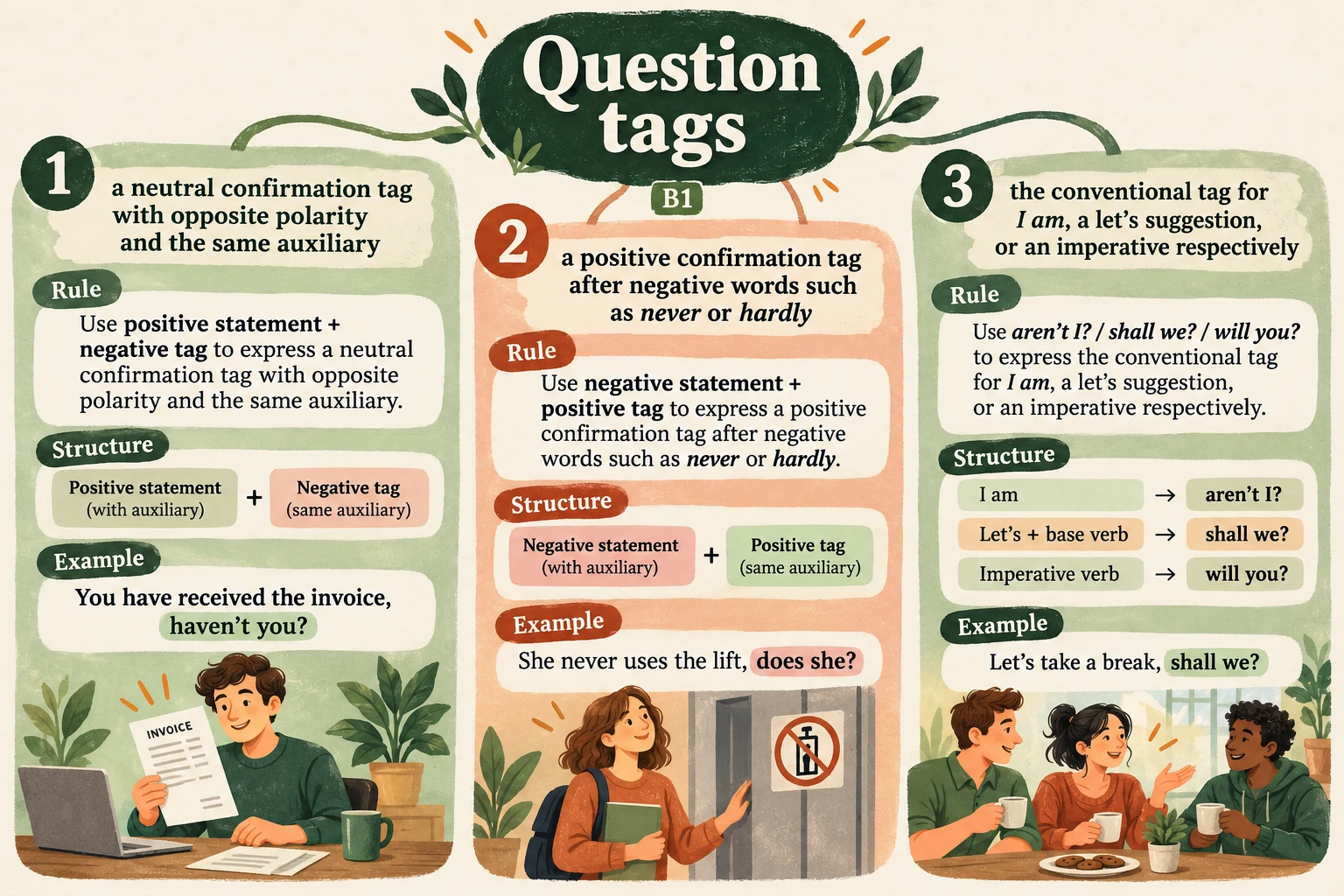
Usa positive statement + negative tag para expresar una coletilla neutra con polaridad contraria y el mismo auxiliar.
You have received the invoice, haven’t you?Usa negative statement + positive tag para expresar una coletilla afirmativa tras palabras negativas como never o hardly.
She never uses the lift, does she?Usa aren't I? / shall we? / will you? para expresar la coletilla habitual de I am, una sugerencia con let’s o un imperativo, respectivamente.
Let’s take a break, shall we?
Use a neutral confirmation tag after the positive statement.
Usa positive statement + negative tag para expresar una coletilla neutra con polaridad contraria y el mismo auxiliar.
You have received the invoice, haven’t you?Usa negative statement + positive tag para expresar una coletilla afirmativa tras palabras negativas como never o hardly.
She never uses the lift, does she?Usa aren't I? / shall we? / will you? para expresar la coletilla habitual de I am, una sugerencia con let’s o un imperativo, respectivamente.
Let’s take a break, shall we?Conserva el primer intento, entiende el cambio y compruébalo en otra situación.
Aún no hay repasos. Prueba un calentamiento corto.
Usa positive statement + negative tag para expresar una coletilla neutra con polaridad contraria y el mismo auxiliar.
You have received the invoice, haven’t you?Usa negative statement + positive tag para expresar una coletilla afirmativa tras palabras negativas como never o hardly.
She never uses the lift, does she?Usa aren't I? / shall we? / will you? para expresar la coletilla habitual de I am, una sugerencia con let’s o un imperativo, respectivamente.
Let’s take a break, shall we?Abrir una respuesta registra ayuda para esa pregunta.
Use a neutral confirmation tag after the positive statement.
Mira «You have received the invoice, ___?». Usa positive statement + negative tag para expresar una coletilla neutra con polaridad contraria y el mismo auxiliar. Oración completa: «You have received the invoice, haven’t you?».
Never makes the statement negative in meaning.
Mira «She never uses the lift, ___?». Usa negative statement + positive tag para expresar una coletilla afirmativa tras palabras negativas como never o hardly. Oración completa: «She never uses the lift, does she?».
Use the conventional tag for a suggestion with let’s.
Mira «Let’s take a break, ___?». Usa aren't I? / shall we? / will you? para expresar la coletilla habitual de I am, una sugerencia con let’s o un imperativo, respectivamente. Oración completa: «Let’s take a break, shall we?».
The main clause is a positive past simple statement. Use a neutral opposite-polarity confirmation tag, not a same-polarity echo.
Mira «The main clause is a positive past simple statement. Use a neutral opposite-polarity confirmation tag, not a same-polarity echo.». Usa positive statement + negative tag para expresar una coletilla neutra con polaridad contraria y el mismo auxiliar. Oración completa: «They signed the contract, didn’t they?».
Write the positive tag after a negative past statement.
Oración completa: «You did not see the notice, did you?» Usa negative statement + positive tag para expresar una coletilla afirmativa tras palabras negativas como never o hardly. El sujeto, el tiempo y el sentido de la tarea determinan la forma. Solo se cotejan automáticamente las respuestas revisadas; otra redacción no es automáticamente incorrecta.
Use the conventional informal confirmation tag for I am.
Mira «I am next, ___?». Usa aren't I? / shall we? / will you? para expresar la coletilla habitual de I am, una sugerencia con let’s o un imperativo, respectivamente. Oración completa: «I am next, aren’t I?».
Write the negative tag corresponding to will.
Oración completa: «They will call tonight, won’t they?» Usa positive statement + negative tag para expresar una coletilla neutra con polaridad contraria y el mismo auxiliar. El sujeto, el tiempo y el sentido de la tarea determinan la forma. Solo se cotejan automáticamente las respuestas revisadas; otra redacción no es automáticamente incorrecta.
The positive statement contains can. Use a neutral opposite-polarity confirmation tag, not a same-polarity echo.
Mira «The positive statement contains can. Use a neutral opposite-polarity confirmation tag, not a same-polarity echo.». Usa positive statement + negative tag para expresar una coletilla neutra con polaridad contraria y el mismo auxiliar. Oración completa: «Ravi can drive the van, can’t he?».
Write the positive tag; hardly gives the statement negative meaning.
Oración completa: «We hardly know them, do we?» Usa negative statement + positive tag para expresar una coletilla afirmativa tras palabras negativas como never o hardly. El sujeto, el tiempo y el sentido de la tarea determinan la forma. Solo se cotejan automáticamente las respuestas revisadas; otra redacción no es automáticamente incorrecta.
Use a conventional request tag after an imperative.
Mira «Close the gate, ___?». Usa aren't I? / shall we? / will you? para expresar la coletilla habitual de I am, una sugerencia con let’s o un imperativo, respectivamente. Oración completa: «Close the gate, will you?».
Nobody makes the statement negative; use they for the tag’s person. Use a neutral opposite-polarity confirmation tag, not a same-polarity echo.
Mira «Nobody makes the statement negative; use they for the tag’s person. Use a neutral opposite-polarity confirmation tag, not a same-polarity echo.». Usa negative statement + positive tag para expresar una coletilla afirmativa tras palabras negativas como never o hardly. Oración completa: «Nobody has objected, have they?».
Write the conventional question tag for a suggestion beginning with let’s.
Oración completa: «Let’s check the route first, shall we?» Usa aren't I? / shall we? / will you? para expresar la coletilla habitual de I am, una sugerencia con let’s o un imperativo, respectivamente. El sujeto, el tiempo y el sentido de la tarea determinan la forma. Solo se cotejan automáticamente las respuestas revisadas; otra redacción no es automáticamente incorrecta.