
B1

Bestätigungsfragen Übungen

Über diese Lektion

Bestätigungsfragen · B1. Verwende positive statement + negative tag für eine neutrale Bestätigungsfrage mit umgekehrter Verneinung und gleichem Hilfsverb.

Bearbeite 12 neue Aufgaben. Erschließe die beabsichtigte Bedeutung aus der Situation, übe die Form und wende sie in einem neuen Kontext an.

12 Aufgaben
Speichere es für deine Sammlung.
Wissensübersicht

Question tags

Jetzt üben
Question tags — Wissensübersicht

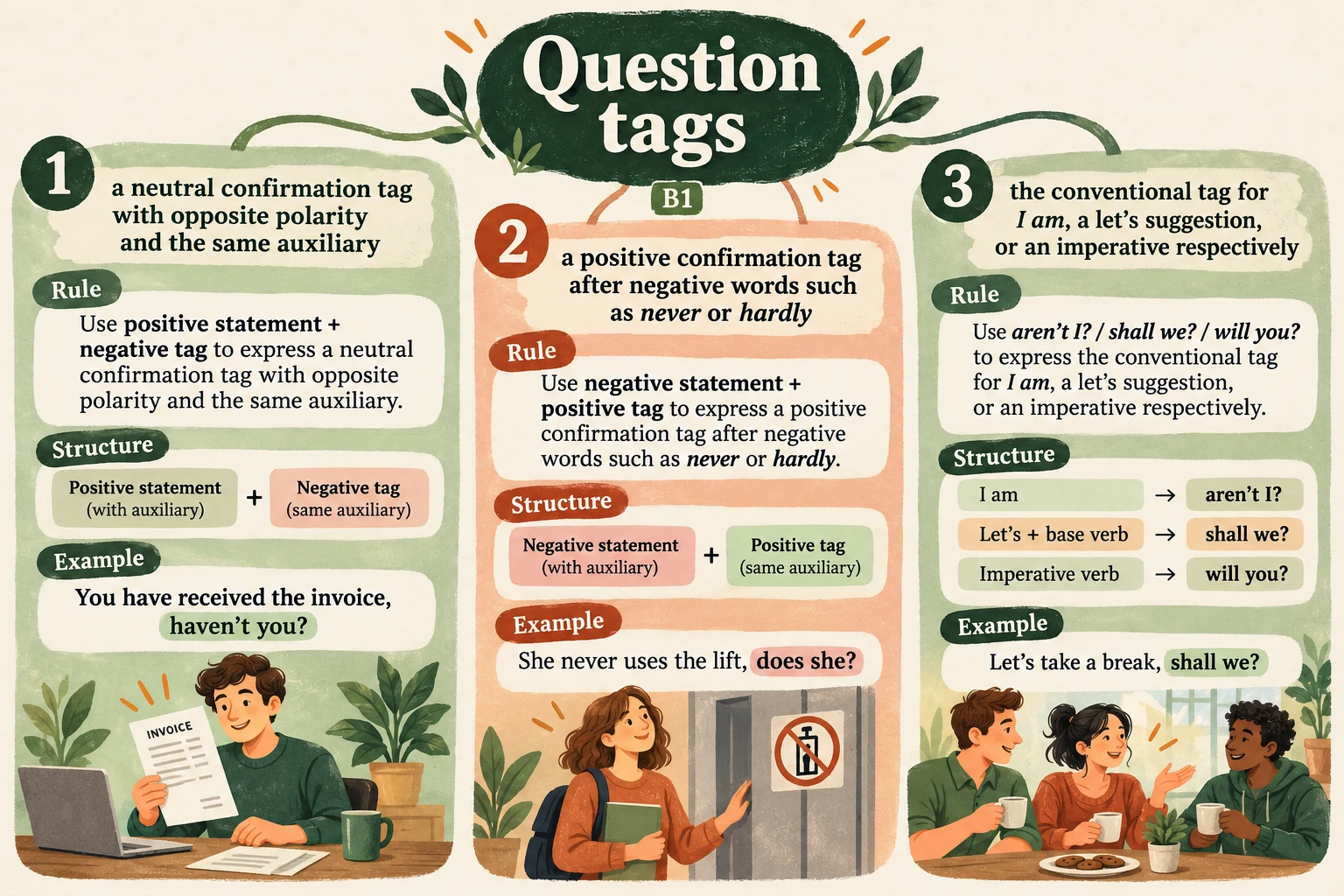
01eine neutrale Bestätigungsfrage mit umgekehrter Verneinung und gleichem Hilfsverb

Verwende positive statement + negative tag für eine neutrale Bestätigungsfrage mit umgekehrter Verneinung und gleichem Hilfsverb.

You have received the invoice, haven’t you?
02eine positive Bestätigungsfrage nach negativen Wörtern wie never oder hardly

Verwende negative statement + positive tag für eine positive Bestätigungsfrage nach negativen Wörtern wie never oder hardly.

She never uses the lift, does she?

03die üblichen Anhängsel zu I am, einem let’s-Vorschlag bzw. einem Imperativ

Verwende aren't I? / shall we? / will you? für die üblichen Anhängsel zu I am, einem let’s-Vorschlag bzw. einem Imperativ.

Let’s take a break, shall we?

Illustrierte Übersicht

0/12
Aufgaben
01 / 12D01Speichere es für deine Sammlung.

Use a neutral confirmation tag after the positive statement.

You have received the invoice, ___?

Deine Antwort
1 / 12

Dein Lernweg

01
Schritt 1 · Einstieg

Einstieg

0/3
02
Schritt 2 · Gezielt üben

eine neutrale Bestätigungsfrage mit umgekehrter Verneinung und gleichem Hilfsverb

0/2

Verwende positive statement + negative tag für eine neutrale Bestätigungsfrage mit umgekehrter Verneinung und gleichem Hilfsverb.

You have received the invoice, haven’t you?
03
Schritt 3 · Gezielt üben

eine positive Bestätigungsfrage nach negativen Wörtern wie never oder hardly

0/1

Verwende negative statement + positive tag für eine positive Bestätigungsfrage nach negativen Wörtern wie never oder hardly.

She never uses the lift, does she?
04
Schritt 4 · Gezielt üben

die üblichen Anhängsel zu I am, einem let’s-Vorschlag bzw. einem Imperativ

0/1

Verwende aren't I? / shall we? / will you? für die üblichen Anhängsel zu I am, einem let’s-Vorschlag bzw. einem Imperativ.

Let’s take a break, shall we?
05
Schritt 5 · Neue Situationen

Neue Situationen

0/3
06
Schritt 6 · Neue Herausforderung

Neue Herausforderung

0/2
Lernnotizen dieser Einheit

Aus Fehlern lernen.

Bewahre den ersten Versuch. Verstehe die Änderung. Prüfe sie in einer neuen Situation.

0

Noch keine Lernnotizen. Starte mit einem kurzen Einstieg.

Lernübersicht

Bestätigungsfragen

B1
Question tags

Lektionspunkte

01

eine neutrale Bestätigungsfrage mit umgekehrter Verneinung und gleichem Hilfsverb

Verwende positive statement + negative tag für eine neutrale Bestätigungsfrage mit umgekehrter Verneinung und gleichem Hilfsverb.

You have received the invoice, haven’t you?
02

eine positive Bestätigungsfrage nach negativen Wörtern wie never oder hardly

Verwende negative statement + positive tag für eine positive Bestätigungsfrage nach negativen Wörtern wie never oder hardly.

She never uses the lift, does she?
03

die üblichen Anhängsel zu I am, einem let’s-Vorschlag bzw. einem Imperativ

Verwende aren't I? / shall we? / will you? für die üblichen Anhängsel zu I am, einem let’s-Vorschlag bzw. einem Imperativ.

Let’s take a break, shall we?

Fragen & Antworten

Das Öffnen einer Antwort wird für diese Aufgabe als Hilfe erfasst.

D01 · Einstieg

Use a neutral confirmation tag after the positive statement.

You have received the invoice, ___?

  1. aren’t you
  2. didn’t you
  3. haven’t you
  4. have you
Antwort und Erklärung
haven’t you

Achte auf „You have received the invoice, ___?“. Verwende positive statement + negative tag für eine neutrale Bestätigungsfrage mit umgekehrter Verneinung und gleichem Hilfsverb. Vollständiger Satz: „You have received the invoice, haven’t you?“.

Weitere gültige Antworten
  • haven't you
D02 · Einstieg

Never makes the statement negative in meaning.

She never uses the lift, ___?

  1. did she
  2. does she
  3. doesn’t she
  4. is she
Antwort und Erklärung
does she

Achte auf „She never uses the lift, ___?“. Verwende negative statement + positive tag für eine positive Bestätigungsfrage nach negativen Wörtern wie never oder hardly. Vollständiger Satz: „She never uses the lift, does she?“.

D03 · Einstieg

Use the conventional tag for a suggestion with let’s.

Let’s take a break, ___?

  1. shall we
  2. will you
  3. aren’t we
  4. do we
Antwort und Erklärung
shall we

Achte auf „Let’s take a break, ___?“. Verwende aren't I? / shall we? / will you? für die üblichen Anhängsel zu I am, einem let’s-Vorschlag bzw. einem Imperativ. Vollständiger Satz: „Let’s take a break, shall we?“.

P01 · Gezielt üben

The main clause is a positive past simple statement. Use a neutral opposite-polarity confirmation tag, not a same-polarity echo.

They signed the contract, ___?

  1. didn’t they
  2. did they
  3. haven’t they
  4. aren’t they
Antwort und Erklärung
didn’t they

Achte auf „The main clause is a positive past simple statement. Use a neutral opposite-polarity confirmation tag, not a same-polarity echo.“. Verwende positive statement + negative tag für eine neutrale Bestätigungsfrage mit umgekehrter Verneinung und gleichem Hilfsverb. Vollständiger Satz: „They signed the contract, didn’t they?“.

Weitere gültige Antworten
  • didn't they
P02 · Gezielt üben

Write the positive tag after a negative past statement.

You did not see the notice, ___?

Antwort und Erklärung
did you

Vollständiger Satz: „You did not see the notice, did you?“ Verwende negative statement + positive tag für eine positive Bestätigungsfrage nach negativen Wörtern wie never oder hardly. Subjekt, Zeit und Bedeutung der Aufgabe bestimmen diese Form. Nur geprüfte Antworten werden automatisch abgeglichen; andere Formulierungen sind nicht automatisch falsch.

P03 · Gezielt üben

Use the conventional informal confirmation tag for I am.

I am next, ___?

  1. isn’t I
  2. don’t I
  3. am I
  4. aren’t I
Antwort und Erklärung
aren’t I

Achte auf „I am next, ___?“. Verwende aren't I? / shall we? / will you? für die üblichen Anhängsel zu I am, einem let’s-Vorschlag bzw. einem Imperativ. Vollständiger Satz: „I am next, aren’t I?“.

Weitere gültige Antworten
  • aren't I
P04 · Gezielt üben

Write the negative tag corresponding to will.

They will call tonight, ___?

Antwort und Erklärung
won’t they

Vollständiger Satz: „They will call tonight, won’t they?“ Verwende positive statement + negative tag für eine neutrale Bestätigungsfrage mit umgekehrter Verneinung und gleichem Hilfsverb. Subjekt, Zeit und Bedeutung der Aufgabe bestimmen diese Form. Nur geprüfte Antworten werden automatisch abgeglichen; andere Formulierungen sind nicht automatisch falsch.

Weitere gültige Antworten
  • won't they
  • will they not
R01 · Neue Situationen

The positive statement contains can. Use a neutral opposite-polarity confirmation tag, not a same-polarity echo.

Ravi can drive the van, ___?

  1. can’t he
  2. can he
  3. doesn’t he
  4. isn’t he
Antwort und Erklärung
can’t he

Achte auf „The positive statement contains can. Use a neutral opposite-polarity confirmation tag, not a same-polarity echo.“. Verwende positive statement + negative tag für eine neutrale Bestätigungsfrage mit umgekehrter Verneinung und gleichem Hilfsverb. Vollständiger Satz: „Ravi can drive the van, can’t he?“.

Weitere gültige Antworten
  • can't he
R02 · Neue Situationen

Write the positive tag; hardly gives the statement negative meaning.

We hardly know them, ___?

Antwort und Erklärung
do we

Vollständiger Satz: „We hardly know them, do we?“ Verwende negative statement + positive tag für eine positive Bestätigungsfrage nach negativen Wörtern wie never oder hardly. Subjekt, Zeit und Bedeutung der Aufgabe bestimmen diese Form. Nur geprüfte Antworten werden automatisch abgeglichen; andere Formulierungen sind nicht automatisch falsch.

R03 · Neue Situationen

Use a conventional request tag after an imperative.

Close the gate, ___?

  1. will you
  2. do you
  3. shall we
  4. aren’t you
Antwort und Erklärung
will you

Achte auf „Close the gate, ___?“. Verwende aren't I? / shall we? / will you? für die üblichen Anhängsel zu I am, einem let’s-Vorschlag bzw. einem Imperativ. Vollständiger Satz: „Close the gate, will you?“.

X01 · Neue Herausforderung

Nobody makes the statement negative; use they for the tag’s person. Use a neutral opposite-polarity confirmation tag, not a same-polarity echo.

Nobody has objected, ___?

  1. does it
  2. have they
  3. has it
  4. haven’t they
Antwort und Erklärung
have they

Achte auf „Nobody makes the statement negative; use they for the tag’s person. Use a neutral opposite-polarity confirmation tag, not a same-polarity echo.“. Verwende negative statement + positive tag für eine positive Bestätigungsfrage nach negativen Wörtern wie never oder hardly. Vollständiger Satz: „Nobody has objected, have they?“.

X02 · Neue Herausforderung

Write the conventional question tag for a suggestion beginning with let’s.

Let’s check the route first, ___?

Antwort und Erklärung
shall we

Vollständiger Satz: „Let’s check the route first, shall we?“ Verwende aren't I? / shall we? / will you? für die üblichen Anhängsel zu I am, einem let’s-Vorschlag bzw. einem Imperativ. Subjekt, Zeit und Bedeutung der Aufgabe bestimmen diese Form. Nur geprüfte Antworten werden automatisch abgeglichen; andere Formulierungen sind nicht automatisch falsch.