01Was/were with verb-ing
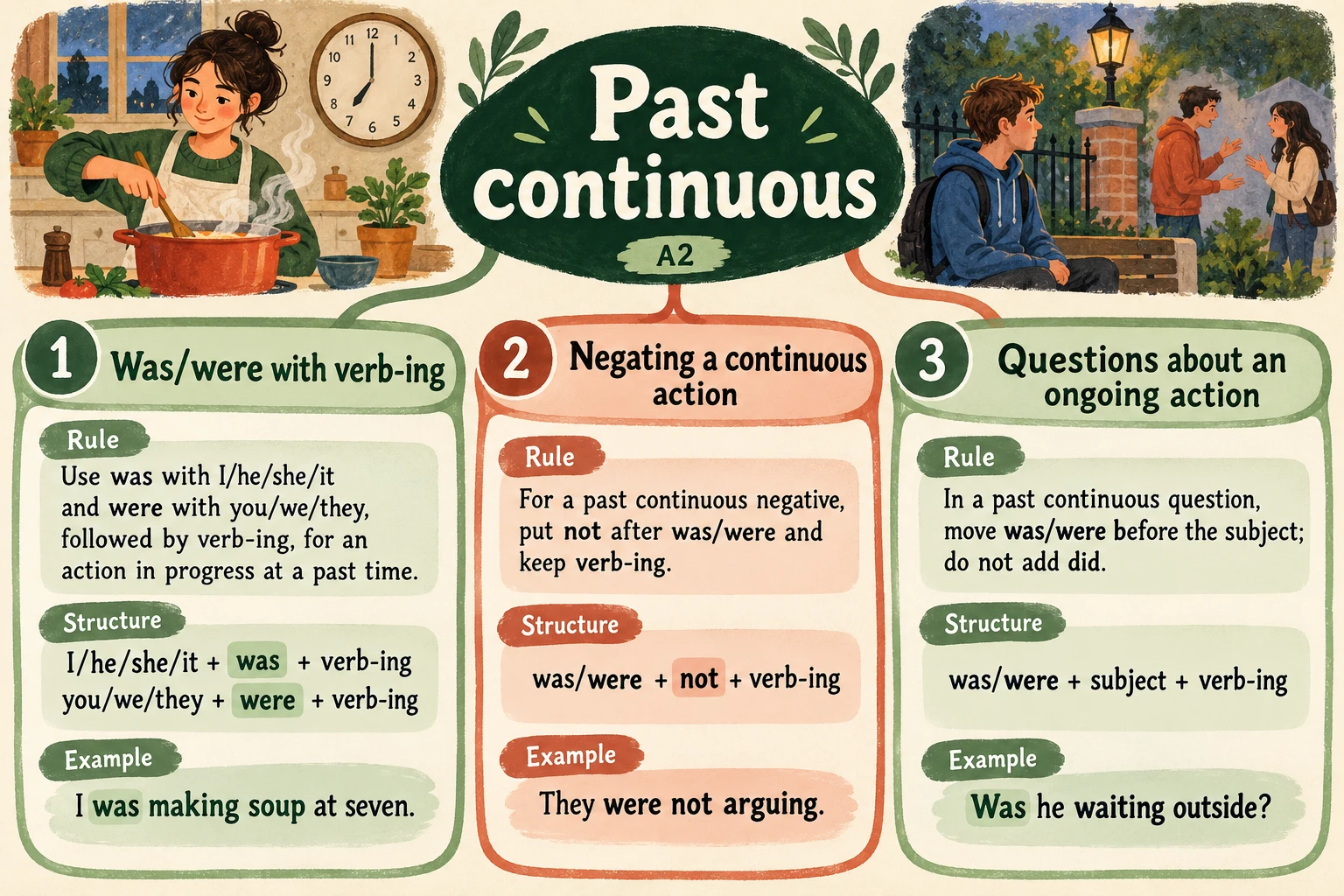
Use was with I/he/she/it and were with you/we/they, followed by verb-ing, for an action in progress at a past time.
I was making soup at seven.
Past continuous · A2. Use was with I/he/she/it and were with you/we/they, followed by verb-ing, for an action in progress at a past time.
Practise Past continuous in short situations. Read the clue, choose or write a form, then check the reason. The level is an editorial guide.
Use was with I/he/she/it and were with you/we/they, followed by verb-ing, for an action in progress at a past time.
I was making soup at seven.For a past continuous negative, put not after was/were and keep verb-ing.
They were not arguing.In a past continuous question, move was/were before the subject; do not add did.
Was he waiting outside?
At nine last night, I ___ a report. (write)
Use was with I/he/she/it and were with you/we/they, followed by verb-ing, for an action in progress at a past time.
I was making soup at seven.For a past continuous negative, put not after was/were and keep verb-ing.
They were not arguing.In a past continuous question, move was/were before the subject; do not add did.
Was he waiting outside?Keep the first try. Understand the change. Check it in a fresh situation.
No practice notes yet. Try a short warm-up.
Use was with I/he/she/it and were with you/we/they, followed by verb-ing, for an action in progress at a past time.
I was making soup at seven.For a past continuous negative, put not after was/were and keep verb-ing.
They were not arguing.In a past continuous question, move was/were before the subject; do not add did.
Was he waiting outside?Opening an answer records help for that question.
At nine last night, I ___ a report. (write)
Look at “At nine last night, I ___ a report. (write)”. Use was with I/he/she/it and were with you/we/they, followed by verb-ing, for an action in progress at a past time. Complete sentence: “At nine last night, I was writing a report. (write)”.
At midnight we were awake. We ___. (not sleep)
Look at “At midnight we were awake. We ___. (not sleep)”. For a past continuous negative, put not after was/were and keep verb-ing. Complete sentence: “At midnight we were awake. We were not sleeping. (not sleep)”.
___ you working at six yesterday?
Look at “___ you working at six yesterday?”. In a past continuous question, move was/were before the subject; do not add did. Complete sentence: “Were you working at six yesterday?”.
At this time yesterday, the children ___ in the pool. (swim)
Reference completion: “At this time yesterday, the children were swimming in the pool. (swim)”. Use was with I/he/she/it and were with you/we/they, followed by verb-ing, for an action in progress at a past time.
The engine was off. The driver ___ at that moment. (not drive)
Look at “The engine was off. The driver ___ at that moment. (not drive)”. For a past continuous negative, put not after was/were and keep verb-ing. Complete sentence: “The engine was off. The driver was not driving at that moment. (not drive)”.
___ Mina studying when you called?
Look at “___ Mina studying when you called?”. In a past continuous question, move was/were before the subject; do not add did. Complete sentence: “Was Mina studying when you called?”.
At ten yesterday morning, Dad ___ the gate. (paint)
Reference completion: “At ten yesterday morning, Dad was painting the gate. (paint)”. Use was with I/he/she/it and were with you/we/they, followed by verb-ing, for an action in progress at a past time.
The birds ___ loudly at sunrise yesterday. (sing)
Look at “The birds ___ loudly at sunrise yesterday. (sing)”. Use was with I/he/she/it and were with you/we/they, followed by verb-ing, for an action in progress at a past time. Complete sentence: “The birds were singing loudly at sunrise yesterday. (sing)”.
At eight I was on the train. I ___ at home. (not sit)
Look at “At eight I was on the train. I ___ at home. (not sit)”. For a past continuous negative, put not after was/were and keep verb-ing. Complete sentence: “At eight I was on the train. I was not sitting at home. (not sit)”.
What ___ the guests eating when you arrived?
Reference completion: “What were the guests eating when you arrived?”. In a past continuous question, move was/were before the subject; do not add did.
The lights were off. They ___ in the office at nine. (not work)
Look at “The lights were off. They ___ in the office at nine. (not work)”. For a past continuous negative, put not after was/were and keep verb-ing. Complete sentence: “The lights were off. They were not working in the office at nine. (not work)”.
Where ___ your sister staying last week?
Reference completion: “Where was your sister staying last week?”. In a past continuous question, move was/were before the subject; do not add did.