01Predictions, promises and decisions
Use will + base verb for a prediction, a promise or a decision made now. Will has the same form for every subject.
I will call you tonight.
Future with will · A2. Use will + base verb for a prediction, a promise or a decision made now. Will has the same form for every subject.
Practise Future with will in short situations. Read the clue, choose or write a form, then check the reason. The level is an editorial guide.
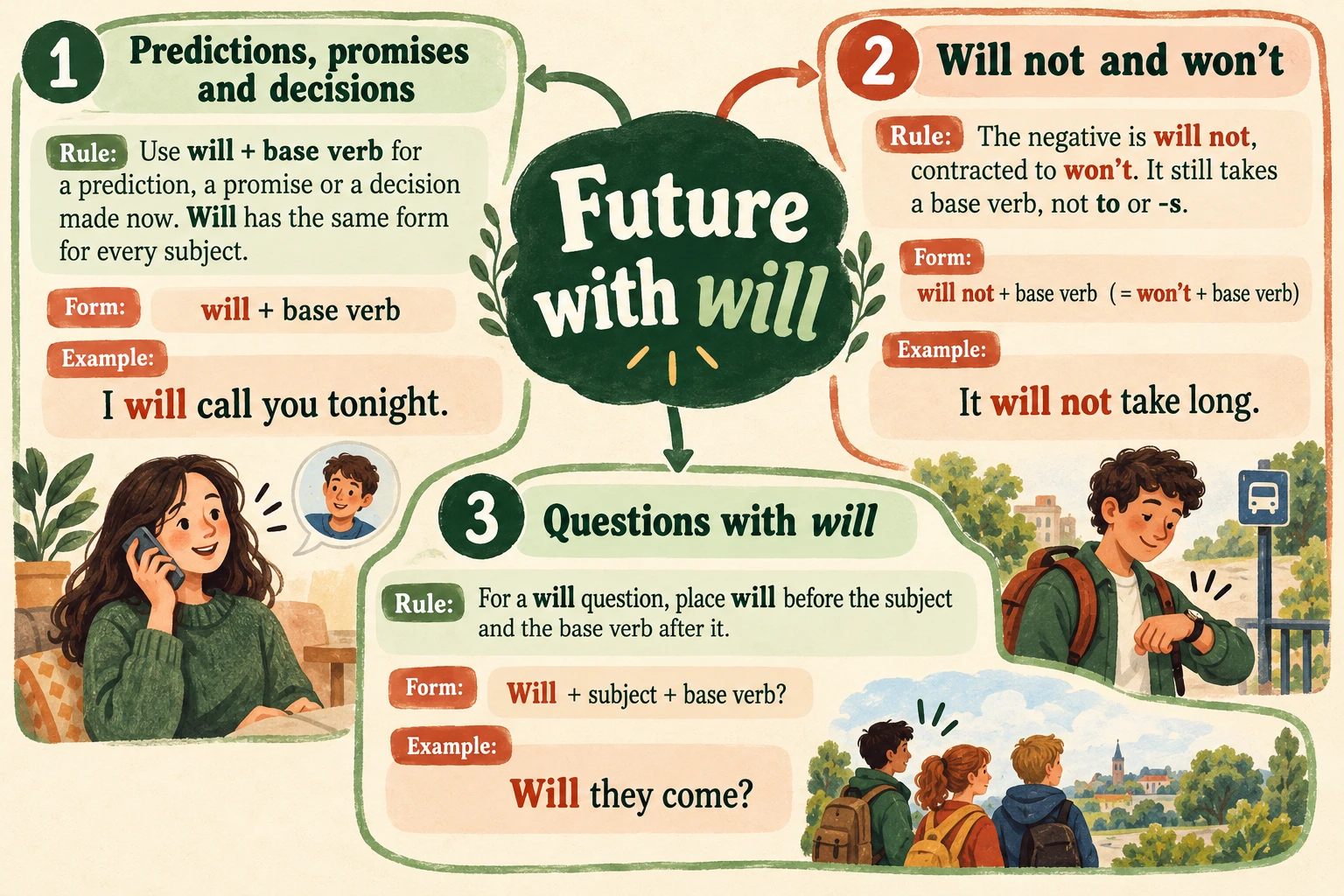
Use will + base verb for a prediction, a promise or a decision made now. Will has the same form for every subject.
I will call you tonight.The negative is will not, contracted to won’t. It still takes a base verb, not to or -s.
It will not take long.For a will question, place will before the subject and the base verb after it.
Will they come?
The phone is ringing. I ___ it now. (answer; use will)
Use will + base verb for a prediction, a promise or a decision made now. Will has the same form for every subject.
I will call you tonight.The negative is will not, contracted to won’t. It still takes a base verb, not to or -s.
It will not take long.For a will question, place will before the subject and the base verb after it.
Will they come?Keep the first try. Understand the change. Check it in a fresh situation.
No practice notes yet. Try a short warm-up.
Use will + base verb for a prediction, a promise or a decision made now. Will has the same form for every subject.
I will call you tonight.The negative is will not, contracted to won’t. It still takes a base verb, not to or -s.
It will not take long.For a will question, place will before the subject and the base verb after it.
Will they come?Opening an answer records help for that question.
The phone is ringing. I ___ it now. (answer; use will)
Look at “The phone is ringing. I ___ it now. (answer; use will)”. Use will + base verb for a prediction, a promise or a decision made now. Will has the same form for every subject. Complete sentence: “The phone is ringing. I will answer it now. (answer; use will)”.
I promise I ___ forget your birthday. (negative will)
Look at “I promise I ___ forget your birthday. (negative will)”. The negative is will not, contracted to won’t. It still takes a base verb, not to or -s. Complete sentence: “I promise I will not forget your birthday. (negative will)”.
___ you help me with this box? (use will)
Look at “___ you help me with this box? (use will)”. For a will question, place will before the subject and the base verb after it. Complete sentence: “Will you help me with this box? (use will)”.
I think the new café ___ popular. (be; use will)
Reference completion: “I think the new café will be popular. (be; use will)”. Use will + base verb for a prediction, a promise or a decision made now. Will has the same form for every subject.
The shop is closed tomorrow, so it ___ open. (negative will)
Look at “The shop is closed tomorrow, so it ___ open. (negative will)”. The negative is will not, contracted to won’t. It still takes a base verb, not to or -s. Complete sentence: “The shop is closed tomorrow, so it will not open. (negative will)”.
Will the parcel ___ tomorrow? (arrive)
Look at “Will the parcel ___ tomorrow? (arrive)”. For a will question, place will before the subject and the base verb after it. Complete sentence: “Will the parcel arrive tomorrow? (arrive)”.
I promise I ___ the door. (lock; use will)
Reference completion: “I promise I will lock the door. (lock; use will)”. Use will + base verb for a prediction, a promise or a decision made now. Will has the same form for every subject. Also accepted in this task: 'll lock. These are reviewed alternatives, not an exhaustive list of all possible English.
That bag looks heavy. I ___ it for you. (carry; use will)
Look at “That bag looks heavy. I ___ it for you. (carry; use will)”. Use will + base verb for a prediction, a promise or a decision made now. Will has the same form for every subject. Complete sentence: “That bag looks heavy. I will carry it for you. (carry; use will)”.
We have decided to refuse. We ___ accept the offer. (negative will)
Look at “We have decided to refuse. We ___ accept the offer. (negative will)”. The negative is will not, contracted to won’t. It still takes a base verb, not to or -s. Complete sentence: “We have decided to refuse. We will not accept the offer. (negative will)”.
Where ___ they wait for us? (use will)
Reference completion: “Where will they wait for us? (use will)”. For a will question, place will before the subject and the base verb after it.
He promises he ___ tell anyone the secret. (negative will)
Look at “He promises he ___ tell anyone the secret. (negative will)”. The negative is will not, contracted to won’t. It still takes a base verb, not to or -s. Complete sentence: “He promises he will not tell anyone the secret. (negative will)”.
Will your sister ___ us at the station? (meet)
Reference completion: “Will your sister meet us at the station? (meet)”. For a will question, place will before the subject and the base verb after it.