
A1-A2

Past Simple Exercises

About this lesson

Past simple · A2. Use the past simple for events located in a finished past time. Regular verbs usually add -ed, with spelling changes such as carry → carried and stop → stopped. Irregular forms must be learned, for example go → went and find → found. These main-verb past forms do not change with the subject.

Practise finished past events, regular and irregular verbs, did questions, and was/were.

12 items
Save it to find it in My collection.
Knowledge map

Past simple

Start practising
Past simple — Knowledge map

01Affirmative past forms

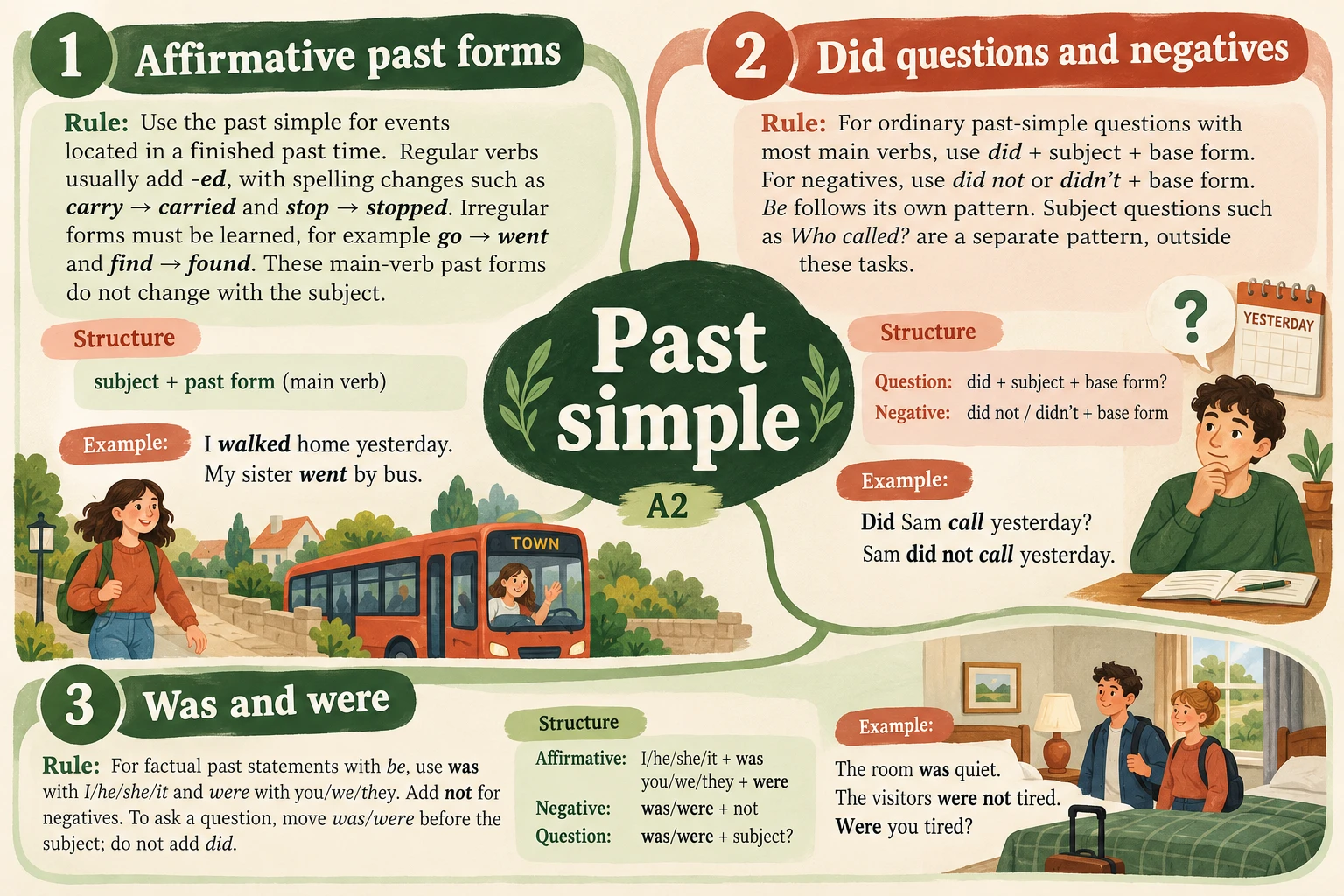
Use the past simple for events located in a finished past time. Regular verbs usually add -ed, with spelling changes such as carry → carried and stop → stopped. Irregular forms must be learned, for example go → went and find → found. These main-verb past forms do not change with the subject.

walk → walked · go → went

02Did questions and negatives

For ordinary past-simple questions with most main verbs, use did + subject + base form. For negatives, use did not or didn’t + base form. Be follows its own pattern. Subject questions such as Who called? are a separate pattern, outside these tasks.

did / didn’t + base verb

03Was and were

For factual past statements with be, use was with I/he/she/it and were with you/we/they. Add not for negatives. To ask a question, move was/were before the subject; do not add did.

I/he/she/it was · you/we/they were

Affirmative

I worked yesterday.She went home.

Negative

I didn’t work yesterday.She didn’t go home.

Question

Did you work yesterday?Did she go home?

Short answer

Yes, I did.No, she didn’t.

Illustrated guide

0/12
Questions
01 / 12D01Save it to find it in My collection.

Mia finished cleaning her room yesterday.

Choose the correct past-simple sentence.

Your answer
1 / 12

Your learning route

01
Step 1 · Warm-up

Warm-up

0/3
02
Step 2 · Build the skill

Affirmative past forms

0/1

Use the past simple for events located in a finished past time. Regular verbs usually add -ed, with spelling changes such as carry → carried and stop → stopped. Irregular forms must be learned, for example go → went and find → found. These main-verb past forms do not change with the subject.

I walked home yesterday. My sister went by bus.
03
Step 3 · Build the skill

Was and were

0/2

For factual past statements with be, use was with I/he/she/it and were with you/we/they. Add not for negatives. To ask a question, move was/were before the subject; do not add did.

The room was quiet. The visitors were not tired. Were you tired?
04
Step 4 · Build the skill

Did questions and negatives

0/1

For ordinary past-simple questions with most main verbs, use did + subject + base form. For negatives, use did not or didn’t + base form. Be follows its own pattern. Subject questions such as Who called? are a separate pattern, outside these tasks.

Did Sam call yesterday? Sam did not call yesterday.
05
Step 5 · New contexts

New contexts

0/3
06
Step 6 · A fresh challenge

A fresh challenge

0/2
Practice notes in this unit

Make mistakes useful.

Keep the first try. Understand the change. Check it in a fresh situation.

0

No practice notes yet. Try a short warm-up.

Lesson map

Past simple

A2
Past simple

Lesson points

01

Affirmative past forms

Use the past simple for events located in a finished past time. Regular verbs usually add -ed, with spelling changes such as carry → carried and stop → stopped. Irregular forms must be learned, for example go → went and find → found. These main-verb past forms do not change with the subject.

I walked home yesterday. My sister went by bus.
02

Did questions and negatives

For ordinary past-simple questions with most main verbs, use did + subject + base form. For negatives, use did not or didn’t + base form. Be follows its own pattern. Subject questions such as Who called? are a separate pattern, outside these tasks.

Did Sam call yesterday? Sam did not call yesterday.
03

Was and were

For factual past statements with be, use was with I/he/she/it and were with you/we/they. Add not for negatives. To ask a question, move was/were before the subject; do not add did.

The room was quiet. The visitors were not tired. Were you tired?

Questions & answers

Opening an answer records help for that question.

D01 · Warm-up

Mia finished cleaning her room yesterday.

Choose the correct past-simple sentence.

  1. Mia cleaned her room yesterday.
  2. Mia cleaning her room yesterday.
  3. Mia cleans her room yesterday.
Answer & explanation
Mia cleaned her room yesterday.

Look at “Mia finished cleaning her room yesterday.”. Use the past simple for events located in a finished past time. Regular verbs usually add -ed, with spelling changes such as carry → carried and stop → stopped. Irregular forms must be learned, for example go → went and find → found. These main-verb past forms do not change with the subject. Complete sentence: “Mia cleaned her room yesterday.”.

D02 · Warm-up

You want to know whether Omar bought a notebook yesterday.

Choose the correct question.

  1. Did Omar bought a notebook yesterday?
  2. Does Omar buy a notebook yesterday?
  3. Did Omar buy a notebook yesterday?
Answer & explanation
Did Omar buy a notebook yesterday?

Look at “You want to know whether Omar bought a notebook yesterday.”. For ordinary past-simple questions with most main verbs, use did + subject + base form. For negatives, use did not or didn’t + base form. Be follows its own pattern. Subject questions such as Who called? are a separate pattern, outside these tasks. Complete sentence: “Did Omar buy a notebook yesterday?”.

D03 · Warm-up

You want to know if someone left the windows open last night.

Choose the correct question.

  1. Were the windows open last night?
  2. Was the windows open last night?
  3. Did the windows be open last night?
Answer & explanation
Were the windows open last night?

Look at “You want to know if someone left the windows open last night.”. For factual past statements with be, use was with I/he/she/it and were with you/we/they. Add not for negatives. To ask a question, move was/were before the subject; do not add did. Complete sentence: “Were the windows open last night?”.

P01 · Build the skill

The boxes are upstairs now. The work finished yesterday.

Complete the sentence with the past-simple form of carry. Write only the missing verb: We ___ the boxes upstairs yesterday.

Answer & explanation
carried

The action ended yesterday. Carry ends in a consonant + y: change y to i and add -ed to make carried.

P02 · Build the skill

Nina stayed at home last Friday because of a fever.

Choose the correct sentence about last Friday.

  1. Nina was ill last Friday.
  2. Nina did be ill last Friday.
  3. Nina were ill last Friday.
Answer & explanation
Nina was ill last Friday.

Look at “Nina stayed at home last Friday because of a fever.”. For factual past statements with be, use was with I/he/she/it and were with you/we/they. Add not for negatives. To ask a question, move was/were before the subject; do not add did. Complete sentence: “Nina was ill last Friday.”.

P03 · Build the skill

They planned to play chess last night, but the game did not happen.

Choose the correct negative sentence.

  1. They did not play chess last night.
  2. They do not play chess last night.
  3. They did not played chess last night.
Answer & explanation
They did not play chess last night.

Look at “They planned to play chess last night, but the game did not happen.”. For ordinary past-simple questions with most main verbs, use did + subject + base form. For negatives, use did not or didn’t + base form. Be follows its own pattern. Subject questions such as Who called? are a separate pattern, outside these tasks. Complete sentence: “They did not play chess last night.”.

P04 · Build the skill

The cafe was closed yesterday. Correct this claim by making it negative: The cafe was open yesterday.

Write the full negative sentence. Keep all other words in the same order.

Answer & explanation
The cafe was not open yesterday.

With past be, place not after was. Both was not and wasn’t are correct; keep the rest of the sentence unchanged.

Other accepted versions
  • The cafe wasn't open yesterday.
R01 · New contexts

This sentence has one spelling error: Ava stoped near the bridge yesterday.

Correct only the misspelled past verb and write the full sentence.

Answer & explanation
Ava stopped near the bridge yesterday.

For the short verb stop, double the final p before adding -ed: stopped. The sentence describes a completed stop yesterday.

R02 · New contexts

Yesterday you left your bag somewhere. Your friend asks about the place.

Choose the correctly formed question.

  1. Where did you left your bag yesterday?
  2. Where you leave your bag yesterday?
  3. Where did you leave your bag yesterday?
Answer & explanation
Where did you leave your bag yesterday?

Look at “Yesterday you left your bag somewhere. Your friend asks about the place.”. For ordinary past-simple questions with most main verbs, use did + subject + base form. For negatives, use did not or didn’t + base form. Be follows its own pattern. Subject questions such as Who called? are a separate pattern, outside these tasks. Complete sentence: “Where did you leave your bag yesterday?”.

R03 · New contexts

We arrived before the lesson started yesterday. Describe our arrival using a negative with late.

Choose the correct negative sentence.

  1. We was not late yesterday.
  2. We were not late yesterday.
  3. We did not be late yesterday.
Answer & explanation
We were not late yesterday.

Look at “We arrived before the lesson started yesterday. Describe our arrival using a negative with late.”. For factual past statements with be, use was with I/he/she/it and were with you/we/they. Add not for negatives. To ask a question, move was/were before the subject; do not add did. Complete sentence: “We were not late yesterday.”.

X01 · A fresh challenge

My wallet was missing. The search ended yesterday evening: it was under a chair.

Choose the correct past-simple sentence.

  1. I found my wallet under a chair yesterday evening.
  2. I find my wallet under a chair yesterday evening.
  3. I finded my wallet under a chair yesterday evening.
Answer & explanation
I found my wallet under a chair yesterday evening.

Look at “My wallet was missing. The search ended yesterday evening: it was under a chair.”. Use the past simple for events located in a finished past time. Regular verbs usually add -ed, with spelling changes such as carry → carried and stop → stopped. Irregular forms must be learned, for example go → went and find → found. These main-verb past forms do not change with the subject. Complete sentence: “I found my wallet under a chair yesterday evening.”.

X02 · A fresh challenge

You do not know whether your friend sent the email yesterday.

Write one full yes/no question beginning with Did. Use these words in order after Did: you / send / the email / yesterday.

Answer & explanation
Did you send the email yesterday?

A yes/no question about yesterday uses Did + you + send. Send remains in the base form after did.