01Organised future arrangements
Use the present continuous for a future arrangement already organised with a time or another person: be + verb-ing.
I am meeting Alex at five tomorrow.
Future arrangements · A2. Use the present continuous for a future arrangement already organised with a time or another person: be + verb-ing.
Practise Future arrangements in short situations. Read the clue, choose or write a form, then check the reason. The level is an editorial guide.
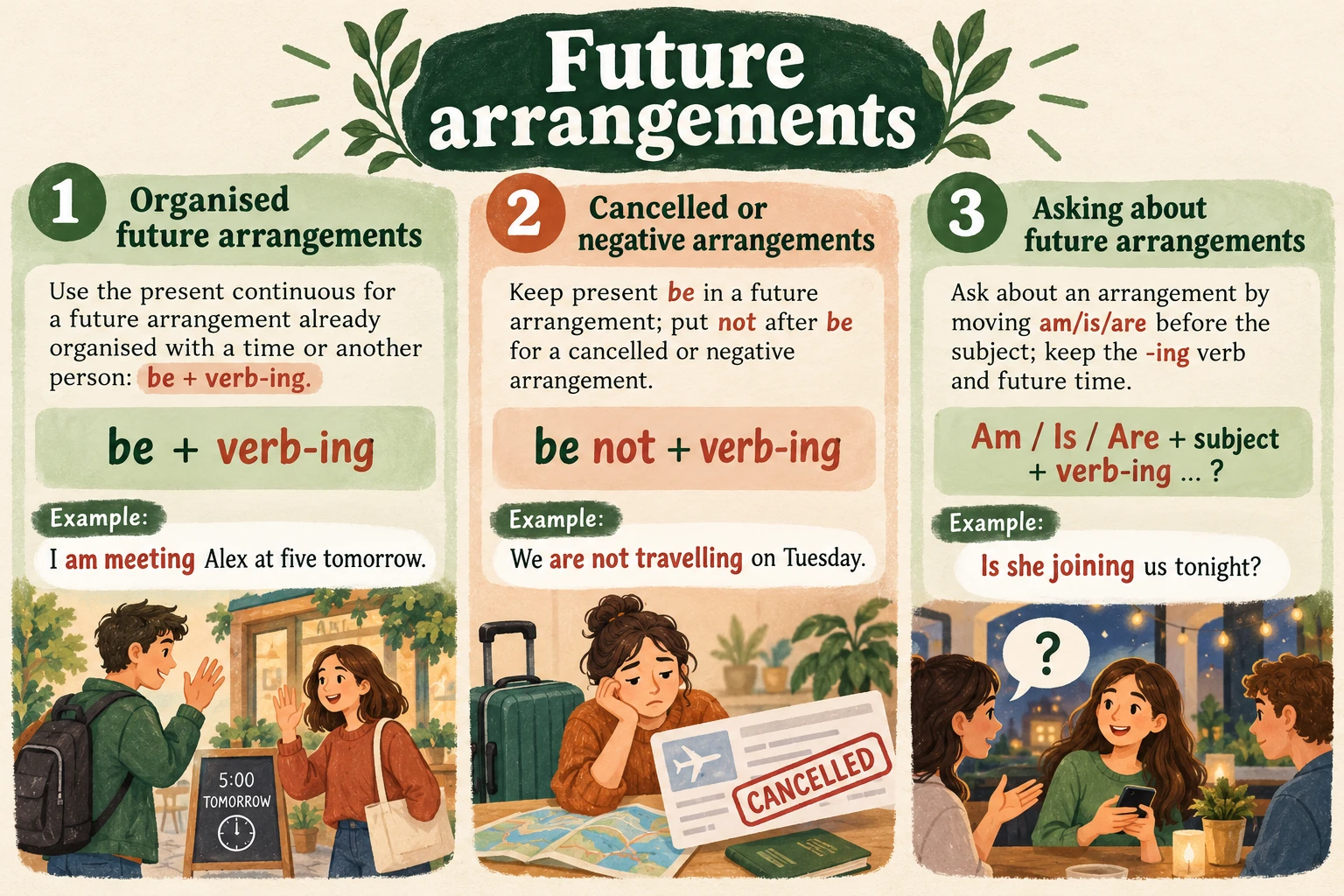
Use the present continuous for a future arrangement already organised with a time or another person: be + verb-ing.
I am meeting Alex at five tomorrow.Keep present be in a future arrangement; put not after be for a cancelled or negative arrangement.
We are not travelling on Tuesday.Ask about an arrangement by moving am/is/are before the subject; keep the -ing verb and future time.
Is she joining us tonight?
We have tickets for tomorrow. We ___ to Rome in the morning. (fly; present continuous)
Use the present continuous for a future arrangement already organised with a time or another person: be + verb-ing.
I am meeting Alex at five tomorrow.Keep present be in a future arrangement; put not after be for a cancelled or negative arrangement.
We are not travelling on Tuesday.Ask about an arrangement by moving am/is/are before the subject; keep the -ing verb and future time.
Is she joining us tonight?Keep the first try. Understand the change. Check it in a fresh situation.
No practice notes yet. Try a short warm-up.
Use the present continuous for a future arrangement already organised with a time or another person: be + verb-ing.
I am meeting Alex at five tomorrow.Keep present be in a future arrangement; put not after be for a cancelled or negative arrangement.
We are not travelling on Tuesday.Ask about an arrangement by moving am/is/are before the subject; keep the -ing verb and future time.
Is she joining us tonight?Opening an answer records help for that question.
We have tickets for tomorrow. We ___ to Rome in the morning. (fly; present continuous)
Look at “We have tickets for tomorrow. We ___ to Rome in the morning. (fly; present continuous)”. Use the present continuous for a future arrangement already organised with a time or another person: be + verb-ing. Complete sentence: “We have tickets for tomorrow. We are flying to Rome in the morning. (fly; present continuous)”.
The meeting is cancelled. She ___ us on Friday. (not meet; present continuous)
Look at “The meeting is cancelled. She ___ us on Friday. (not meet; present continuous)”. Keep present be in a future arrangement; put not after be for a cancelled or negative arrangement. Complete sentence: “The meeting is cancelled. She is not meeting us on Friday. (not meet; present continuous)”.
___ you having dinner with Jo tomorrow?
Look at “___ you having dinner with Jo tomorrow?”. Ask about an arrangement by moving am/is/are before the subject; keep the -ing verb and future time. Complete sentence: “Are you having dinner with Jo tomorrow?”.
My appointment is booked. I ___ the dentist at two tomorrow. (see; present continuous)
Reference completion: “My appointment is booked. I am seeing the dentist at two tomorrow. (see; present continuous)”. Use the present continuous for a future arrangement already organised with a time or another person: be + verb-ing. Also accepted in this task: 'm seeing. These are reviewed alternatives, not an exhaustive list of all possible English.
Our booking has changed. We ___ on Monday. (not leave; present continuous)
Look at “Our booking has changed. We ___ on Monday. (not leave; present continuous)”. Keep present be in a future arrangement; put not after be for a cancelled or negative arrangement. Complete sentence: “Our booking has changed. We are not leaving on Monday. (not leave; present continuous)”.
What time ___ Leo catching the train tomorrow?
Look at “What time ___ Leo catching the train tomorrow?”. Ask about an arrangement by moving am/is/are before the subject; keep the -ing verb and future time. Complete sentence: “What time is Leo catching the train tomorrow?”.
The venue is reserved. Nina ___ a party on Saturday. (have; present continuous)
Reference completion: “The venue is reserved. Nina is having a party on Saturday. (have; present continuous)”. Use the present continuous for a future arrangement already organised with a time or another person: be + verb-ing. Also accepted in this task: 's having. These are reviewed alternatives, not an exhaustive list of all possible English.
The restaurant has our booking. We ___ there at eight tonight. (eat; present continuous)
Look at “The restaurant has our booking. We ___ there at eight tonight. (eat; present continuous)”. Use the present continuous for a future arrangement already organised with a time or another person: be + verb-ing. Complete sentence: “The restaurant has our booking. We are eating there at eight tonight. (eat; present continuous)”.
His flight was changed. He ___ tonight. (not arrive; present continuous)
Look at “His flight was changed. He ___ tonight. (not arrive; present continuous)”. Keep present be in a future arrangement; put not after be for a cancelled or negative arrangement. Complete sentence: “His flight was changed. He is not arriving tonight. (not arrive; present continuous)”.
Who ___ you meeting after class tomorrow?
Reference completion: “Who are you meeting after class tomorrow?”. Ask about an arrangement by moving am/is/are before the subject; keep the -ing verb and future time.
I cancelled my ticket. I ___ the concert on Sunday. (not attend; present continuous)
Look at “I cancelled my ticket. I ___ the concert on Sunday. (not attend; present continuous)”. Keep present be in a future arrangement; put not after be for a cancelled or negative arrangement. Complete sentence: “I cancelled my ticket. I am not attending the concert on Sunday. (not attend; present continuous)”.
Where ___ your parents staying next weekend?
Reference completion: “Where are your parents staying next weekend?”. Ask about an arrangement by moving am/is/are before the subject; keep the -ing verb and future time.