01Was/were com verbo-ing
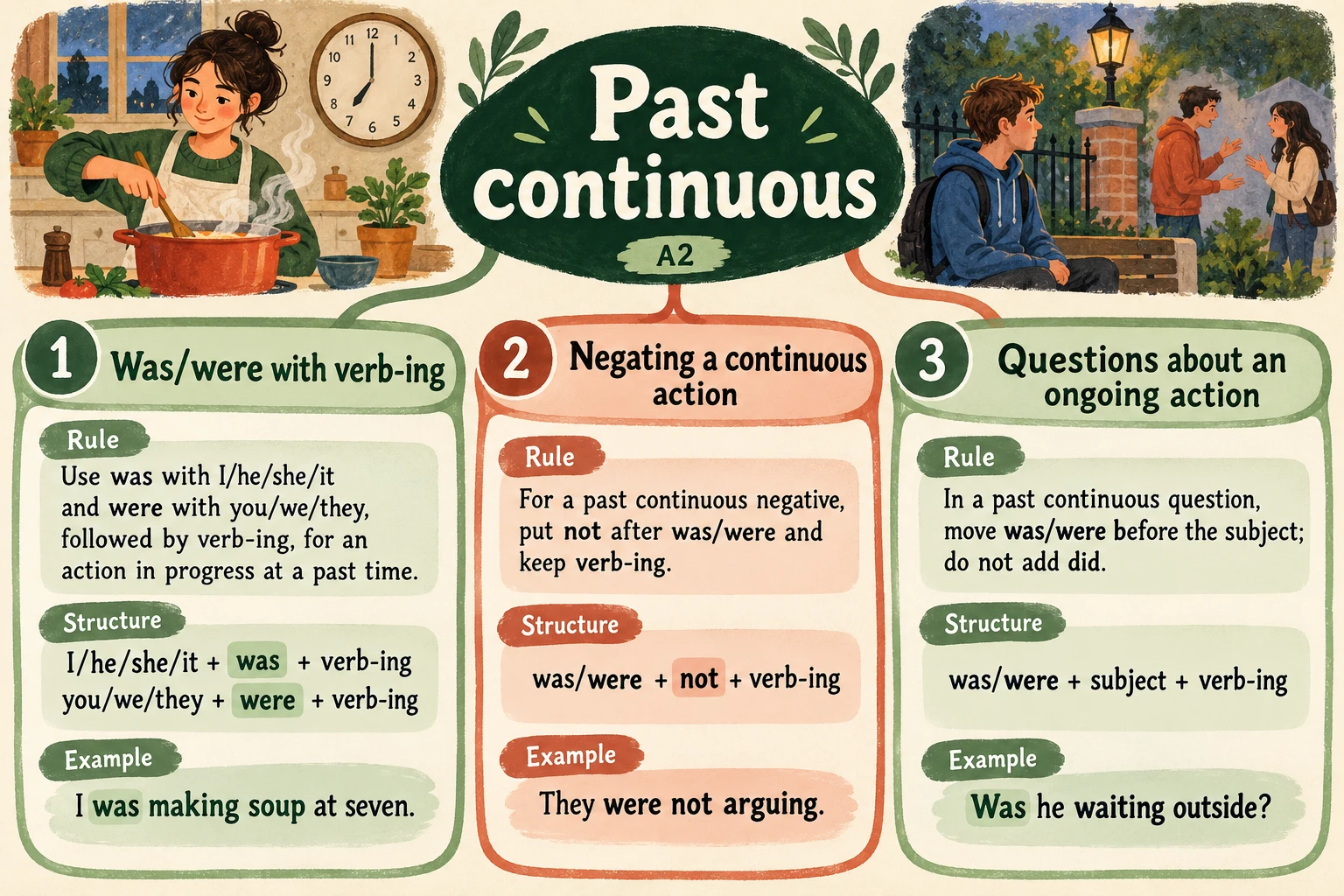
Para ações em curso no passado, use was com I/he/she/it e were com you/we/they, seguido de verbo-ing.
I was making soup at seven.
Passado contínuo · A2. Para ações em curso no passado, use was com I/he/she/it e were com you/we/they, seguido de verbo-ing.
Pratique Passado contínuo em situações curtas. Leia a pista, escolha ou escreva uma forma e confira a explicação. O nível é uma orientação editorial.
Para ações em curso no passado, use was com I/he/she/it e were com you/we/they, seguido de verbo-ing.
I was making soup at seven.Na negativa do passado contínuo, ponha not após was/were e mantenha verbo-ing.
They were not arguing.Nas perguntas do passado contínuo, mova was/were para antes do sujeito, sem did.
Was he waiting outside?
At nine last night, I ___ a report. (write)
Para ações em curso no passado, use was com I/he/she/it e were com you/we/they, seguido de verbo-ing.
I was making soup at seven.Na negativa do passado contínuo, ponha not após was/were e mantenha verbo-ing.
They were not arguing.Nas perguntas do passado contínuo, mova was/were para antes do sujeito, sem did.
Was he waiting outside?Guarde a primeira tentativa, entenda a mudança e confira em outra situação.
Ainda não há revisões. Faça um aquecimento curto.
Para ações em curso no passado, use was com I/he/she/it e were com you/we/they, seguido de verbo-ing.
I was making soup at seven.Na negativa do passado contínuo, ponha not após was/were e mantenha verbo-ing.
They were not arguing.Nas perguntas do passado contínuo, mova was/were para antes do sujeito, sem did.
Was he waiting outside?Abrir uma resposta registra ajuda para essa questão.
At nine last night, I ___ a report. (write)
Observe “At nine last night, I ___ a report. (write)”. Para ações em curso no passado, use was com I/he/she/it e were com you/we/they, seguido de verbo-ing. Frase completa: “At nine last night, I was writing a report. (write)”.
At midnight we were awake. We ___. (not sleep)
Observe “At midnight we were awake. We ___. (not sleep)”. Na negativa do passado contínuo, ponha not após was/were e mantenha verbo-ing. Frase completa: “At midnight we were awake. We were not sleeping. (not sleep)”.
___ you working at six yesterday?
Observe “___ you working at six yesterday?”. Nas perguntas do passado contínuo, mova was/were para antes do sujeito, sem did. Frase completa: “Were you working at six yesterday?”.
At this time yesterday, the children ___ in the pool. (swim)
Frase de referência: “At this time yesterday, the children were swimming in the pool. (swim)”. Para ações em curso no passado, use was com I/he/she/it e were com you/we/they, seguido de verbo-ing.
The engine was off. The driver ___ at that moment. (not drive)
Observe “The engine was off. The driver ___ at that moment. (not drive)”. Na negativa do passado contínuo, ponha not após was/were e mantenha verbo-ing. Frase completa: “The engine was off. The driver was not driving at that moment. (not drive)”.
___ Mina studying when you called?
Observe “___ Mina studying when you called?”. Nas perguntas do passado contínuo, mova was/were para antes do sujeito, sem did. Frase completa: “Was Mina studying when you called?”.
At ten yesterday morning, Dad ___ the gate. (paint)
Frase de referência: “At ten yesterday morning, Dad was painting the gate. (paint)”. Para ações em curso no passado, use was com I/he/she/it e were com you/we/they, seguido de verbo-ing.
The birds ___ loudly at sunrise yesterday. (sing)
Observe “The birds ___ loudly at sunrise yesterday. (sing)”. Para ações em curso no passado, use was com I/he/she/it e were com you/we/they, seguido de verbo-ing. Frase completa: “The birds were singing loudly at sunrise yesterday. (sing)”.
At eight I was on the train. I ___ at home. (not sit)
Observe “At eight I was on the train. I ___ at home. (not sit)”. Na negativa do passado contínuo, ponha not após was/were e mantenha verbo-ing. Frase completa: “At eight I was on the train. I was not sitting at home. (not sit)”.
What ___ the guests eating when you arrived?
Frase de referência: “What were the guests eating when you arrived?”. Nas perguntas do passado contínuo, mova was/were para antes do sujeito, sem did.
The lights were off. They ___ in the office at nine. (not work)
Observe “The lights were off. They ___ in the office at nine. (not work)”. Na negativa do passado contínuo, ponha not após was/were e mantenha verbo-ing. Frase completa: “The lights were off. They were not working in the office at nine. (not work)”.
Where ___ your sister staying last week?
Frase de referência: “Where was your sister staying last week?”. Nas perguntas do passado contínuo, mova was/were para antes do sujeito, sem did.