01Prior plans with going to
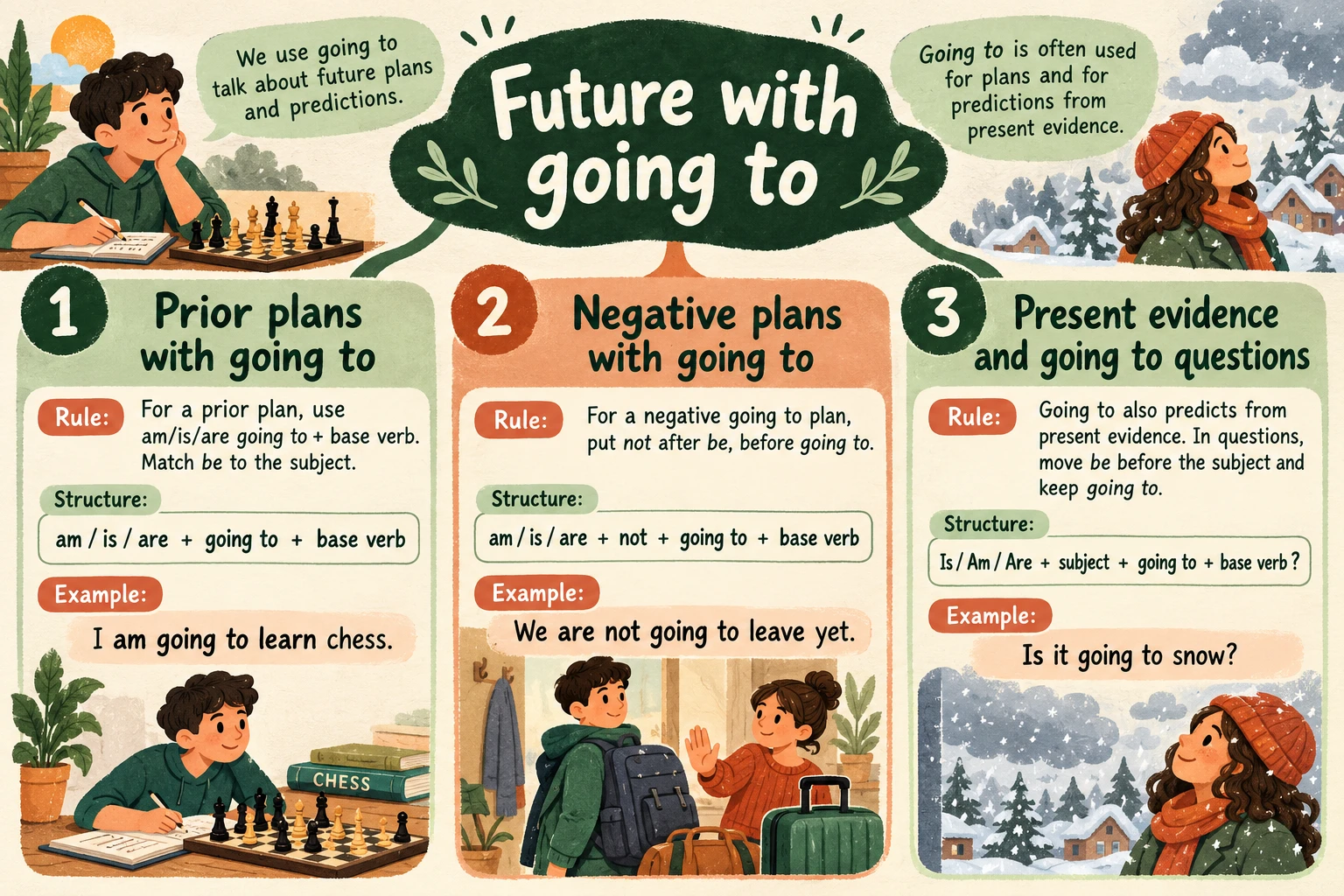
For a prior plan, use am/is/are going to + base verb. Match be to the subject.
I am going to learn chess.
Future with going to · A2. For a prior plan, use am/is/are going to + base verb. Match be to the subject.
Practise Future with going to in short situations. Read the clue, choose or write a form, then check the reason. The level is an editorial guide.
For a prior plan, use am/is/are going to + base verb. Match be to the subject.
I am going to learn chess.For a negative going to plan, put not after be, before going to.
We are not going to leave yet.Going to also predicts from present evidence. In questions, move be before the subject and keep going to.
Is it going to snow?
We have decided to move. We ___ going to rent a bigger flat.
For a prior plan, use am/is/are going to + base verb. Match be to the subject.
I am going to learn chess.For a negative going to plan, put not after be, before going to.
We are not going to leave yet.Going to also predicts from present evidence. In questions, move be before the subject and keep going to.
Is it going to snow?Keep the first try. Understand the change. Check it in a fresh situation.
No practice notes yet. Try a short warm-up.
For a prior plan, use am/is/are going to + base verb. Match be to the subject.
I am going to learn chess.For a negative going to plan, put not after be, before going to.
We are not going to leave yet.Going to also predicts from present evidence. In questions, move be before the subject and keep going to.
Is it going to snow?Opening an answer records help for that question.
We have decided to move. We ___ going to rent a bigger flat.
Look at “We have decided to move. We ___ going to rent a bigger flat.”. For a prior plan, use am/is/are going to + base verb. Match be to the subject. Complete sentence: “We have decided to move. We are going to rent a bigger flat.”.
He has cancelled the trip. He ___ going to travel tomorrow.
Look at “He has cancelled the trip. He ___ going to travel tomorrow.”. For a negative going to plan, put not after be, before going to. Complete sentence: “He has cancelled the trip. He is not going to travel tomorrow.”.
Look at that loose glass! It is going to ___. (fall)
Look at “Look at that loose glass! It is going to ___. (fall)”. Going to also predicts from present evidence. In questions, move be before the subject and keep going to. Complete sentence: “Look at that loose glass! It is going to fall. (fall)”.
I have saved for a course. I ___ going to study design.
Reference completion: “I have saved for a course. I am going to study design.”. For a prior plan, use am/is/are going to + base verb. Match be to the subject. Also accepted in this task: 'm. These are reviewed alternatives, not an exhaustive list of all possible English.
We have other plans. We ___ going to join the tour.
Look at “We have other plans. We ___ going to join the tour.”. For a negative going to plan, put not after be, before going to. Complete sentence: “We have other plans. We are not going to join the tour.”.
___ Nina going to take the early train?
Look at “___ Nina going to take the early train?”. Going to also predicts from present evidence. In questions, move be before the subject and keep going to. Complete sentence: “Is Nina going to take the early train?”.
My brother has chosen a recipe. He ___ going to bake a cake.
Reference completion: “My brother has chosen a recipe. He is going to bake a cake.”. For a prior plan, use am/is/are going to + base verb. Match be to the subject. Also accepted in this task: 's. These are reviewed alternatives, not an exhaustive list of all possible English.
The neighbours have bought paint. They ___ going to paint the fence.
Look at “The neighbours have bought paint. They ___ going to paint the fence.”. For a prior plan, use am/is/are going to + base verb. Match be to the subject. Complete sentence: “The neighbours have bought paint. They are going to paint the fence.”.
I have decided to keep my car. I ___ going to sell it.
Look at “I have decided to keep my car. I ___ going to sell it.”. For a negative going to plan, put not after be, before going to. Complete sentence: “I have decided to keep my car. I am not going to sell it.”.
___ your friends going to stay at a hotel?
Reference completion: “Are your friends going to stay at a hotel?”. Going to also predicts from present evidence. In questions, move be before the subject and keep going to.
The tickets cost too much. She ___ going to buy them.
Look at “The tickets cost too much. She ___ going to buy them.”. For a negative going to plan, put not after be, before going to. Complete sentence: “The tickets cost too much. She is not going to buy them.”.
Watch out! Those boxes are going to ___. (fall)
Reference completion: “Watch out! Those boxes are going to fall. (fall)”. Going to also predicts from present evidence. In questions, move be before the subject and keep going to.