01Requirements with have to
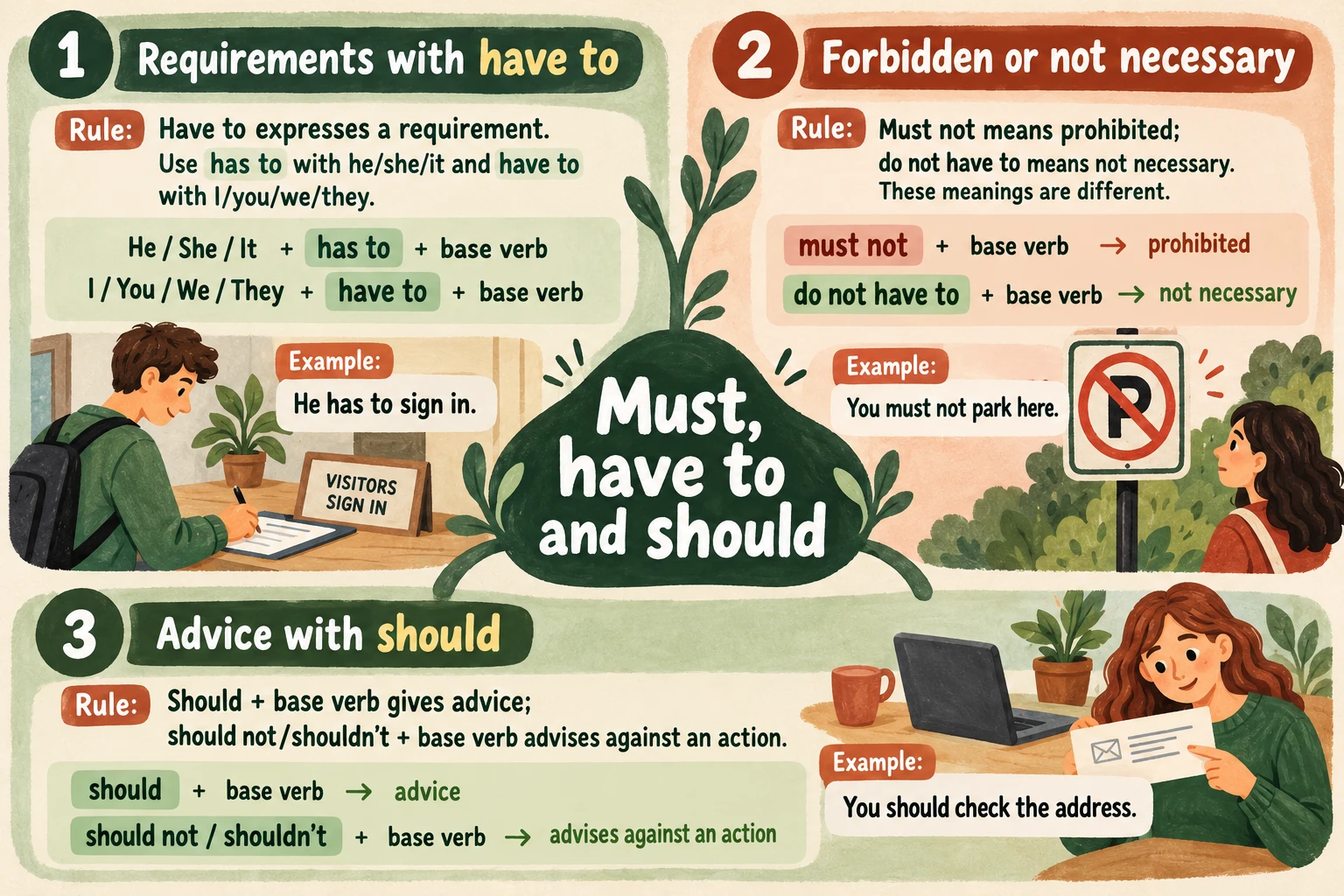
Have to expresses a requirement. Use has to with he/she/it and have to with I/you/we/they.
He has to sign in.
Must, have to and should · A2. Have to expresses a requirement. Use has to with he/she/it and have to with I/you/we/they.
Practise Must, have to and should in short situations. Read the clue, choose or write a form, then check the reason. The level is an editorial guide.
Have to expresses a requirement. Use has to with he/she/it and have to with I/you/we/they.
He has to sign in.Must not means prohibited; do not have to means not necessary. These meanings are different.
You must not park here.Should + base verb gives advice; should not/shouldn’t + base verb advises against an action.
You should check the address.
The rule says all staff have to wear badges. Nina ___ to wear one too.
Have to expresses a requirement. Use has to with he/she/it and have to with I/you/we/they.
He has to sign in.Must not means prohibited; do not have to means not necessary. These meanings are different.
You must not park here.Should + base verb gives advice; should not/shouldn’t + base verb advises against an action.
You should check the address.Keep the first try. Understand the change. Check it in a fresh situation.
No practice notes yet. Try a short warm-up.
Have to expresses a requirement. Use has to with he/she/it and have to with I/you/we/they.
He has to sign in.Must not means prohibited; do not have to means not necessary. These meanings are different.
You must not park here.Should + base verb gives advice; should not/shouldn’t + base verb advises against an action.
You should check the address.Opening an answer records help for that question.
The rule says all staff have to wear badges. Nina ___ to wear one too.
Look at “The rule says all staff have to wear badges. Nina ___ to wear one too.”. Have to expresses a requirement. Use has to with he/she/it and have to with I/you/we/they. Complete sentence: “The rule says all staff have to wear badges. Nina has to wear one too.”.
It is optional to bring lunch. You ___ bring it.
Look at “It is optional to bring lunch. You ___ bring it.”. Must not means prohibited; do not have to means not necessary. These meanings are different. Complete sentence: “It is optional to bring lunch. You do not have to bring it.”.
My advice is to rest. You should ___ a break. (take)
Look at “My advice is to rest. You should ___ a break. (take)”. Should + base verb gives advice; should not/shouldn’t + base verb advises against an action. Complete sentence: “My advice is to rest. You should take a break. (take)”.
I ___ to show my ticket before entering. (have)
Reference completion: “I have to show my ticket before entering. (have)”. Have to expresses a requirement. Use has to with he/she/it and have to with I/you/we/they.
The sign says entry is forbidden. You ___ enter.
Look at “The sign says entry is forbidden. You ___ enter.”. Must not means prohibited; do not have to means not necessary. These meanings are different. Complete sentence: “The sign says entry is forbidden. You must not enter.”.
For safety, you should not ___ while driving. (text)
Look at “For safety, you should not ___ while driving. (text)”. Should + base verb gives advice; should not/shouldn’t + base verb advises against an action. Complete sentence: “For safety, you should not text while driving. (text)”.
Each player ___ to arrive by eight. (have)
Reference completion: “Each player has to arrive by eight. (have)”. Have to expresses a requirement. Use has to with he/she/it and have to with I/you/we/they.
The children ___ to wait for a teacher. (have)
Look at “The children ___ to wait for a teacher. (have)”. Have to expresses a requirement. Use has to with he/she/it and have to with I/you/we/they. Complete sentence: “The children have to wait for a teacher. (have)”.
The museum is free today. You ___ pay.
Look at “The museum is free today. You ___ pay.”. Must not means prohibited; do not have to means not necessary. These meanings are different. Complete sentence: “The museum is free today. You do not have to pay.”.
If you want better sleep, you should ___ less coffee. (drink)
Reference completion: “If you want better sleep, you should drink less coffee. (drink)”. Should + base verb gives advice; should not/shouldn’t + base verb advises against an action.
Touching the cable is prohibited. You ___ touch it.
Look at “Touching the cable is prohibited. You ___ touch it.”. Must not means prohibited; do not have to means not necessary. These meanings are different. Complete sentence: “Touching the cable is prohibited. You must not touch it.”.
You look ill. You should ___ a doctor. (see)
Reference completion: “You look ill. You should see a doctor. (see)”. Should + base verb gives advice; should not/shouldn’t + base verb advises against an action.